
The “Domino Effect” of Liability
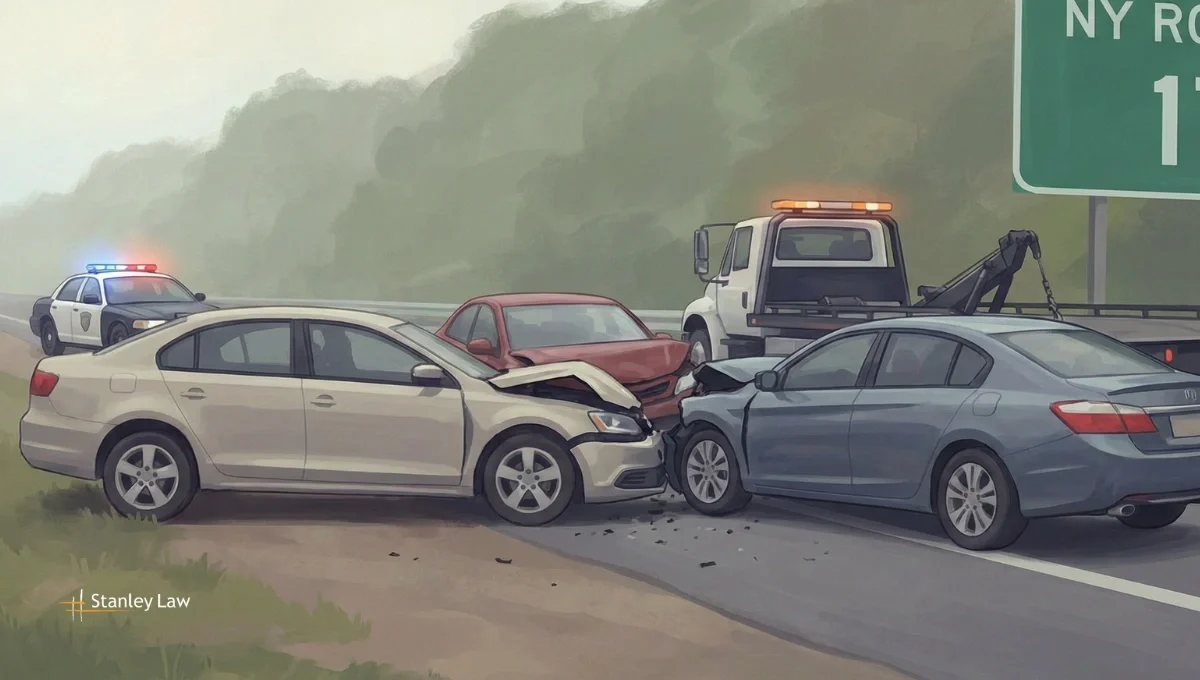
Multi-vehicle accidents are among the most legally intricate cases to litigate in New York. Unlike a straightforward two-car collision, a pileup often results in a “domino effect” of liability where insurance carriers for every driver involved attempt to shift the blame to others. Adjusters frequently argue that a specific driver was merely reacting to an initial impact, thereby trying to absolve their policyholder of the Duty of Care. For victims, this creates a chaotic landscape where securing fair compensation requires untangling a web of finger-pointing and overlapping insurance policies to determine the true proximate cause.
The Accident Brief
- Incident Date: Thursday, January 8, 2026.
- Location: Route 17 between Endicott and Johnson City, NY.
- The Conflict: A multi-vehicle collision caused heavy congestion and significant lane closures.
- Outcome: Emergency crews cleared the scene; the investigation into the crash sequence remains ongoing.
Comparative Negligence and Safe Following Distance
This case involves a complex intersection of driver behavior and New York traffic statutes. Liability in multi-car pileups is rarely isolated to one driver; often, multiple failures of duty combine to cause the tragedy.
- “Following Too Closely” (NY VTL § 1129) A common dispute in chain-reaction crashes is the violation of NY Vehicle & Traffic Law § 1129(a), which requires drivers to maintain a “reasonable and prudent” following distance. Even if a lead car stops suddenly due to a crash ahead, rear drivers may still be liable for failing to leave adequate stopping room. In New York, striking a vehicle from behind creates a strong presumption of negligence against the rear driver.
- Pure Comparative Negligence (CPLR § 1411) New York follows the Pure Comparative Negligence standard (CPLR § 1411). Unlike other states, a victim is not barred from recovery even if they are partially at fault (e.g., 20% responsible). However, damages are reduced by that percentage. Insurance adjusters aggressively attempt to inflate the victim’s fault to minimize payouts, making legal representation critical to refute these calculations.
- The “Emergency Doctrine” Defense Defendants often claim the “Emergency Doctrine,” arguing they faced a sudden, unforeseen hazard. This defense fails, however, if the emergency was self-created—such as by speeding or distracted driving. We utilize skid mark analysis and “black box” data to prove the driver had ample time to react but failed to do so.
Preserving Evidence Before it Disappears
If you are involved in a multi-vehicle crash, relying on the police report is dangerous. Evidence regarding the crash sequence disappears quickly.
- Send Spoliation Letters: We must immediately send legal notices to all involved parties—especially if commercial trucks were involved—to preserve Electronic Control Module (ECM) data and dashcam footage. This data provides objective proof of speed and braking times.
- Secure Witness Statements: In a chaotic scene, police often only interview the drivers. Passenger statements and independent witnesses are essential to corroborate the timeline of impacts and prove who hit whom first.
- Photograph All Vehicles: Documenting the damage to every car involved, not just your own, helps reconstruction experts determine the angle and force of impact, which is critical for proving liability.
Navigating the insurance claims process after a multi-vehicle accident is overwhelming, but you do not have to face it alone. If your family has been affected by a similar tragedy on Route 17, do not accept the insurance company’s initial offer. Contact Stanley Law Offices at 888-997-3889 for a private, comprehensive case evaluation. Our New York car accident lawyer can help you determine the true liability and fight for the compensation you deserve.


