

A medical condition that stops you from working can upend everything, and navigating the Social Security Disability system on top of that shouldn’t have to fall entirely on you.
If you live in Syracuse or Upstate New York and your disability has made sustained work impossible, you may qualify for SSDI or SSI benefits under federal law. But qualifying and getting approved are two different things. Most initial applications in New York are denied – frequently due to missing medical documentation, insufficient work history records, or procedural errors that have nothing to do with how serious your condition actually is.
At Stanley Law Offices, our Syracuse Social Security Disability attorneys focus on making sure claims are filed correctly, supported by the right medical evidence, and presented in line with how the Social Security Administration actually evaluates disability. When Stanley Law handles your SSDI or SSI case, here is what you can count on:
- 45+ years fighting for the injured
- 4.7 rating across 900+ verified reviews
- Millions recovered in verdicts & settlements every year
- Available 24/7
- No recovery, no fee
Before you file, or if your claim has already been denied, Attorney Shannon Doan walks through the 10 steps that most directly affect your outcome. Watch the full webinar below.
Attorney Shannon Doan of Stanley Law Offices walks through 10 practical steps to strengthen a Social Security Disability claim, from setting up a My Social Security account to track your case in real time, to accessing your medical records through patient portals and catching any inaccuracies before they affect your claim. She also covers how to stay on top of Social Security communications, keep your attorney updated on medical changes, and respond to requests promptly – all of which directly impact how quickly a decision is made. Importantly, she emphasizes consistent medical treatment and full honesty throughout the process, without exaggerating limitations. Whether you’re filing for the first time or recovering from a denial, these steps apply directly to how claims are evaluated here in New York.
If you’re unsure whether you qualify, or if your claim has already been denied, call 1-800-608-3333 or visit us at 215 Burnet Ave, Syracuse, NY 13203. There’s no cost to speak with our team.
Do You Qualify for Social Security Disability Benefits?
You may qualify for SSDI or SSI benefits if your medical condition meets all three of the following requirements under federal disability rules:
- A medically documented condition: Your impairment must be supported by medical records, test results, and treatment notes from acceptable medical providers.
- Inability to work at a meaningful level: Your condition must prevent you from performing substantial gainful activity (SGA), which is how Social Security measures whether you can work and earn income.
- Long-term impact: Your condition must have lasted, or be expected to last, at least 12 continuous months or be expected to result in death.
Many people meet these requirements without realizing it, especially if their claim was denied due to missing records, technical errors, or incomplete documentation rather than medical ineligibility.
If these requirements sound familiar but you are unsure how Social Security applies them to your situation, a consultation with our disability attorney can help clarify eligibility before filing or appealing a claim.
SSDI vs. SSI: Which Disability Program Applies to You?
SSDI and SSI are two different federal disability programs, and the rules for qualifying are not the same. Understanding the differences between them helps you determine which program applies to your work history, income, and medical situation.
Some people qualify for both programs at the same time, known as a concurrent claim, depending on their work history and financial circumstances.
Example: You may qualify for both SSDI and SSI if you worked long enough to earn Social Security work credits, but your monthly SSDI benefit is low, and your current income and resources fall within SSI limits.
How Social Security Evaluates Disability Claims (The Five-Step Evaluation)
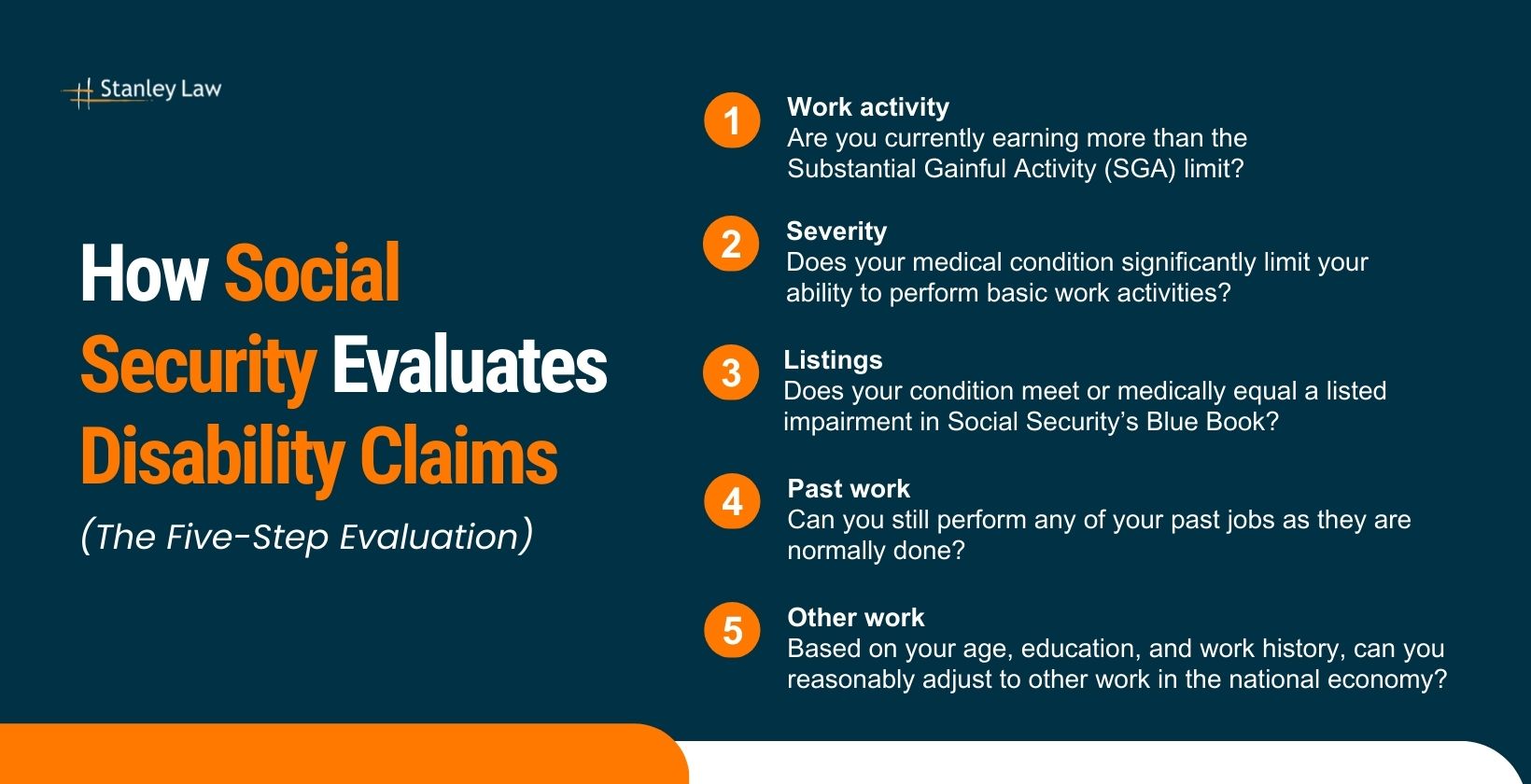
Social Security uses a five-step evaluation process to decide whether a disability claim meets federal requirements. Every application and appeal is reviewed using this same framework.
- Work activity: Are you currently earning more than the Substantial Gainful Activity (SGA) limit?
- Severity: Does your medical condition significantly limit your ability to perform basic work activities?
- Listings: Does your condition meet or medically equal a listed impairment in Social Security’s Blue Book?
- Past work: Can you still perform any of your past jobs as they are normally done?
- Other work: Based on your age, education, and work history, can you reasonably adjust to other work in the national economy?
An SSDI claim can be denied at any step if Social Security determines the requirements are not met, which is why how medical and work limitations are documented matters at every stage.
How Age 50 and Older Affects Social Security Disability Claims (Grid Rules)
Social Security applies special rules to disability applicants age 50 and older, known as the Medical-Vocational Guidelines or “Grid Rules.” These rules recognize that adjusting to new types of work can become more difficult as people age.
If you are under age 50, Social Security generally evaluates whether you can perform any work that exists in the national economy, not just the type of work you did in the past.
Once you reach age 50, and again at ages 55 and 60, the analysis changes in important ways:
- Age is given greater consideration: Social Security places increasing emphasis on age at 50, 55, and 60 when evaluating whether someone can reasonably adjust to other work.
- Work history matters more: The focus shifts to the type of work you performed previously and whether those skills realistically transfer to other jobs.
- Less emphasis on theoretical jobs: Social Security may determine that you cannot reasonably adjust to other work, even if lighter or sedentary jobs exist in theory.
- Medical limits are matched to job demands: Physical or mental restrictions are evaluated against the actual demands of your prior work, not abstract job descriptions.
For example, someone in Syracuse with a long history of physically demanding work in manufacturing or construction may be found disabled under the Grid Rules if medical limitations prevent a return to that type of work.
Medical Conditions That May Qualify for SSDI Benefits
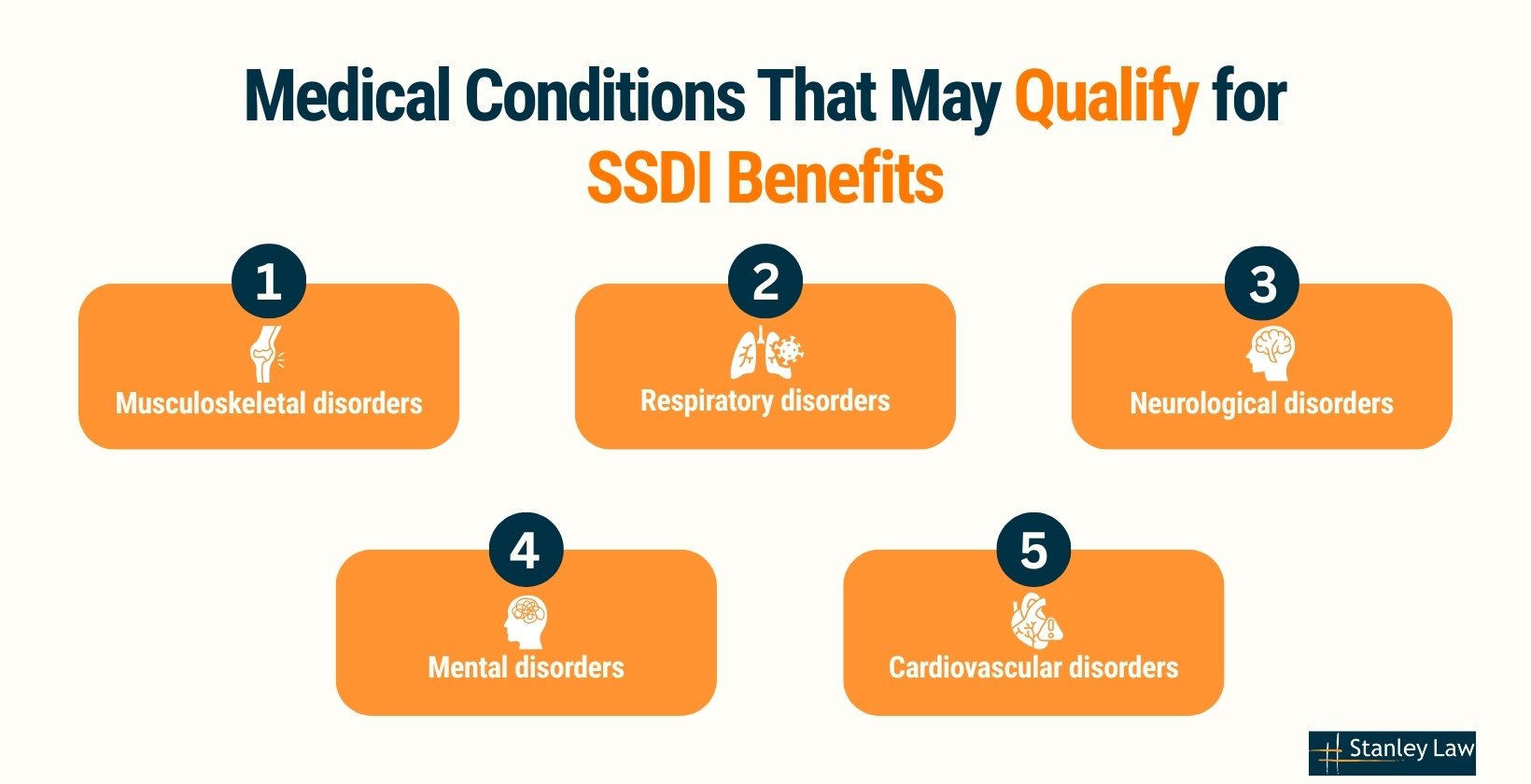
Under Social Security’s Listing of Impairments (the “Blue Book”), adult disability claims are evaluated by body system and functional impact, not by diagnosis alone. In the Syracuse area, claims commonly involve conditions such as:
- Musculoskeletal disorders: Degenerative disc disease, arthritis, and serious back or joint conditions that limit standing, walking, lifting, or use of the upper extremities.
- Respiratory disorders: Chronic obstructive pulmonary disease (COPD), severe asthma, and other respiratory conditions that restrict breathing capacity or sustained activity.
- Neurological disorders: Multiple sclerosis (MS), epilepsy, Parkinson’s disease, and related conditions that affect movement, coordination, or neurological function.
- Mental disorders: PTSD, bipolar disorder, schizophrenia, and other severe mental health conditions that significantly impair concentration, social interaction, or the ability to function in a work setting.
- Cardiovascular disorders: Heart failure, coronary artery disease, and related conditions that limit physical exertion, endurance, or tolerance for sustained work activity.
A condition does not need to match a Blue Book listing word-for-word to qualify. Disability benefits may still be available if medical evidence shows the condition is medically equivalent to a listed impairment or otherwise prevents sustained work under Social Security’s evaluation rules.
What Is the Social Security Blue Book?
The Blue Book is a medical guide used by the Social Security Administration to evaluate disability claims. It outlines specific medical criteria for different body systems and conditions, but it is not a list of diagnoses that automatically qualify for SSDI benefits. A condition may still qualify if medical evidence shows it meets a listing, is medically equivalent to one, or otherwise prevents sustained work under Social Security’s rules.
Signs You Need Syracuse Social Essential Documents & Evidences for Filing an SSDI Claim
Social Security disability decisions are based on documentation. Medical records, work history, and functional evidence are reviewed together to determine whether a condition limits the ability to perform sustained work.
Key documents and evidence typically include:
- Medical records and treatment history: Office notes, diagnoses, imaging, test results, medications, and treatment plans that describe symptoms and ongoing care, particularly records explaining work-related limitations.
- Residual Functional Capacity (RFC) evidence: Statements or assessments from treating providers that describe physical or mental limitations, such as sitting, standing, lifting, reaching, concentration, pace, or attendance. These may come from providers affiliated with Upstate University Hospital, St. Joseph’s Health, or Crouse Hospital.
- Objective medical testing: Diagnostic studies such as MRIs, EMGs, X-rays, pulmonary testing, or laboratory results that support reported symptoms and functional limits.
- Work history and job details: A record of past jobs, duties performed, physical or mental demands, and dates worked so Social Security can evaluate past work and potential job adjustment.
- Earnings and Social Security tax history: Information used to confirm insured status and work credits for SSDI eligibility.
- Longitudinal treatment history: Evidence showing that treatment has continued over time and that the condition has lasted, or is expected to last, at least 12 continuous months.
Incomplete or inconsistent documentation is a common reason disability claims are delayed or denied, which is why how records describe functional limitations matters as much as the diagnosis itself.
In this free webinar, SSD Attorney Shannon Doan explains how to turn the documents listed above into records that actually support your claim. The SSA decides cases on what your medical file says, not on what you know to be true about your condition, and Shannon shows how to close that gap. She covers why regular visits with your primary care provider and specialists matter, and why being honest about your limitations during appointments beats “toughing it out.” She explains how to handle treatment recommendations, including what to do when side effects make a medication hard to tolerate, and why keeping logs of things like blood pressure, seizures, or headaches gives your doctor evidence to put in your chart. She also walks through using patient portals, the same MyChart system used by Upstate University Hospital and St. Joseph’s Health, to review your visit notes and fix errors before they hurt your claim. The final section covers attorney fees: nothing upfront, and nothing at all unless you win back-due benefits.
Hearings and consultations are held virtually. Call 1-800-608-3333 or visit our office at 215 Burnet Ave to get started.
How a Syracuse Social Security Disability Attorney Helps With SSDI and SSI
Having a New York Social Security Disability lawyer helps ensure your claim is handled correctly at each stage.
Here is how we assist with SSDI and SSI claims:
- Prepare and file your application: We help complete disability applications accurately, submit required documentation, and track deadlines to reduce avoidable delays or technical denials.
- Develop medical and work evidence: We organize medical records, treatment history, and work information to clearly document how your condition affects your ability to perform sustained work.
- Represent you in appeals and hearings: If a claim is denied, we prepare appeal filings, explain the hearing process, and present evidence before an administrative law judge when required.
Steps to File for Social Security Disability Compensation
Filing a Social Security disability claim involves multiple stages and agencies. Taking each step carefully helps avoid unnecessary delays caused by missing information or procedural errors.
To file an SSDI claim, Social Security generally requires the following:
- Submit an application: You can apply online at SSA.gov, by phone, or in person at your local Social Security office.
- Provide complete information: Include accurate details about your medical conditions, treatment history, work history, and how symptoms limit your ability to work.
- Submit supporting documentation: Medical records, diagnostic testing, and detailed job information are used to evaluate eligibility.
- Review for accuracy: Incomplete or inconsistent information can delay processing or result in a denial.
- Respond to follow-up requests: Social Security may request additional records, examinations, or clarification during review.
How Disability Claims Are Reviewed in New York
In New York, initial disability applications and reconsideration appeals are medically evaluated by Disability Determination Services (DDS), a state agency that reviews medical evidence on behalf of the Social Security Administration. Local Social Security field offices handle application intake and non-medical issues, but they do not make medical disability decisions.
If a claim proceeds to a hearing, it is typically scheduled through the Office of Hearings Operations (OHO) that serves the Syracuse area. At this stage, an Administrative Law Judge reviews testimony, medical records, and vocational evidence before issuing a written decision.
Social Security Disability Resources
What is Social Security Disability Insurance (SSDI)?
SSDI Eligibility Requirements in New York
What Are Work Credits? How They Impact SSDI Benefits in NY
How to Apply for Social Security disability Benefits
What to Do if Your SSDI Claim is Denied?
How to Increase Social Security Disability Payments
Can You Get SSDI and SSI Benefits Together?
Are Social Security Disability Benefits Taxable?
What Other Benefits Can I Get with SSDI?
What to Do if SSA Denies Your Disability Claim
An initial denial of an SSDI or SSI claim is common and does not necessarily mean you are ineligible. Many claims are denied due to missing documentation, incomplete medical records, or technical issues in the application.
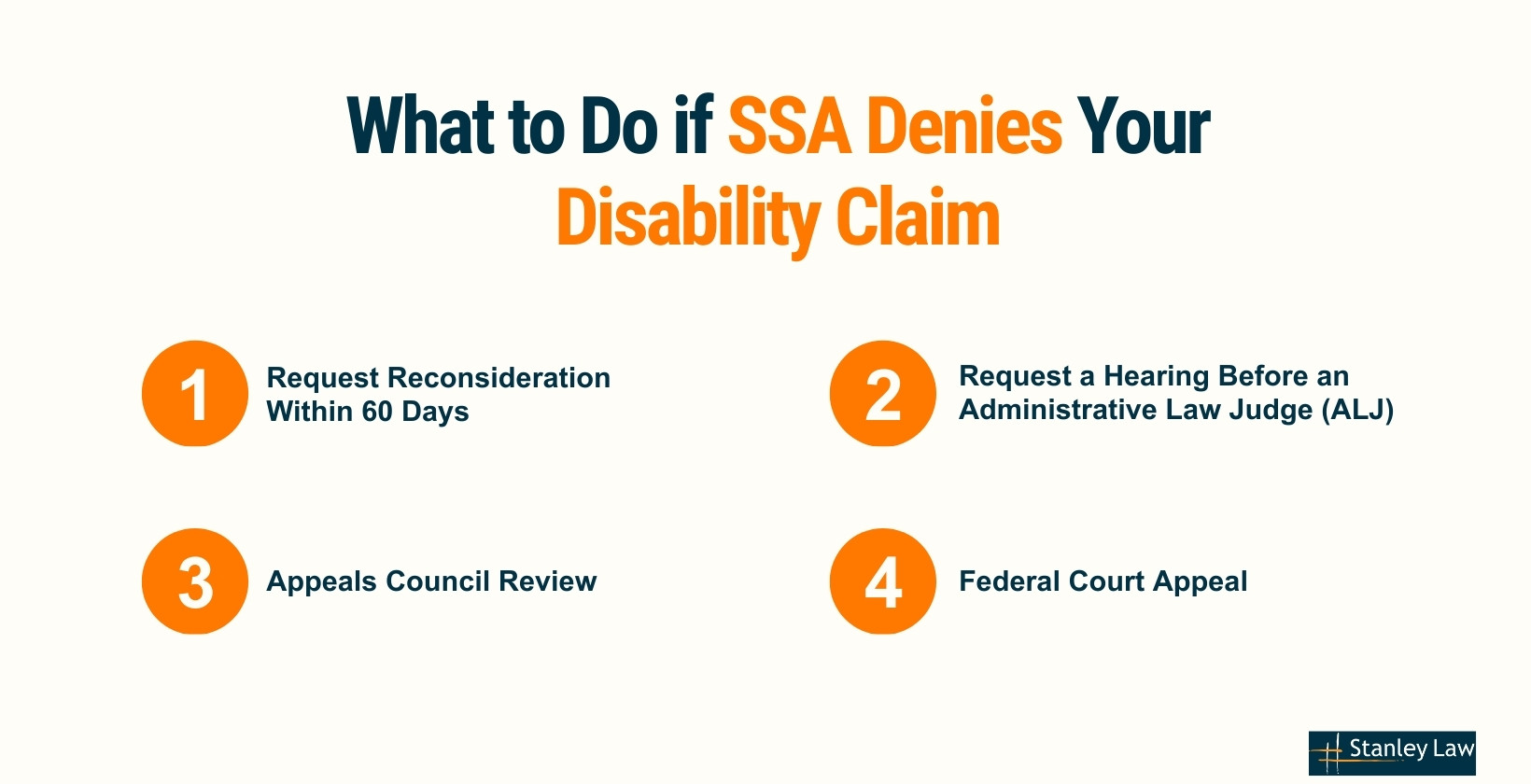
If Social Security denies your claim, the appeals process generally follows these steps:
Request Reconsideration Within 60 Days
The first appeal step is reconsideration. You must request reconsideration within 60 days of receiving the denial notice. At this stage, you may submit updated medical records, additional evidence, or corrections to information in your original application.
Your claim is reviewed by a different evaluator at Disability Determination Services (DDS).
Request a Hearing Before an Administrative Law Judge (ALJ)
If reconsideration is denied, you may request a hearing within 60 days. Hearings are conducted by an Administrative Law Judge who was not involved in the earlier decisions.
At the hearing level, testimony, medical evidence, and vocational information are reviewed before a written decision is issued.
Appeals Council Review
If the Administrative Law Judge denies the claim, you may request review by the Appeals Council. The Appeals Council may deny review, issue a decision, or return the case for another hearing.
This step focuses on whether the judge applied the law correctly and whether the decision is supported by the record.
Federal Court Appeal
If all administrative appeals are denied, you may file a lawsuit in U.S. District Court. This is a formal legal process governed by federal rules and deadlines.
Appeal deadlines are strict, and missing a filing window can affect the ability to continue a claim. Reviewing a denial notice with a Syracuse SSI lawyer can help identify the appropriate next step.
Why Choose Stanley Law for Social Security Disability Representation in Syracuse
Handling a Social Security disability claim requires familiarity with federal rules, medical evidence standards, and administrative procedures. Choosing a local law firm with experience in SSDI and SSI matters helps ensure claims are prepared, presented, and managed consistently with Social Security’s requirements.
Reasons people in Syracuse and Upstate New York choose us:
- Local knowledge and accessibility: With offices throughout Upstate New York, we provide in-person or virtual meetings for clients in the Syracuse area.
- Extensive experience in disability claims: Our attorneys have more than 90 years of combined experience handling SSDI and SSI claims and understand the documentation, filing deadlines, and administrative procedures required by Social Security.
- Structured case preparation: Claims are handled using established internal processes designed to ensure medical records, work history, and supporting documentation are complete and organized.
- Contingency-based representation: Attorney fees are regulated by Social Security, and legal fees are paid only if benefits are awarded, consistent with federal rules
- Clear communication: Clients receive guidance at each stage of the process and can communicate by phone, email, or virtual appointment without needing to visit an office.
Contact a Syracuse Social Security Disability Appeal Lawyer
If a medical condition is preventing you from working, guidance from a Social Security disability attorney can help you understand the process, deadlines, and documentation requirements involved in SSDI and SSI claims.
Our SSDI attorneys assist individuals in Syracuse and surrounding communities with initial applications, appeals, and hearings. Consultations are available by phone, email, or virtual appointment.
To speak with our office, call us or request a consultation through our contact form.
FAQs on Hiring a Syracuse Social Security Disability Lawyer
Can I Work Part-Time and Still Qualify for SSDI Benefits?
Yes. Social Security allows limited work while receiving SSDI, as long as earnings remain below the Substantial Gainful Activity (SGA) level. Even earnings below SGA may be reviewed depending on job duties, hours worked, and consistency, which is why work activity should be reported accurately.
Is There an Age Limit for Receiving SSDI?
Yes. SSDI is available to adults between age 18 and full retirement age, which is generally between 66 and 67 depending on birth year. After reaching full retirement age, disability benefits typically convert to Social Security retirement benefits.
What Happens if My Medical Condition Improves After I Start Receiving Benefits?
Social Security periodically reviews disability cases through a Continuing Disability Review (CDR). If medical evidence shows improvement that allows a return to substantial work, benefits may be reduced or stopped based on Social Security’s rules.
Do I Need a Lawyer to Apply for SSDI in Syracuse?
No. You are not required to have a lawyer to apply for SSDI. However, many applicants seek legal guidance when claims involve complex medical records, prior denials, or upcoming hearings, where procedural rules and evidence standards become more detailed.
Where is Stanley Law Office in Syracuse?
We are located at 215 Burnet Ave, Syracuse, NY 13203.
To visit us, from I-81 North (Cortland): Take exit 18 to Adams St., go straight on Almond St. for eight lights, left on Erie Blvd. (two lights), right on Townsend St., then left on Burnet Ave; use the second driveway on the right for parking.
From I-81 South/Thruway North: Exit at Clinton St., left on West Genesee St. (past Salina and Warren), right on Oswego to Erie Blvd., left on Erie, first left on State St., right on Burnet Ave. before James St. light, and proceed uphill to parking; street parking on James or Burnet is an option, but prefer the dedicated lot.
Nearby landmarks include Burnet Park (2 miles west, Syracuse’s 88-acre gem with Rosamond Gifford Zoo, trails, and playgrounds via I-81/Hiawatha Blvd.), Clinton Square downtown (1 mile west near Syracuse University), the Erie Canal Museum, Everson Museum of Art (within 2 miles), and the local Burnet Deli uphill for quick eats.
