

When a medical condition stops you from working, medical bills pile up, and income disappears. The Social Security Disability process compounds it with strict documentation requirements, tight deadlines, and a high rate of initial denials. Most first-time applications in Georgia are not approved.
At Stanley Law Offices, our Georgia Social Security disability lawyers bring a distinct advantage to every case. Attorney Shannon Doan spent nearly 19 years as an attorney inside the Social Security Administration, training other SSA attorneys in the Atlanta region. Our team knows how examiners evaluate claims, what medical evidence the SSA requires, and where applications break down. With 90 years of combined experience, we represent claimants in Atlanta, Savannah, Augusta, and across the state, serving you remotely from our offices in NY & PA.
Call us at 1-800-608-3333 for a free and confidential case evaluation.
How a Lawyer Can Help With Your Georgia Disability Application
A successful disability claim depends on complete documentation, accurate work history, and timely responses to SSA requests. Our attorneys for Social Security disability help Georgia claimants build a strong case from the start and provide representation at every stage when claims are denied.
Here is how we support your claim:
- Prepare and file applications: Your SSDI or SSI application is completed and submitted accurately, reducing errors that lead to delays or denials.
- Gather medical evidence: Records from doctors, hospitals, therapists, and specialists are obtained to document your diagnosis, symptoms, and functional limitations.
- Confirm work history and work credits: Your application is reviewed to accurately reflect your employment history, earnings, and Social Security contributions.
- Track SSA notices and deadlines: SSA communications are monitored closely, so requests and deadlines are never missed.
- Prepare you for Consultative Exams (CE): You receive clear guidance on what to expect and why attending your scheduled exam is critical to your claim.
- Handle appeals: If your SSD claim is denied, a reconsideration request is filed, and you are represented at Administrative Law Judge (ALJ) hearings.
Talk to a Georgia SSD Attorney – No Upfront Fees
Who Can Qualify for SSDI or SSI Benefits?
Anyone who have a medical condition that is severe enough to prevent you from engaging in substantial work and is expected to last at least 12 months or result in death can qualify for SSDI or SSI benefits. The Social Security Administration (SSA) uses a detailed, five-step process to see if your situation meets their strict definition of disability.
The SSA’s 5-Step Sequential Evaluation
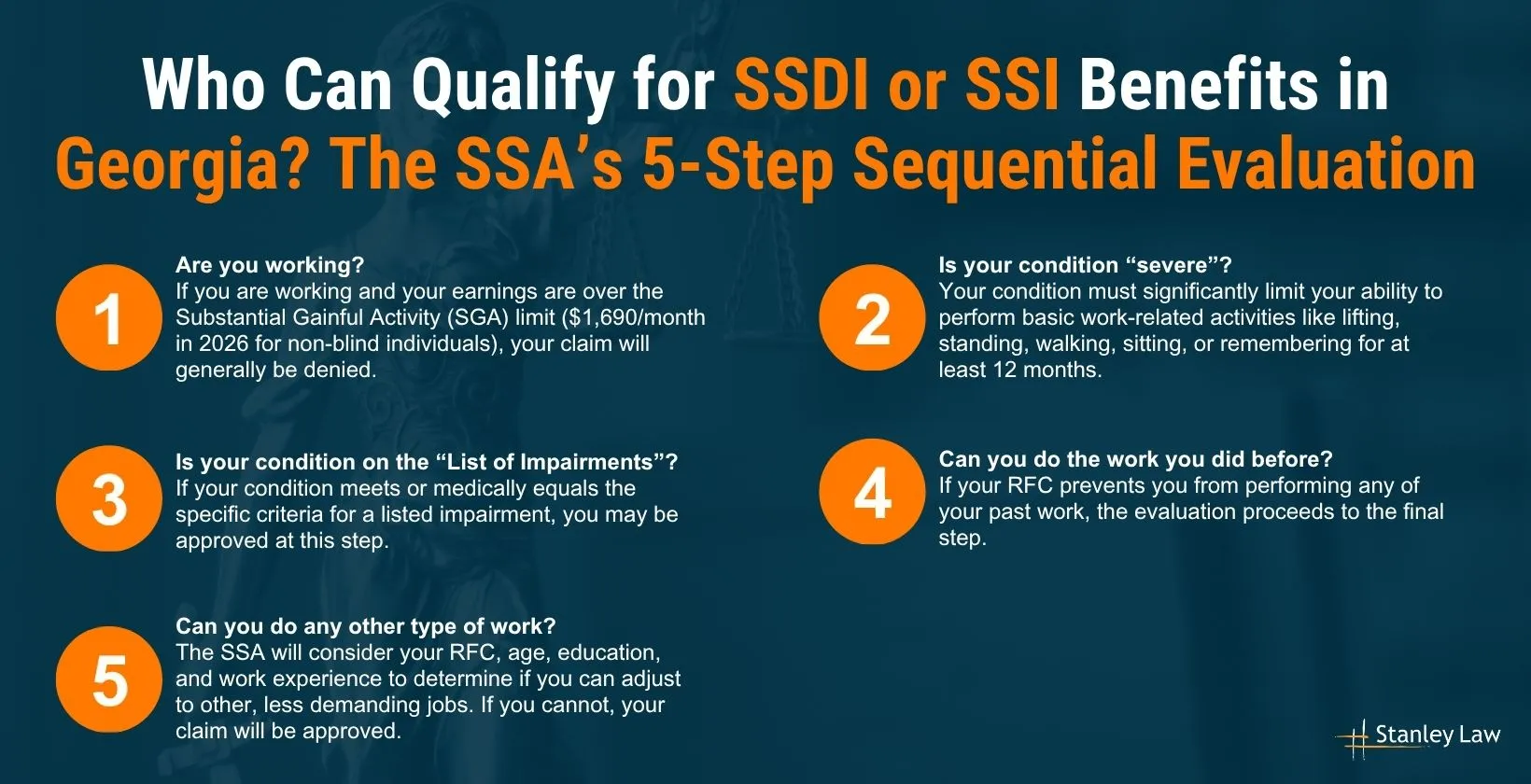
Georgia’s Disability Determination Services (DDS) will evaluate your claim using these five questions:
- Are you working? If you are working and your earnings are over the Substantial Gainful Activity (SGA) limit ($1,690/month in 2026 for non-blind individuals), your claim will generally be denied.
- Is your condition “severe”? Your condition must significantly limit your ability to perform basic work-related activities like lifting, standing, walking, sitting, or remembering for at least 12 months.
- Is your condition on the “List of Impairments”? The SSA maintains a Listing of Impairments (also known as the Blue Book) for various body systems. If your condition meets or medically equals the specific criteria for a listed impairment, you may be approved at this step.
- Can you do the work you did before? If your condition does not meet a listing, the SSA will determine your Residual Functional Capacity (RFC), what you can still do despite your limitations. If your RFC prevents you from performing any of your past work, the evaluation proceeds to the final step.
- Can you do any other type of work? The SSA will consider your RFC, age, education, and work experience to determine if you can adjust to other, less demanding jobs. If you cannot, your claim will be approved.
SSDI vs SSI: Which Disability Program Applies to Your Case
SSDI (Social Security Disability Insurance) and SSI (Supplemental Security Income) are the two main federal disability programs, but they serve different people. SSDI is an insurance program for those who have a sufficient history of working and paying Social Security taxes, while SSI is a needs-based program for those with limited income and resources, regardless of work history.
| Program | What it is based on | Who it helps | Key requirement |
|---|---|---|---|
| SSDI | Work credits earned through employment | Workers who paid into Social Security before becoming disabled | Qualifying work credits and a disabling condition |
| SSI | Financial need | People with limited income and resources who are disabled, blind, or age 65+ | Limited income, resources, and disability eligibility |
How SSDI Work Credits Are Calculated
The SSA assigns work credits based on annual earnings, up to 4 per year. In 2026, one credit equals $1,730 in covered earnings. Most claimants need 40 total credits, with 20 earned in the 10 years before disability onset. Younger workers may qualify with fewer credits depending on their age. If your work history falls short, SSI may be the right program instead.
It is possible to be eligible for both (SSDI & SSI) programs at the same time, which is known as receiving “concurrent benefits.” This often happens when an individual’s SSDI payment is very low. An experienced lawyer can help you determine which program(s) you may qualify for before you file.
Evidence That Strengthens a Social Security Disability Claim
The most critical factor in a successful disability claim is strong, consistent medical evidence that documents not just your diagnosis, but exactly how your condition limits your ability to function in a work environment. The SSA needs objective, detailed proof to approve a claim; your diagnosis alone is not enough.
Key documentation that strengthens a Social Security disability claim includes:
- Treating physician records: Clinical notes, diagnoses, prescribed treatments, and your response to those treatments over time.
- Functional limitation statements: Written opinions from your doctors describing what you can and cannot do physically (e.g., how long you can sit, stand, or lift) or cognitively (e.g., your ability to concentrate or follow instructions).
- Specialist reports: Evaluations from neurologists, orthopedic surgeons, psychiatrists, or other relevant providers.
- Imaging and objective test results: X-rays, MRIs, lab work, and other clinical findings that support your reported symptoms.
- Mental health records: Documentation of anxiety, depression, PTSD, or cognitive conditions that affect your ability to maintain work activity.
- Employment history and job duty records: Evidence of the physical or mental demands your past work required.
Common Causes of SSDI and SSI Claim Denials
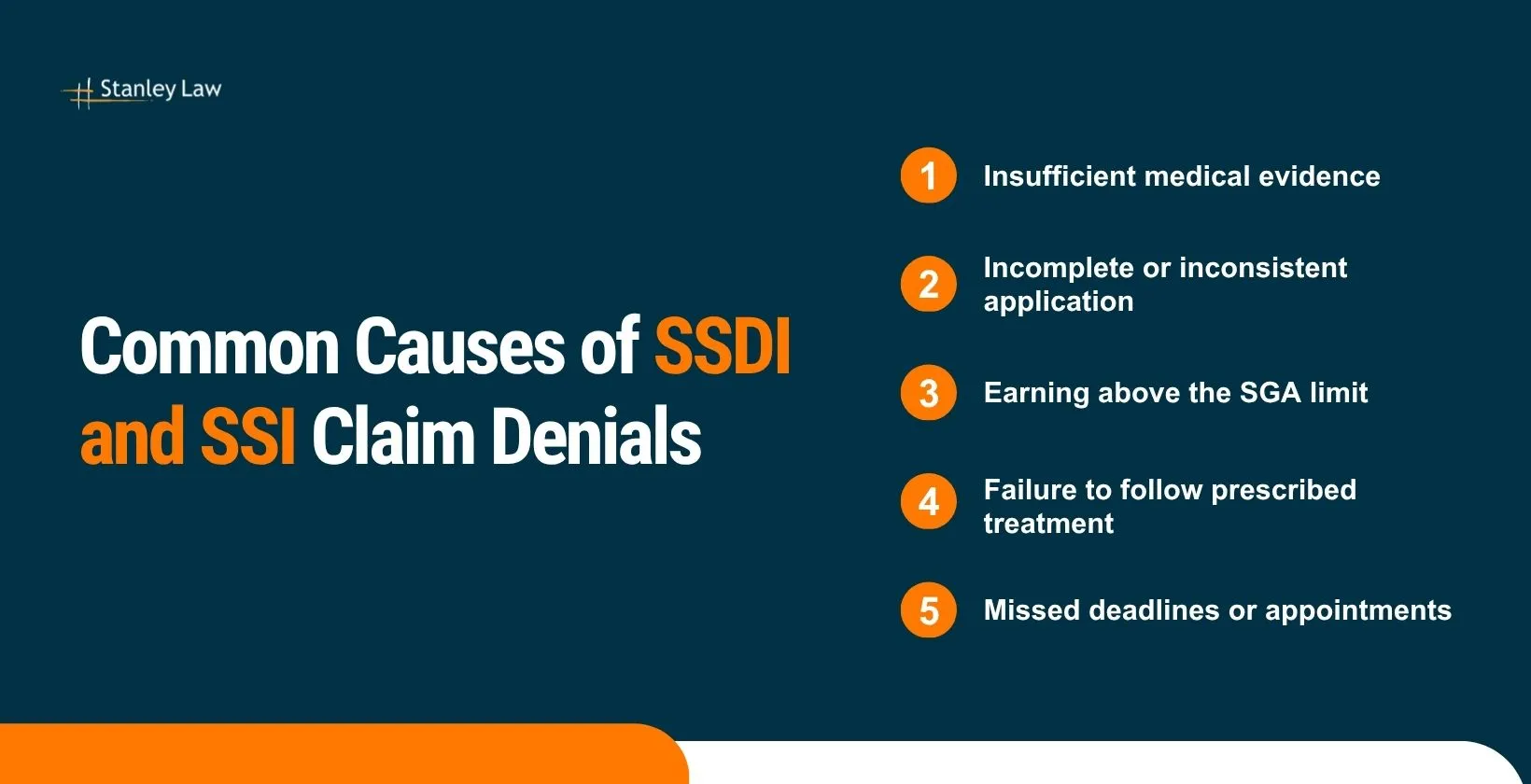
Most initial disability claims are denied in Georgia, and the reasons are often preventable. Understanding what leads to a denial helps you avoid the same mistakes before you file.
Common reasons social security disability claims are denied:
- Insufficient medical evidence: The record shows a diagnosis, but does not clearly document how the condition limits your ability to work.
- Incomplete or inconsistent application: Errors, omissions, or contradictions between forms and medical records raise red flags during SSA review.
- Earning above the SGA limit: Income above the Substantial Gainful Activity threshold signals an ability to engage in substantial work.
- Failure to follow prescribed treatment: Not following your doctor’s recommended treatment without a valid reason leads the SSA to question the severity of your condition.
- Missed deadlines or appointments: Failing to respond to SSA notices or skipping a Consultative Exam can result in an automatic denial.
Already Denied? You Have 60 Days to Appeal.
Missing this deadline means starting over – losing your original filing date and any back pay tied to it. Call us today before the window closes.
If you have received a denial notice, do not give up. A denial is not final, but it is a critical time to speak with an attorney who can help you file a timely appeal.
What Happens After Filing a Social Security Disability Claim
Filing a Social Security disability application starts a multi-step review process that can take months or even years.
Here is what claimants can typically expect:
- Initial application review: Your claim is submitted and reviewed by Georgia’s Disability Determination Services (DDS). This stage often takes several months, and many first-time applications are denied here.
- Reconsideration: If denied, you have 60 days to request a reconsideration. A different reviewer at DDS will look at your entire file again, including any new evidence you submit.
- Administrative Law Judge (ALJ) Hearing: If denied again, you can request a hearing before an ALJ. This is your best chance of winning an appeal. You can present evidence, have your lawyer make legal arguments, and testify about your condition.
- Appeals Council Review: If the ALJ denies the claim, you can ask the Appeals Council to review that decision. The Council can deny your request, decide the case itself, or send it back to an ALJ.
- Federal Court Review: The final step is filing a lawsuit in a U.S. District Court.
Why Choose Stanley Law Offices for Your Georgia Social Security Disability Claim
When choosing a lawyer for your disability claim in Georgia, you need a team whose experience aligns with the complexities of the SSA system. Stanley Law Offices provides Georgia residents with a clear path forward, backed by unmatched experience and a commitment to personal service.
A Former SSA Attorney on Your Side
Our team is led by attorney Shannon Doan, who worked for nearly two decades as an attorney inside the Social Security Administration. She knows the system from the inside out, how claims are evaluated, why they are denied, and what it takes to build a case that meets the SSA’s strict standards. Crucially for Georgia claimants, she was responsible for developing and delivering training for all Senior Attorneys in the Atlanta Region. This insider knowledge is an invaluable asset that no other firm can offer.
Experience and Recognition You Can Trust
- 90 Years of Combined Experience: Our firm has a long history of helping clients navigate complex legal challenges.
- Nationally Recognized: We are proud members of the National Association of Personal Injury Lawyers and have been recognized by Super Lawyers, The National Trial Lawyers Top 100, and the American Board of Trial Advocates.
Dedicated Support for Georgia Claimants
SSDI is a federal program, and our firm is built to handle it nationwide. We serve all of Georgia from Atlanta to Savannah, remotely through phone and virtual consultations. You get the full benefit of our firm’s national experience without ever needing to leave your home. And because we work on a contingency fee basis, there are no fees unless we help you get benefits. Start your free Georgia SSD consultation.
What Other Benefits Can You Get with SSDI?
SSDI approval may provide more than just a monthly disability payment. Depending on your situation, approval can also grant you access to Medicare, back pay, and certain benefits for your family members.
Additional benefits or related support may include:
- Medicare coverage: Most SSDI recipients become eligible for Medicare 24 months after their date of entitlement to disability benefits.
- Dependent benefits: A spouse, ex-spouse, or child may qualify for benefits based on your Social Security disability record.
- Back pay: If your claim is approved, you may receive past-due benefits based on your established onset date and the SSA’s payment rules.
- Workers’ compensation overlap: You may receive both workers’ compensation and SSDI at the same time, but the SSA may reduce your SSDI payment if the combined total exceeds 80% of your average pre-disability earnings. Proper legal coordination is essential.

Speak With a Georgia Social Security Disability Lawyer About Your Case Today
When you can’t work, and the bills keep coming, you don’t have to face the uncertainty of the disability process alone. Stanley Law Offices provides clear, experienced guidance for SSDI and SSI applications, denials, and appeals throughout Georgia.
We have offices in Syracuse, Rochester, Watertown, Binghamton, and Oneonta, New York, and Montrose, Pennsylvania. Georgia clients are served by phone and virtual consultation, with home or hospital visits available when travel is not possible.
Call 1-800-608-3333 or contact us online to request a free case evaluation.
Frequently Asked Questions About Georgia Disability Lawyers
How Does Social Security Define Disability?
Social Security defines disability as a medically determinable physical or mental impairment that prevents you from doing any substantial gainful activity and is expected to last for a continuous period of at least 12 months or result in death.
How Long Does It Take to Receive Social Security Disability Benefits in Georgia?
It depends. An initial decision in Georgia often takes 4 to 6 months. If your claim is denied and you appeal, the entire process, including waiting for an ALJ hearing, can take over a year or even longer. Approved claimants may receive back pay to cover this waiting period.
Can I Work While Applying for Social Security Disability Benefits?
Yes, but only in a very limited capacity. You can work while applying, but your earnings cannot exceed the Substantial Gainful Activity (SGA) limit. In 2026, that limit is $1,690 per month for most non-blind applicants. Earning more than this will almost always result in a denial.
What Should I Do if My Social Security Disability Claim Is Denied?
Act quickly. You have only 60 days from the date you receive the denial letter to file an appeal. Do not simply reapply, as this can cause you to lose out on potential back pay. The best first step is to contact a disability lawyer to review your denial notice and prepare a strong appeal.
What Are Some Common Conditions That Qualify for Disability Benefits?
While any severe condition can qualify, some common categories of impairments that lead to approved disability claims include:
- Musculoskeletal disorders (e.g., back injuries, arthritis)
- Mental health conditions (e.g., depression, anxiety, PTSD, bipolar disorder)
- Cardiovascular conditions (e.g., heart failure, coronary artery disease)
- Neurological disorders (e.g., multiple sclerosis, epilepsy, stroke)
- Cancers
Approval is based not on the condition itself, but on the functional limitations it causes.
How Much Does a Disability Lawyer Cost in Georgia?
Social Security disability lawyers in Georgia work on a contingency fee basis, which is set by federal law. This means there is no upfront cost to you. The lawyer’s fee is 25% of the past-due benefits (or “back pay”) you are awarded, and it is capped at a maximum of $9,200. If you are not awarded any back pay, you do not owe your lawyer a fee.
Can Workers’ Comp and Social Security Disability Benefits Overlap?
Yes. It is common to receive both workers’ compensation and Social Security Disability benefits for the same injury. However, the SSA may reduce your SSDI payment if your combined benefits exceed 80% of your average pre-disability earnings. How your workers’ compensation settlement is structured can significantly impact this offset, making it crucial to have a lawyer who understands both systems.
