

Stanley Law Offices offers experienced legal help for New Jersey residents and disabled workers applying for Social Security Disability Insurance (SSDI) benefits or appealing a denied claim. As Social Security Disability Lawyers in New Jersey, Attorney Shannon Doan and our team help clients strengthen their SSDI claims with practical guidance, organized medical evidence, and clear next steps through the Social Security Administration (SSA) process. With 90 years of combined experience, support for disability cases in all 50 states, and office locations in New York and Pennsylvania, we help New Jersey claimants move forward with confidence.
Call us at 1-800-608-3333 or request a free case evaluation today.
Need SSDI Help in New Jersey? Get the Benefits You Deserve
A disabling condition can make it hard to keep up with bills, treatment, and daily life. The SSDI process adds more stress with forms, deadlines, and strict proof requirements. Stanley Law Offices helps New Jersey claimants understand their options, avoid costly mistakes, and take the next step with confidence.
Whether you are applying for benefits, appealing a denial, or preparing for a hearing, we are here to help.
Request a confidential consultation today.
Why Hire Stanley Law Offices for Your SSDI Case in New Jersey?
Many SSDI claims become harder than they should be because the process is strict, stressful, and full of deadlines. Stanley Law Offices gives New Jersey claimants a clearer path forward with accessible support and deep disability law experience.
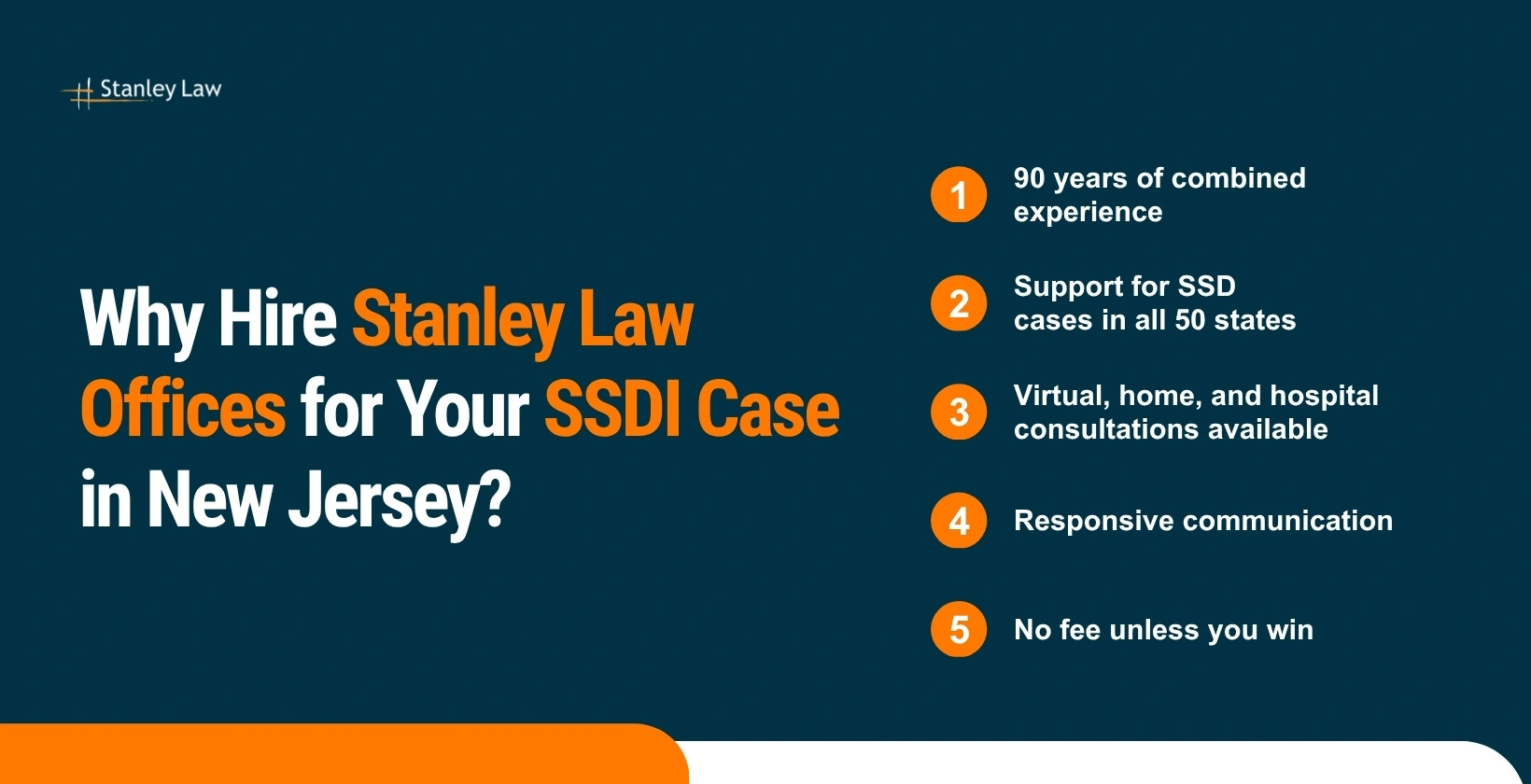
- 90 years of combined experience: Our team brings decades of combined legal experience to disability claims and appeals. We understand how to present medical proof, work history, and functional limits in a way the SSA can evaluate clearly.
- Support for SSD cases in all 50 states: SSDI is a federal program, and we help clients nationwide, including people living in New Jersey. That means you can get experienced guidance no matter where you are.
- Virtual, home, and hospital consultations available: When your condition makes travel difficult, getting legal help should not become another burden. We offer virtual consultations and, when needed, home or hospital consultations for clients who cannot come in.
- Responsive communication: You deserve clear answers during a stressful time. We keep you informed, explain the process, and help you understand what comes next.
- No fee unless you win: SSDI fees are regulated by SSA rules and are generally paid only if benefits are awarded. There is no upfront cost to speak with our team about your claim.
If you’re located outside New Jersey and need disability benefit support, our SSD lawyer in Georgia offers the same dedicated advocacy to help you file, appeal, and secure the SSDI benefits you’re entitled to.
How Our Social Security Disability Lawyers in New Jersey Can Help You
A successful SSDI claim depends on solid medical documentation, accurate work history, and proof of how your condition prevents you from performing substantial gainful activity. Our attorneys focus on building a compelling case while helping you avoid common mistakes:
- Gather medical evidence: We obtain records from doctors, hospitals, therapists, and specialists to document your diagnosis, symptoms, treatments, and functional limitations.
- Guidance on SSA forms: We walk you through what SSA requires at each stage and help you understand the forms, questionnaires, and disability reports involved in your claim.
- Track SSA notices and deadlines. We monitor communication from the SSA, file responses on time, and keep your claim moving forward.
- Prepare you for interviews and Consultative Exams (CE): If the SSA schedules a CE, we help you understand what to expect and why attendance is crucial.
- Address missing records or eligibility issues: When gaps exist in your treatment history or earnings record, we help you obtain additional records or explanations.
- Handle appeals: If your claim is denied, we file a request for reconsideration and represent you at an Administrative Law Judge (ALJ) hearing. We prepare you for testimony and cross‑examine SSA experts.
What we need from you:
To build the strongest possible claim, please bring:
- Any recent SSA letters or denial notices.
- A list of your doctors and healthcare providers.
- Current medications and treatment history.
- A timeline of your work history and job duties.
- Copies of any appeals you have already filed.
Steps to Apply for SSDI Benefits in New Jersey
Applying for Social Security Disability Insurance (SSDI) involves several stages of review by the Social Security Administration (SSA), including review by Disability Determination Services (DDS).
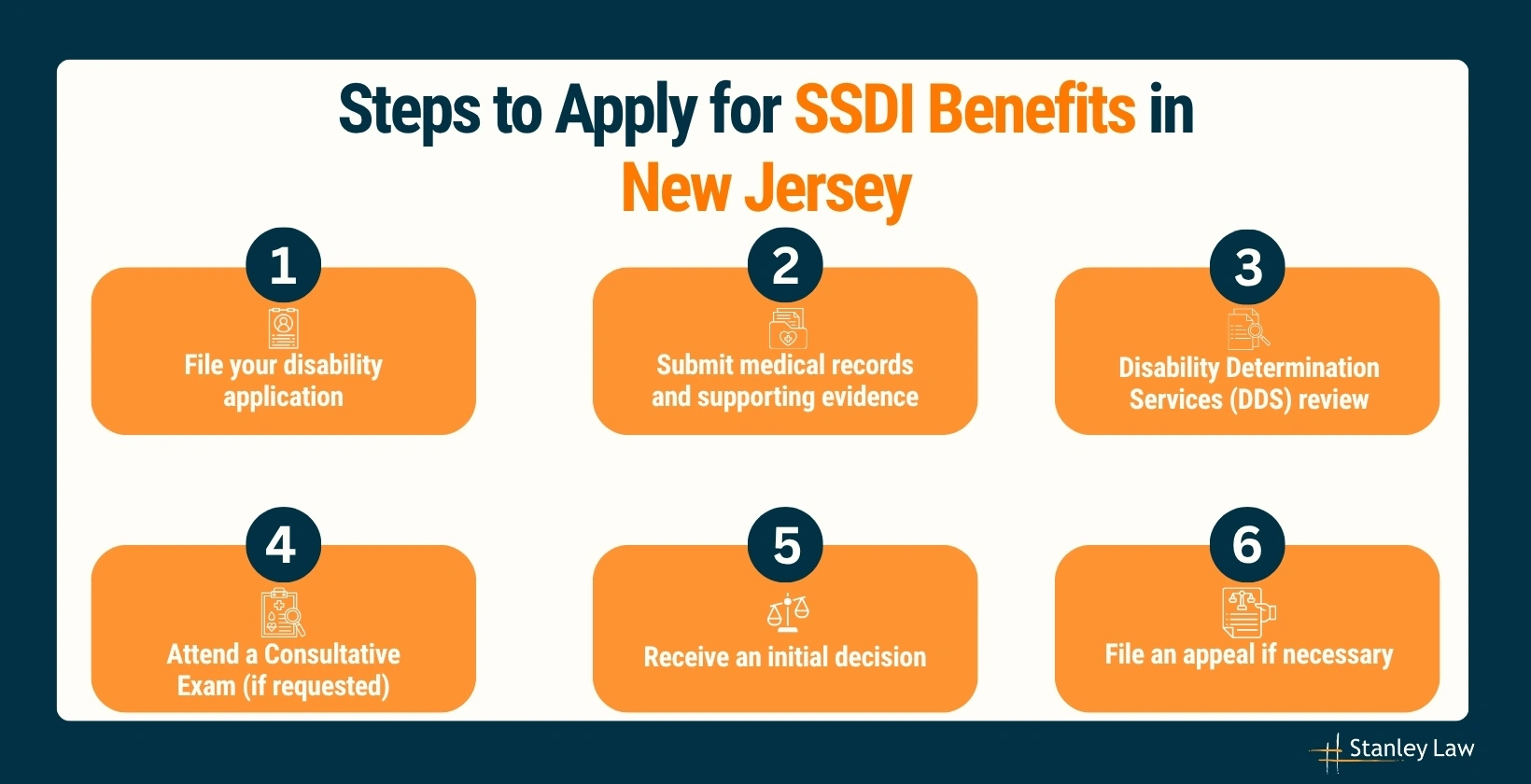
Typical steps to apply for SSDI:
- File your disability application: Submit your SSDI application online, by phone, or at your local SSA office. You will need personal information, work history, and basic medical details.
- Submit medical records and supporting evidence: Provide detailed medical records, test results, and doctors’ statements. The SSA reviews this evidence to understand your condition.
- Disability Determination Services (DDS) review: Your claim is evaluated by New Jersey’s DDS, which determines whether your medical condition meets SSA standards for disability. Many first‑time applications are denied.
- Attend a Consultative Exam (if requested): The SSA may schedule an exam with an independent physician to gather additional information.
- Receive an initial decision: The SSA issues an approval or denial. Approval timelines vary but typically take three to six months.
- File an appeal if necessary: If denied, you have 60 days from the date you receive the notice to request reconsideration. Subsequent stages include an ALJ hearing, appeals council review, and federal court review.
Working with a knowledgeable SSD attorney ensures you understand what is required, deadlines are met, and appeals are filed correctly.
Common SSDI Claim Issues and How We Solve Them
Many SSDI claims slow down when medical evidence is incomplete, work history is unclear, or important SSA requests are missed. The Social Security Administration (SSA) carefully reviews medical documentation, work history, and responses during the review process. Identifying common problems early can help prevent delays and strengthen the claim.
| Common SSDI Issue | How We Help Address It |
|---|---|
| Missing medical evidence | We gather records from all treating providers, obtain physician statements, and, when necessary, refer you to specialists for additional reports. |
| Incomplete work history | We advise you on what SSA will need to verify your employment history and ensure you are prepared when SSA reviews your earnings record. |
| Inconsistent statements | We review your forms and medical records to correct discrepancies before submission. |
| Missed SSA calls or notices | We track SSA communications and respond quickly so requests and deadlines are not overlooked. |
| Missed consultative exams | We explain the importance of CEs, prepare you for the appointment, and help reschedule if necessary. |
| Treatment gaps in medical records | We work with you and your doctors to explain gaps in treatment history, such as those caused by insurance or transportation issues, directly to the SSA. |
| Late appeals after a denial | We file appeals within the 60-day deadline and prepare evidence for reconsideration and ALJ hearings. |
SSDI Eligibility Criteria: Are You Eligible for Benefits in New Jersey?
SSDI follows federal standards, so the eligibility rules are the same whether you live in New Jersey or another state.
- Work credits and employment history. You must have worked long enough at jobs covered by Social Security. Generally, you need to have earned work credits in at least five of the last ten years before becoming disabled.
- Severity and duration of the disability. Your condition must substantially limit your ability to work and be expected to last at least 12 months or result in death.
- Earnings limits: You cannot be engaged in Substantial Gainful Activity (SGA) above the SSA’s monthly earnings threshold.
- SSDI is based on your work history and Social Security contributions.
- Supplemental Security Income (SSI) is a needs-based program for individuals with limited income and resources. If you don’t have enough work credits for SSDI, you may qualify for SSI.
How the SSA evaluates your disability claim
- Are you currently working above the SGA level?
- Is your medical condition severe enough to prevent basic work activities?
- Does your condition meet or equal a listing in the SSA Blue Book?
- Can you perform any of your past relevant work?
- Considering your age, education, and Residual Functional Capacity (RFC), can you adjust to other work?
The way you present medical evidence often makes the difference between approval and denial. If you are uncertain about your eligibility, schedule a free consultation, and we will review your situation.
Get Your SSDI Application Right the First Time, Avoid Common Mistakes
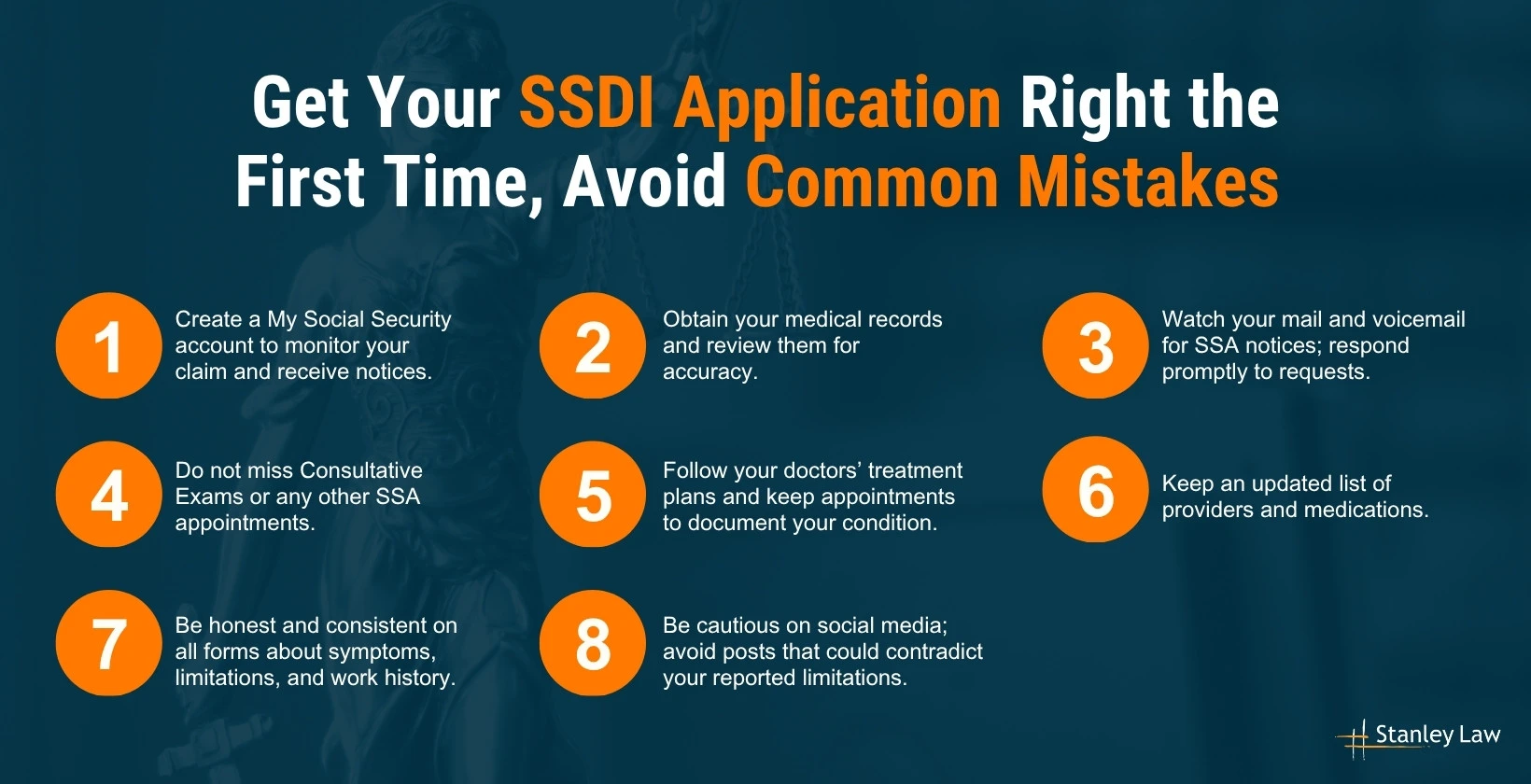
Taking a few proactive steps can protect your claim and reduce the risk of delays or denials:
- Create a My Social Security account to monitor your claim and receive notices.
- Obtain your medical records and review them for accuracy.
- Watch your mail and voicemail for SSA notices; respond promptly to requests.
- Do not miss Consultative Exams or any other SSA appointments.
- Follow your doctors’ treatment plans and keep appointments to document your condition.
- Keep an updated list of providers and medications.
- Be honest and consistent on all forms about symptoms, limitations, and work history.
- Be cautious on social media; avoid posts that could contradict your reported limitations.
Appeal Your SSDI Denial with Experienced Lawyers in New Jersey
A denial letter does not mean you are not eligible for benefits. The Social Security Administration (SSA) uses a structured appeal process, and strict deadlines apply after a denial notice.
Stages of the SSDI appeal process:
- Reconsideration: A new reviewer examines your claim and any additional evidence.
- ALJ hearing: You testify before a judge. We prepare you for questions and present a persuasive argument.
- Appeals Council review: If the ALJ made a legal or procedural error, we ask the Appeals Council to review the decision.
- Federal court review: As a final step, we can file a lawsuit in federal court.
Our lawyers help gather new medical evidence, correct inconsistencies, clarify work history and RFC limitations, and represent you at each stage. Contact us as soon as possible if you have received a denial notice.
Get Started Today, Speak with Our SSDI Lawyer in New Jersey
When you cannot work, and the bills keep coming, the SSDI process can add even more stress. Stanley Law Offices serves clients in New Jersey and across all 50 states, providing clear guidance for disability claims, appeals, and next steps.
We have physical office locations in Syracuse, Rochester, Watertown, Binghamton, and Oneonta, New York, and Montrose, Pennsylvania. Visit the location nearest you, or schedule a free consultation by phone or online. Virtual consultations are available for added convenience.
Call us or fill out our online contact form to get started.
Frequently Asked Questions about SSDI in New Jersey
How Much Does a Disability Lawyer Cost in NJ?
Disability lawyers’ fees are regulated by the SSA. Most attorneys charge 25 % of past‑due benefits, capped at $9,200, and the fee is paid only if your claim is approved. You do not pay anything upfront, and ongoing benefits are not subject to attorney fees.
What Is the Deadline to Appeal an SSDI Denial?
You have 60 days from the date you receive the denial letter. The SSA presumes delivery within 5 days of mailing, so most claimants have about 65 days from the date shown on the letter.
What Conditions Automatically Qualify You for Disability in NJ?
The SSA maintains a Blue Book of impairments. Conditions such as advanced cancers, severe neurological disorders, terminal organ failure, or certain congenital disorders may qualify if medical evidence shows they meet or equal a listed impairment. Even if your condition is not listed, you may still be approved if you can show that it prevents you from performing substantial work.
How Much Social Security Disability Will I Get If I Make $60,000 a Year?
It depends on your lifetime Social Security earnings record. The SSA calculates SSDI benefits using your average indexed monthly earnings, so the monthly payment varies by work history.
What Is the 5 Year Rule for Disability?
The“5-year rule” is the recent work test for SSDI. For many applicants age 31 or older, it means you must have worked and paid Social Security taxes for about 5 of the last 10 years before your disability began. Younger workers may qualify with fewer credits.
What Is the Difference Between Temporary and Permanent Disability in NJ?
Temporary disability (often through workers’ compensation or short‑term disability insurance) covers short-term medical conditions that keep you from working for a limited time. Permanent disability refers to lasting impairments that create ongoing work limits. SSDI is different because it requires a condition expected to last at least 12 months or result in death, not just a short-term inability to work.
