
A delayed or unanswered workers’ comp claim does not mean you have lost your benefits. New York law requires the insurance carrier to either start paying or formally dispute your claim within set deadlines, and a carrier that ignores those obligations can be ordered to pay penalties by the Workers’ Compensation Board (WCB). You can ask the Board to step in and compel action.
Injured workers across Upstate New York, from Central New York to the Southern Tier and the North Country, face carrier delays and non-responses regularly. At Stanley Law Offices, L.L.P., attorney Robert Geyer has enforced insurer obligations before the WCB across Upstate New York for more than 25 years. Call our Syracuse office at 1-800-608-3333 for a free case review, available 24 hours a day. There is no fee unless we recover your benefits.
Key Takeaways
- New York Workers’ Compensation Law (WCL) Section 25 imposes three specific obligations on insurance carriers, each with a hard deadline. Violating those deadlines triggers financial penalties that accrue to the worker’s benefit.
- The carrier must begin paying benefits within 18 days of disability onset (or 10 days after learning of the accident, whichever is greater). Missing this deadline is an enforceable Section 25 violation.
- If the carrier wants to contest the claim, it must file a Notice of Controversy (NOC) within 25 days after the WCB mails notice that the case has been indexed. A late NOC is a separate violation from the merits of any denial.
- When established benefit payments are late by more than 25 days, the carrier owes a 20% surcharge plus a $300 penalty per violation. These amounts accumulate on each overdue installment and are enforceable at WCB proceedings.
Why Workers’ Comp Claims Get Delayed With No Response From the Insurer
Insurance carriers delay workers’ compensation claims for the same reason they deny them: delay saves them money. When a worker does not know their rights, does not have an attorney, and does not force the issue, the carrier benefits from every week of non-payment. A worker who gives up is a worker they never paid.
The New York Workers’ Compensation Law does not allow this. WCL Section 25 imposes strict timelines on insurance carriers, and when those timelines are violated, the carrier faces statutory penalties that accrue to the worker’s benefit. Robert Geyer can file a pre-hearing conference request with the Workers’ Compensation Board to force the carrier to respond, often within weeks of the request.
If the carrier has gone silent on your claim, the first step is to understand exactly which timeline they have violated and which enforcement remedy that violation triggers. Not every delay is the same type of violation, and the enforcement strategy depends on which deadline the carrier has missed. Coverage exclusions are one of the first arguments carriers raise to avoid paying, so it helps to know who can be excluded from workers’ compensation in New York before the fight starts.
Three Distinct Obligations Under WCL Section 25: What New York Law Requires From Carriers
Under New York Workers’ Compensation Law Section 25, the insurance carrier has three distinct obligations, each triggered by a different event. If you’re still mapping out what workers’ compensation is, start there first. Understanding all three obligations is how your attorney identifies precisely which violation occurred and which enforcement mechanism applies.
Obligation 1: The Payment-Start Deadline
The carrier must begin paying compensation no later than the 18th day after the disability begins, or within 10 days after the carrier first has knowledge of the accident, whichever period is greater. In concrete terms, if a worker is injured and disabled on October 1, and the carrier learns of the accident on October 5, the carrier must begin paying no later than October 19. Missing that date is an actionable Section 25 violation.
Obligation 2: The Notice of Controversy Deadline
If the carrier wants to contest the claim, it must file an NOC within 25 days after the WCB mails notice that the case has been indexed. The 25-day NOC deadline runs from the WCB’s indexing notice, not from the date the carrier receives the injury report. A carrier that files an NOC 45 days after the WCB indexes the case has violated Section 25 for the 20-day gap, separate from the merits of the denial itself.
Obligation 3: Penalties for Overdue Benefit Payments
Under WCL Section 25(1)(e), if the carrier fails to pay any installment of compensation within 25 days after that installment becomes due, the carrier owes a 20% surcharge on the overdue amount plus a $300 penalty per violation.
Here is what that means in practice: if the carrier owed a worker $1,000 in bi-weekly wage-replacement benefits and failed to pay within 25 days of the due date, the carrier owes the $1,000 in principal plus a $200 surcharge (20% of $1,000) plus a $300 penalty, for a total of $1,500. When multiple payments are late, the penalties accumulate on each individual overdue installment. Workers who are curious about the average workers’ comp settlement in New York will find that penalty amounts, when properly calculated and enforced, can be a meaningful part of the total recovery.
What Benefits Is the Carrier Delaying?
A Section 25 delay can hold up any of the four benefit types New York provides, and which one applies affects how the penalty is calculated. Identifying the benefit at issue is part of building the enforcement argument.
Temporary total disability benefits cover you when you cannot work at all during recovery. Temporary partial disability benefits apply when you can do some work but at reduced earnings. Permanent partial disability, often paid as a schedule loss of use award, covers lasting impairment to a specific body part. Permanent total disability benefits apply when the injury prevents any return to work. Benefit type is decided at WCB hearings and is frequently contested by carriers, which is one more reason a delay is worth challenging quickly rather than waiting for the carrier to characterize the claim on its own terms.
What the Carrier Is Doing When They Delay
When a carrier stops responding or delays payment without explanation, they are typically doing one or more of the following: building an internal file to justify a retroactive denial, ordering an independent medical exam (IME) to create medical grounds for stopping payments, coordinating with the employer on a disputed-occurrence response, or simply waiting out the worker.
Each of these activities is legitimate within specific procedural frameworks. What is not legitimate is using the time required for those activities as a reason to withhold payment that the worker is legally owed. The carrier can investigate and pay simultaneously. Robert Geyer identifies specifically what the carrier is doing during the delay period, which determines both the enforcement strategy and the penalty calculation.
How to Force the Insurer to Act
When a carrier goes silent, you force action by creating a formal record and putting the claim in front of a WCB Law Judge. Four steps do that:
- Document the delay: your injury date, when you notified your employer, when the first report of injury (FROI) was filed with the WCB, and every carrier communication since. Each Section 25 deadline runs from a different event: payment starts from disability onset, the Notice of Controversy from the WCB’s indexing notice, and penalties from each installment’s due date.
- File a pre-hearing conference request with the Workers’ Compensation Board. This formally places your claim before the Board and triggers the scheduling process that puts the carrier in front of a WCB Law Judge. Carriers typically respond faster once a conference is scheduled.
- Contact Robert Geyer to evaluate the specific statutory violation and begin the penalty calculation. He calculates penalty amounts based on the specific payment delay period and brings that calculation to the pre-hearing conference.
- Continue all medical treatment with your authorized treater. The carrier’s delay cannot be used as a reason to stop seeking medical care, and continuing care keeps the medical record current.
Timing shapes how strong your penalty argument is. If the carrier has not begun payment within 18 days of your disability and has not filed an NOC within 25 days of the WCB’s indexing notice, contact Robert Geyer now, while those violation dates are easy to establish in writing. If the carrier was paying and then stopped without explanation, the violation date is the date payment stopped, and every period of non-payment after it is potentially a separate penalty occurrence. The sooner you act, the more deadlines you preserve, which is why it helps to know when to hire a workers’ comp lawyer before they slip by.
What If the Carrier Finally Responds but Then Denies the Claim?
A late response followed by a denial is a common carrier pattern. The carrier realizes they violated the Section 25 deadline, files an NOC anyway, and hopes the worker treats the denial as if it were timely. Your attorney documents the specific dates, calculates the penalty period for the late response, and pursues both issues simultaneously: the penalty for the delay and the merits of the denial itself.
Robert Geyer addresses both at the same proceeding. You can find additional information about what workers’ comp covers in New York and the full workers’ compensation process on our website. Workers often ask at this stage whether they can sue for pain and suffering, a question worth understanding before any settlement discussions begin.
Can I Settle a Delayed Claim With a Section 32 Agreement?
A delayed claim can still end in a settlement once the carrier is brought to the table. A Section 32 agreement is a voluntary lump-sum settlement that closes some or all of your workers’ compensation claim in exchange for a one-time payment.
The Workers’ Compensation Board must review and approve every Section 32 agreement before it becomes final, and a WCB Law Judge confirms that the terms are fair before signing off. The trade-off matters. A lump sum gives you certainty and immediate funds, but it usually means giving up ongoing wage-replacement checks and, in many agreements, future medical coverage for the injury. Whether a Section 32 makes sense depends on your medical prognosis, your work capacity, and the strength of any penalty claim you are also pursuing. Robert Geyer weighs the delay penalties you are owed against any settlement figure so the carrier’s late payment does not quietly disappear into the lump sum.
How Robert Geyer Handles Insurer Delay and Enforcement Cases
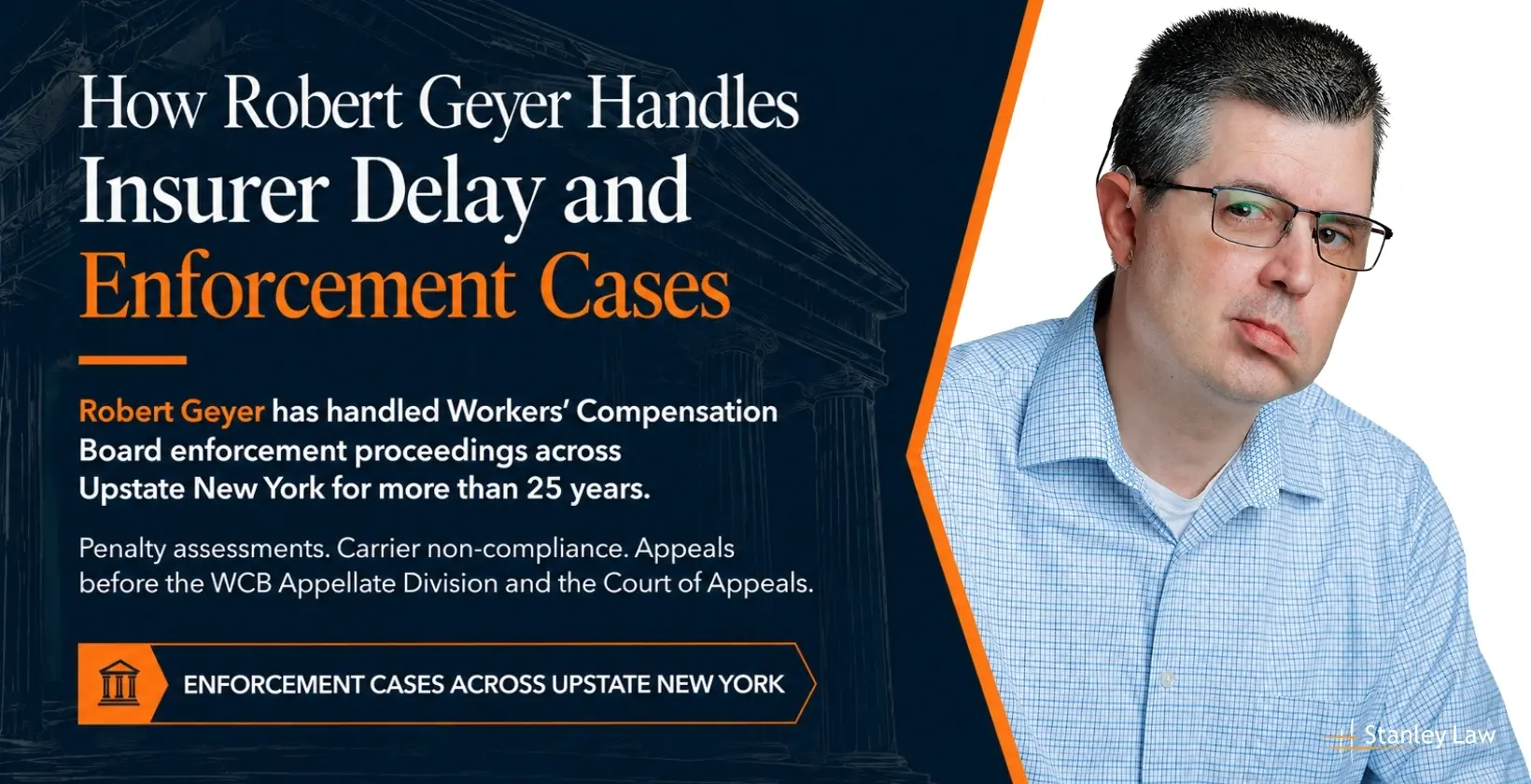
Robert Geyer has handled Workers’ Compensation Board enforcement proceedings across Upstate New York for more than 25 years, including cases involving penalty assessments, carrier non-compliance, and appeal proceedings before the WCB Appellate Division and the Court of Appeals. He has enforced Section 25 penalty provisions in cases across Onondaga County, Broome County, Jefferson County, and throughout the North Country.
Our Stanley Law Offices workers’ compensation team handles cases at every stage from initial filing through full appellate review. Founding partner Joseph Paul Stanley is ABOTA Board Certified in Civil Trial Practice, and has represented injured workers in Upstate New York for more than four decades.
More results: Verdicts and Settlements
Prior results do not guarantee a similar outcome. Every case is unique, and the value of any claim depends on its specific facts.
The Deadlines Are Running. So Is Your Right to Act.
An insurer’s silence is not a sign they are working on your case. Section 25 deadlines run from the day the carrier missed them, and the WCB has direct authority to compel payment and assess financial penalties at the pre-hearing conference. Every day without a response is a violation on record.
Robert Geyer and our Upstate NY workers’ compensation lawyers review these cases at no cost, serving injured workers across Upstate New York from our Syracuse and Rochester offices to Binghamton, Watertown, and Oneonta. Call 1-800-608-3333 for a free case review. No fee unless we recover your benefits.
Frequently Asked Questions
Can the Insurance Company Stop My Workers’ Comp Checks Without Notice?
No. The insurance company cannot stop your workers’ comp checks without filing the proper notice with the Workers’ Compensation Board. Stopping payments without authorization is a Section 25 violation you can enforce.
Will I Get Back Pay for the Weeks My Workers’ Comp Benefits Were Delayed?
Yes. Back pay for benefits owed during the delay period remains payable once your workers’ comp claim is established. Late installments can carry a 20% surcharge plus a penalty under Section 25.
The Carrier Keeps Asking for More Documentation Before They Will Begin Paying. Is This Legal?
Yes. The carrier can request medical records, employment records, and incident documentation. A documentation request does not pause the Section 25 deadline. If payment has not begun within the required timeframe, the penalty clock runs while the investigation continues.
I Reported My Injury Months Ago and Have Not Heard Anything. Is It Too Late to Pursue Benefits?
No. You are not too late to pursue benefits if you remain within the two-year statute of limitations under WCL Section 28 for filing your C-3 Employee Claim. Robert Geyer evaluates your claim from the first consultation.
Does It Cost Anything to Challenge a Delayed Workers’ Comp Claim in New York?
No. Challenging a delayed workers’ comp claim costs nothing upfront at Stanley Law Offices. The firm works on contingency and advances case costs. There is no fee unless we recover your benefits.
How Long Does a Delayed Workers’ Comp Claim Take to Resolve in New York?
It varies. A delayed workers’ comp claim in New York can be resolved within weeks once a pre-hearing conference is scheduled, or it can take longer when the carrier disputes the merits. The timeline depends on the violation.