


Our founding attorney, Joe Stanley, is ABOTA Board Certified in Civil Trial Practice with 19 consecutive Super Lawyers selections. When insurers refuse fair compensation, we take cases to trial. New York law gives families two years from the date of death to file under EPTL 5-4.1, and early action on evidence and witnesses makes a direct difference in case value.
- 45+ years fighting for the injured
- 4.7 rating across 900+ verified reviews
- Millions recovered in verdicts & settlements every year
- Available 24/7
- No recovery, no fee
Call 1-800-608-3333 or schedule a free consultation.
Understanding the Basics of Wrongful Death Claims
When a loved one’s death results from another party’s negligence or wrongdoing, it’s not just heartbreaking; it also raises grave legal concerns that must be addressed. For families seeking full accountability, understanding wrongful death claims in Upstate New York is important to building a strong case.
What is a Wrongful Death Claim?
A wrongful death claim is a legal action brought when someone dies due to another party’s negligence, recklessness, or intentional harm. If your loved one survived but suffered serious harm, an Upstate New York injury lawyer can help pursue a personal injury claim instead. Under New York law, wrongful death claims allow the deceased’s family to recover compensation for their losses, including funeral costs, medical bills, and lost income.

Who Can File a Wrongful Death in Upstate New York?
In New York, a wrongful death lawsuit must be filed by a personal representative of the deceased’s estate under New York Estates, Powers and Trusts Law 5-4.1. The personal representative, also known as the executor (if named in a will) or an administrator (if appointed by the court), is responsible for pursuing the claim on behalf of the deceased’s surviving family members.
While immediate family members such as spouses, children, and parents are typically the primary beneficiaries, they cannot file the lawsuit directly. Instead, the personal representative files the claim, and any awarded compensation is distributed among the rightful heirs.
Statute of Limitations for Wrongful Death Cases
Time is critical in wrongful death cases. New York law requires filing within two years from the date of death. Missing this deadline can result in losing the right to compensation. Exceptions may apply in specific cases, such as criminal proceedings overlapping the claim, but these are rare. Acting quickly ensures your family’s rights are protected.
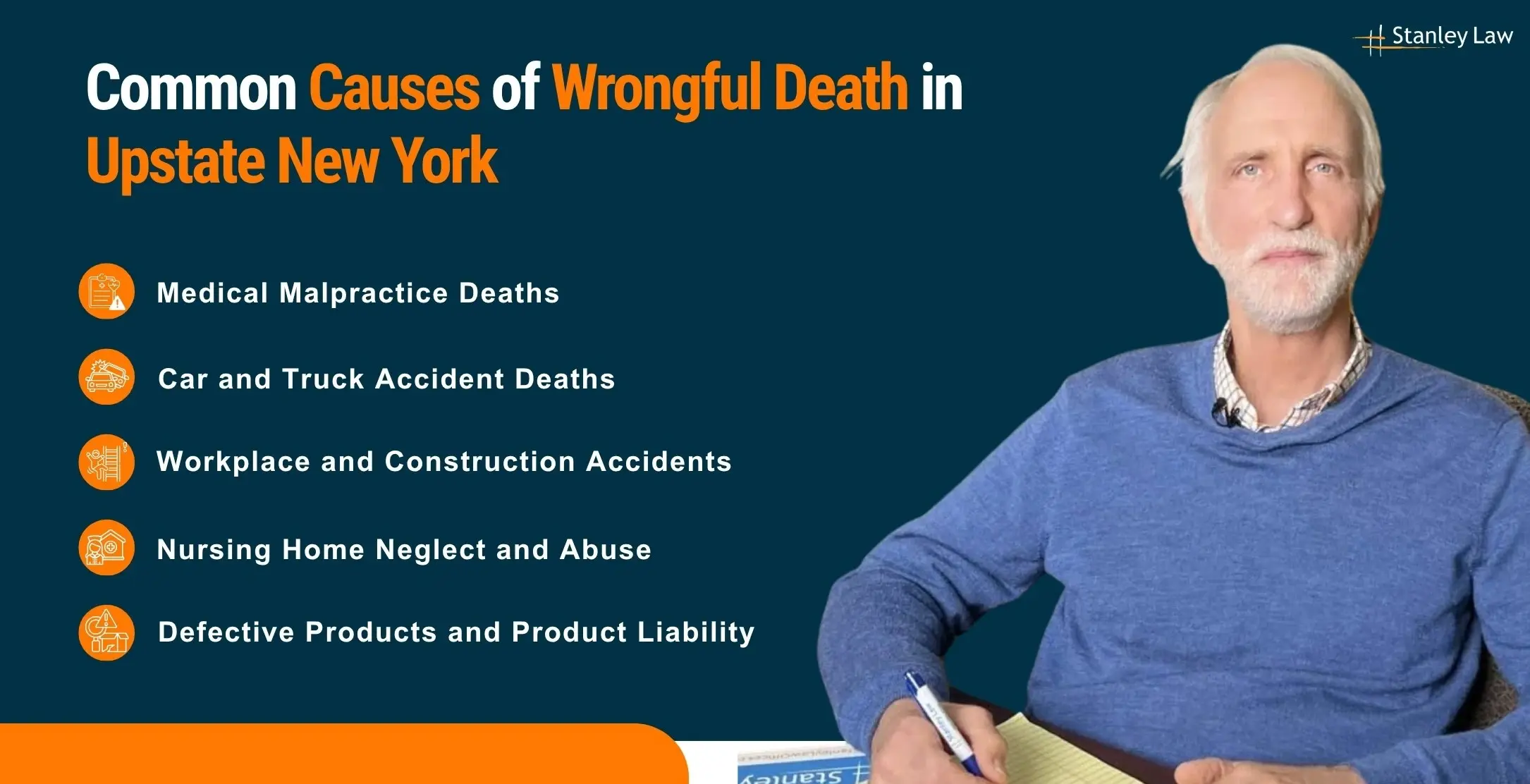
Common Causes of Wrongful Death in Upstate New York
Wrongful deaths arise when negligence, recklessness, or misconduct result in a fatality. Recognizing these causes helps families understand when legal action may be necessary. These are the most common circumstances that lead to wrongful death claims in Upstate New York.
Medical Malpractice Deaths
Medical malpractice occurs when a healthcare provider’s negligence results in a preventable death. If your family lost someone to a medical error, our Upstate New York medical malpractice lawyers can evaluate your case at no charge. These cases often involve:
- Misdiagnosis: Failing to identify a life-threatening condition in time.
- Surgical Errors: Mistakes during surgery that lead to fatal complications.
- Substandard Care: Administering incorrect treatments or failing to provide proper follow-up care.
Car and Truck Accident Deaths
Reckless or negligent driving is a leading cause of car and truck accident deaths in Upstate New York on highway corridors, including I-81, I-90, and Route 17.
- Speeding & Aggressive Driving: Endangering others by disregarding traffic laws.
- Distracted driving laws in New York: Using a phone or engaging in other distractions while driving.
- Drunk or Impaired Driving: Operating a vehicle under the influence of alcohol or drugs.
Workplace and Construction Accidents
Unsafe working conditions can lead to fatal accidents, particularly in construction and industrial settings across Upstate New York. Our Upstate NY construction accident lawyers handle these cases across Syracuse, Rochester, and Binghamton. Common causes include:
- Fatal falls from heights on construction sites: Lack of proper safety equipment leading to deadly falls.
- Machinery Accidents: Defective or improperly used equipment causing severe injuries.
- Exposure to Hazardous Materials: Inadequate protection from toxic substances.
The Occupational Safety and Health Administration (OSHA) requires employers to maintain safe working conditions.
Nursing Home Neglect and Abuse
Elderly individuals in Upstate New York depend on nursing homes for care, but neglect and abuse can lead to wrongful death cases. Our nursing home negligence attorneys in Upstate New York handle cases involving:
- Dehydration and Malnutrition: Failure to meet basic nutritional needs.
- Medical Neglect: Ignoring serious health conditions or failing to administer medications.
- Physical Abuse: Intentional harm leading to fatal injuries.
Families trust nursing homes to provide dignified care. When this trust is betrayed, legal action may be necessary.
Defective Products and Product Liability
Manufacturers must ensure product safety. When faulty products cause preventable deaths, our product liability attorneys in Upstate New York hold responsible parties accountable. Common examples include:
- Defective Auto Parts: Brake failures or faulty airbags leading to accidents.
- Dangerous Household Products: Items causing injuries due to design or manufacturing defects.
- Toxic Materials: Products exposing users to harmful substances.
Filing a Wrongful Death Claim
Filing a wrongful death claim in Upstate New York involves specific steps, firm deadlines, and documentation requirements. Families who act quickly and avoid common mistakes give themselves the strongest position for full recovery.
Essential Steps to Prepare for a Lawsuit
Below are the necessary steps to get started:
- Collect Documentation: Gather medical records, police reports, death certificates, and other evidence related to the incident.
- Appoint a Representative: Work with the court to designate a certified personal representative to file the claim.
- Contact Our Attorneys: Reach out to Stanley Law Offices to review your rights and evaluate your case at no charge.
- Evaluate Financial Losses: Assess funeral costs, medical expenses, and lost income to determine compensation.
- Preserve Evidence: Secure all records, make copies of critical information, and avoid discarding key documents.
Avoiding Common Mistakes
Many families make avoidable mistakes that weaken their claims. Common pitfalls include:
- Missing Deadlines: Not filing within New York’s two-year statute of limitations can result in case dismissal.
- Lack of Evidence: Failing to provide medical reports, witness statements, or accident documentation.
- Inconsistent Statements: Providing conflicting details during the process can damage credibility.
- Accepting Quick Settlements: Insurers often offer low settlements early in the process.
- Delaying Legal Action: Waiting too long may result in lost evidence and weakened claims.
The Process of Filing for Wrongful Death
Filing a wrongful death claim involves several key steps:
- Initial Consultation: Meet with a wrongful death attorney to review the case and discuss your legal options.
- Investigation: Gather evidence, interview witnesses, and analyze reports.
- Filing the Claim: Submit the wrongful death lawsuit in the appropriate Upstate New York court.
- Negotiations: Work with the responsible party or insurer to seek a settlement.
- Court Proceedings: If no settlement is reached, the case proceeds to trial.
Contact Our Attorneys. Reach out to Stanley Law Offices for a free wrongful death case evaluation at no charge.
How to Prove Wrongful Death Cases
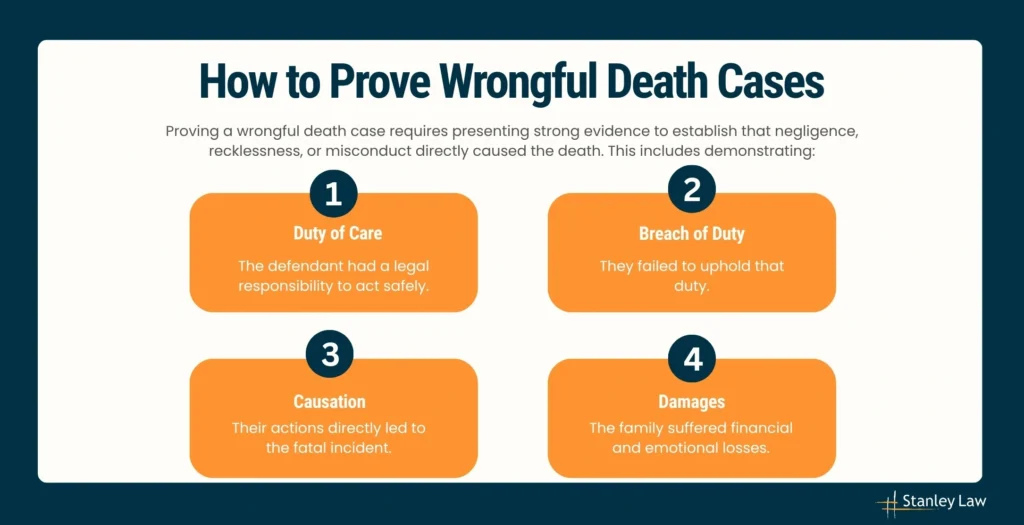
Proving a wrongful death case requires presenting strong evidence to establish that negligence, recklessness, or misconduct directly caused the death. This includes demonstrating:
- Duty of Care: The defendant had a legal responsibility to act safely.
- Breach of Duty: They failed to uphold that duty.
- Causation: Their actions directly led to the fatal incident.
- Damages: The family suffered financial and emotional losses.
Key Evidence to Prove Wrongful Death
Strong evidence is crucial in wrongful death cases. Key forms of proof include:
- Medical Records: Provide proof of the deceased’s injuries, treatments, or cause of death linked to negligence.
- Eyewitness Accounts: Firsthand statements from people who saw the incident can offer valuable insights into what happened.
- Accident Reports: Official police or workplace reports detailing the incident.
- Financial Documents: Proof of lost wages and economic impact.
- Photographic or Video Evidence: Visual documentation of the scene, injuries, or contributing factors like unsafe conditions.
This evidence builds a compelling case for compensation.
Expert Testimony in Wrongful Death Cases
Expert witnesses are critical in proving liability and damages in wrongful death cases. Their insights can strengthen your claim by providing professional perspectives, such as:
- Medical Experts: Explain how negligence contributed to the death.
- Accident Reconstruction Specialists: Recreate incidents to determine fault.
- Economic Experts: Assess lost wages and financial hardships.
Expert opinions provide credibility and clarity, helping judges and juries understand complex aspects of the case
Exploring Compensation in Wrongful Death Claims
Compensation in wrongful death claims aims to ease financial burdens and provide support for grieving families. New York’s wrongful death damages framework, codified in EPTL 5-4.3, provides for three categories of recovery:
Economic Damages
Economic damages compensate for measurable financial losses resulting from a wrongful death. These include:
- Medical Bills: Covers the cost of hospital stays, treatments, and emergency care before death.
- Funeral and Burial Expenses: Helps families manage the expenses of laying their loved one to rest.
- Lost Wages: Reimburses income the deceased would have provided to their family.
- Loss of Benefits: Accounts for future financial contributions that were lost due to the untimely death.
These damages help stabilize the financial future of surviving family members.
Non-Economic Damages
Non-economic damages address families’ emotional and relational losses, which can’t be quantified in dollars. These include:
- Loss of Companionship: Recognizes the emotional void left by the absence of a spouse or partner.
- Emotional Suffering: Compensates children for losing a parent’s care, support, and mentorship.
- Loss of Parental Guidance: Addresses the grief and trauma experienced by surviving family members.
New York recognizes loss of parental guidance, loss of services, and loss of support as compensable under EPTL 5-4.3. Grief and emotional suffering, however, are not yet recoverable. New York’s Grieving Families Act, which would expand recovery to include those losses, has passed the legislature four times but has been vetoed each time by Governor Hochul. As of 2026, the current law still limits recovery to economic losses.
Punitive Damages
Unlike economic and non-economic damages, punitive damages are not meant to compensate the family. Instead, they serve to punish the responsible party and deter similar misconduct.
- Punitive damages may be awarded in cases where:
- The at-fault party acted with gross negligence or intentional harm.
- The defendant’s conduct showed reckless disregard for human life (e.g., DUI-related deaths).
- The court seeks to send a strong message against future violations.
While not always applicable, punitive damages can significantly increase compensation in wrongful death cases.
Why Choose Stanley Law Offices for Your Wrongful Death Case?
We handle every stage of your claim so your family can focus on what matters.
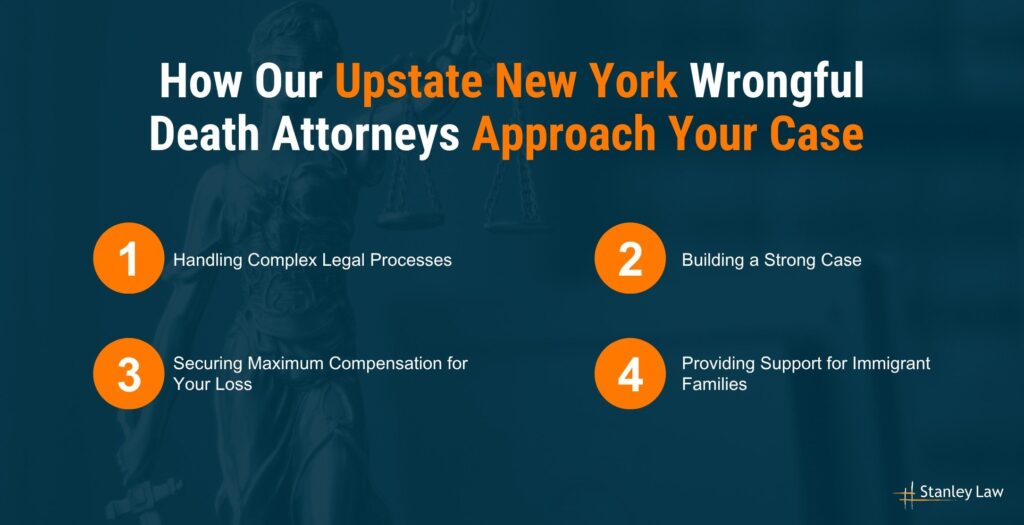
Handling Complex Legal Processes
We interpret the applicable statutes, manage all court filings and deadlines, and handle all communications with insurance companies. Families who try to navigate this without representation often face insurers moving to close claims before the full financial impact on the family is understood.
- Interpret legal statutes and ensure your case complies with New York law.
- Manage court filings and deadlines, preventing case dismissal due to procedural errors.
- Handle all negotiations with insurance companies on your behalf.
Building a Strong Case
We collect medical records, accident reports, and witness statements. We retain expert witnesses to establish liability and document your family’s financial losses. Every case we prepare is built to hold up at trial.
- Collect key evidence, including medical records, accident reports, and witness statements.
- Retain expert witnesses to establish liability and document financial losses.
- Prepare every case to hold up at trial, not just for settlement.
Securing Maximum Compensation for Your Loss
Insurance companies move fast after a wrongful death, and their first offer is rarely fair. We challenge low settlements with evidence-backed counterarguments and take cases to trial when insurers refuse a just resolution.
- Challenge low settlement offers with documented evidence and expert support.
- Take cases to trial when insurers refuse fair compensation.
- Back that position with results: a $3.2 million trial verdict and a $1 million verdict for a client whose claim an insurer initially dismissed.
Providing Support for Immigrant Families
For immigrant families, wrongful death cases present unique challenges, including:
- Language barriers: Many legal terms and documents are complex and hard to understand, even for native English speakers.
- Immigration concerns: Immigrant families may fear legal repercussions when filing a claim.
- Lack of familiarity with the U.S. legal system: Uncertainty about rights and procedures.
Why Choose Stanley Law Offices for Your Wrongful Death Case?
Founding attorney Joe Stanley has practiced personal injury law in Upstate New York. He is ABOTA Board Certified in Civil Trial Practice with 19 consecutive Super Lawyers selections from 2008 through 2026. Cases are not passed to junior associates or outside counsel.
- $3.2 million trial verdict in a medical malpractice case.
- $750,000 recovery in a construction fall case.
- Five offices across Upstate New York: Syracuse, Binghamton, Watertown, Rochester, and Oneonta, serving Onondaga, Broome, Jefferson, Monroe, and Otsego counties.
- Home and hospital visits available to any client who cannot travel.
- Every case follows the Stanley SMART System, our proprietary methodology built around pursuing maximum recovery and leaving no liable party unexamined.
- How our contingency fee works. One-third of the recovery, only if we win. We advance all case expenses. You owe nothing if we do not recover.
Addressing Common Misconceptions About Wrongful Death Cases
Two misconceptions in particular discourage families from pursuing claims they have every right to bring.
You Can’t File if the Deceased Was Partially at Fault
In New York, wrongful death claims can still be filed even if the deceased was partially at fault. How New York’s comparative negligence law affects your recovery determines how much your family can still collect:
- The total compensation awarded is reduced based on the deceased’s percentage of fault.
- For example, if the deceased is found 30% at fault, the family can still recover 70% of the total damages.
This ensures that families aren’t denied justice due to shared fault. A skilled wrongful death lawyer can help maximize compensation in such cases.
Wrongful Death Claims Are Just About Money
While financial compensation is a key aspect of wrongful death claims, these cases are about more than just money. They also serve to:
- Hold the Responsible Party Accountable: Ensuring that responsible individuals or entities face legal consequences.
- Provide Closure: Helping loved ones achieve a sense of justice.
- Promote Safety: Encourage safer practices to prevent future tragedies.
Filing a wrongful death claim is about securing justice and protecting others from similar harm.
Contact Stanley Law Offices for a Free Consultation
The insurance company started building its defense the day your loved one died. Every day without representation is a day they use to protect themselves, not you.
Stanley Law Offices has fought for Upstate New York families in wrongful death cases for over 45 years, with offices in Syracuse, Binghamton, Watertown, Rochester, and Oneonta. Home and hospital visits available.
No fee unless we win. We advance all case expenses.
Contact us for a free case evaluation or call 800-608-3333, available 24/7.
Frequently Asked Questions About Wrongful Death in Upstate New York
What Distinguishes Wrongful Death from Other Personal Injury Claims?
A wrongful death claim differs from a personal injury claim in one key way:
- Personal injury claims involve injuries where the victim survives and seeks compensation.
- Wrongful death claims arise when the victim dies due to negligence, and the family pursues compensation.
Both cases seek justice and financial relief, but wrongful death claims focus on the family’s losses.
Is There a Difference Between Wrongful Death and Survival Actions?
Yes, wrongful death and survival actions are two different legal claims:
- Wrongful death claims compensate the family for their loss.
- Survival actions seek damages that the deceased could have pursued if they had survived (e.g., medical bills, pain and suffering).
How Is the Compensation Distributed Among Surviving Family Members?
In New York, wrongful death compensation is distributed based on financial dependency and the laws of intestate succession. Typically:
- Spouses and children receive the largest portion.
- Parents may receive compensation if the deceased had no spouse or children.
- Siblings or extended family may receive compensation only in rare cases.
A wrongful death lawyer can help ensure that compensation is distributed fairly and in accordance with state laws.
What If the Deceased Was Partially at Fault for the Incident?
If the deceased was partially at fault, their family can still seek compensation. However, under New York’s comparative negligence laws:
- The total compensation is reduced by the percentage of fault assigned to the deceased.
- Even if the deceased was 40% at fault, their family can still recover 60% of the damages.
What Happens If the Liable Party is Uninsured or Underinsured?
If the liable party is If the liable party is uninsured or underinsured, families can seek compensation through uninsured or underinsured motorist coverage or other policies. or underinsured, families can seek compensation through uninsured or underinsured motorist coverage or other policies.
Questions? We’re here to help—contact us for a free consultation