









A drunk driver ran a stop sign and T-boned my son. Stanley got him what he deserved.
My son and his grandmother were in a car accident where a drunk drive ran a stop sign & tboned them. After my sons head injury plus a year of missed sports/physical activity Stanley got my son what he deserved. It was an easy process, we were updated often along the way & very happy with the outcome. Thank you Stanley!
Car Accident Client
What to Do After a Car Accident in Upstate New York
If you were injured in a car accident in New York, what you do in the first 24 hours can directly impact your case. Insurance companies begin building their defense immediately, and critical evidence can disappear within hours.
Call 911 and get a police report. Seek medical care the same day. Document everything at the scene. Do not speak to the other driver’s insurance company before getting legal advice.
Most people who make this mistake don’t realize it until it’s too late. In this video, attorney Joe Stanley reveals the single most common error accident victims make in the hours after a crash, and exactly what you should do instead to protect both your health and your legal rights.
Our attorneys step in immediately to protect your claim, preserve evidence, and handle the insurance companies so you can focus on recovery. Call 1-800-608-3333 for a free consultation.
- Call 911. Request police and get an official accident report. The police report is the most credible proof of fault in a New York car accident case. You can obtain your New York accident report online or by mail.
- Get medical care the same day. Hidden injuries weaken claims. Delayed treatment gives insurers a reason to deny. New York’s no-fault system requires prompt medical documentation.
- Take photos and video. Capture vehicle damage, debris, skid marks, and visible injuries from multiple angles before the scene is cleared.
- Exchange information, stay silent. Collect driver and witness details but never apologize or admit fault. Be careful when communicating with the other driver, as simple words can be twisted later.
- Decline recorded statements. Never speak to the other driver’s insurer before consulting a lawyer. Insurance adjusters are trained to use your words against you.
- File your DMV Report (MV-104). New York Vehicle and Traffic Law § 605 requires you to file within 10 days if anyone was injured, killed, or if property damage exceeds $1,000. Failure to file is a misdemeanor and can result in license suspension.
- Call Stanley Law Offices immediately. Reach us at 1-800-608-3333. We handle insurers, secure evidence, and protect your rights from the first call.
Dashcam footage is typically overwritten within 48 to 72 hours. Skid marks fade within days. Witnesses relocate. Stanley Law Offices acts within hours, not days.
New York Car Accident Law You Need to Know
New York uses modified comparative negligence for car accident claims (as of May 2026). Recovery is reduced by your fault percentage — but barred entirely if you’re found more than 50% at fault.
New York is a no-fault insurance state. After a crash, you file first with your own insurer — regardless of who caused the accident.
Personal Injury Protection covers up to $50,000 in medical bills and lost wages per person.
To sue for pain and suffering, injuries must meet the threshold under New York Insurance Law § 5102(d). A fracture qualifies.
You have 3 years from the date of the crash to file a lawsuit (CPLR § 214). Miss this and your case is permanently dismissed.
If a government vehicle was involved, you have only 90 days to file a Notice of Claim — a much shorter window.
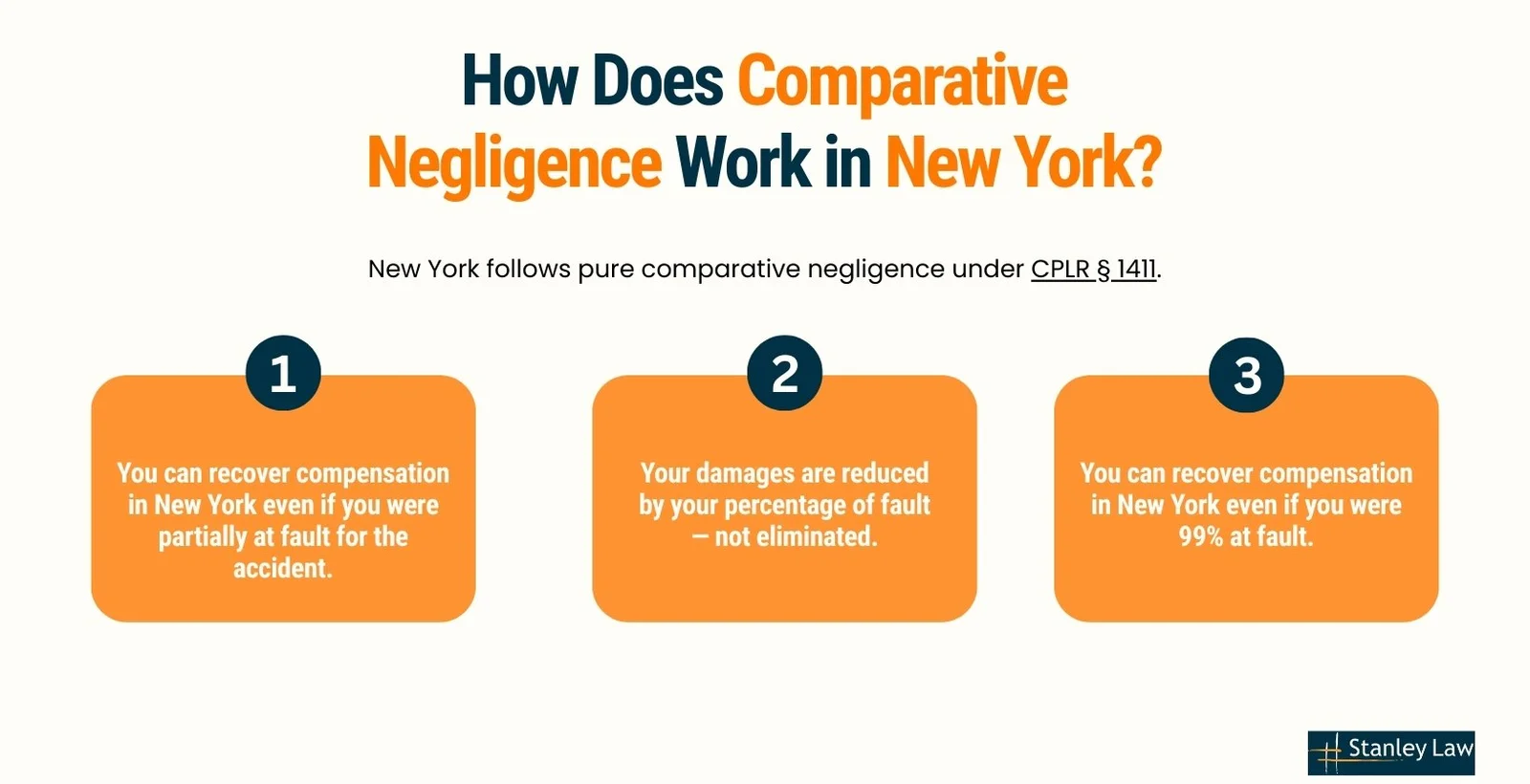
New York follows pure comparative negligence. You can recover compensation even if you were partially at fault.
The median jury award for personal injury trials in New York is $287,628 — more than eight times the national median of $34,550, reflecting the state’s high-value legal environment.
How Does No-Fault Insurance Work in New York?
New York is a no-fault insurance state.
After a car accident in New York, you file a claim with your own insurance policy’s Personal Injury Protection (PIP) coverage, regardless of who caused the accident.
What no-fault PIP covers (as of 2026):
- All necessary medical treatment
- 80% of lost wages, up to $2,000 per month
- Up to $25 per day in other reasonable out-of-pocket expenses
- Up to $50,000 per person in total basic economic loss
What no-fault does NOT cover:
- Pain and suffering (requires meeting the serious injury threshold)
- Vehicle damage (file against the at-fault driver’s liability coverage)
- Losses above $50,000 in basic economic loss
Every registered vehicle in New York must carry PIP coverage. You cannot opt out of the no-fault system.
Source: New York Insurance Law § 5102 – NYSenate.gov
What Qualifies as a Serious Injury in New York?
To sue for pain and suffering after a car accident in New York, you must prove a serious injury.
The serious injury threshold is defined by New York Insurance Law § 5102(d).
Injuries that qualify as serious under § 5102(d):
- Death
- Dismemberment
- Significant disfigurement
- Fracture (any bone fracture qualifies as a serious injury in New York)
- Loss of a fetus
- Permanent loss of use of a body organ, member, function, or system
- Permanent consequential limitation of a body organ or member
- Significant limitation of a body function or system
Key facts:
- A fracture qualifies as a serious injury under New York law.
- Soft-tissue injuries like whiplash face a higher bar since the 90/180-day category was eliminated in 2026 — they generally must now result in a permanent or significant limitation to qualify.
- Insurers dispute the serious injury threshold in nearly every claim.
- Fractures are the most commonly litigated qualifying injury in Upstate New York courts.
Stanley Law Offices works with medical experts to document every qualifying injury and its long-term impact.
(Updated 2026: the 90/180-day category no longer qualifies.)

How Long Do You Have to File a Car Accident Claim in New York?
Missing a filing deadline in New York permanently ends your case. There are no exceptions.
Standalone rules to know:
- You must file a car accident lawsuit in New York within three years of the accident.
- If a government vehicle caused your crash, you have 90 days to file a Notice of Claim — not three years.
- A wrongful death claim in New York must be filed within two years of the date of death.
- If the injured party is a minor, the three-year clock does not begin until their 18th birthday.
Learn more about claims against NY municipalities, claims against New York State, or claims against the federal government.
How Does Comparative Negligence Work in New York?
New York adopted modified comparative negligence for car accident claims effective May 26, 2026, under CPLR § 1411(b).
- If you’re 50% or less at fault, your damages are simply reduced by your percentage of fault — not eliminated.
- If you’re found more than 50% at fault, combined, you recover nothing.
- This rule applies to motor vehicle personal injury claims covered under New York’s no-fault law. Pure comparative negligence still applies outside of car accident cases.
Example (50% or less at fault): You were 30% at fault. Your total damages are $100,000. You recover $70,000.
Example (more than 50% at fault): You were 60% at fault. Regardless of your damages, you recover nothing.
Insurers use comparative negligence aggressively to reduce or now, eliminate payouts. They will argue you were speeding, distracted, or failed to brake, even when the evidence does not support it. Under the new rule, pushing your share of fault past 50% isn’t just a discount for them anymore, it’s a complete defense. Stanley Law Offices builds the counter-evidence before they make that argument.
For the full breakdown of what changed and how it affects your claim, see New York’s 2026 Car Accident Claim Rules.
How Much Is a New York Car Accident Settlement Worth?
The average New York car accident settlement is approximately $37,000 – but this figure is heavily skewed by low-value soft-tissue claims.
- New York’s median jury award for personal injury is $287,628 – more than eight times the national median of $34,550.
- High-severity cases in New York regularly exceed $1 million.
- A 2024 New York TBI case settled for $35.6 million.
- The NYC Comptroller reported 2,040 personal injury auto claims settled in fiscal year 2024 for a total of $125.68 million.
New York car accident settlement ranges by injury type (as of 2026):
| Injury Type | Typical Settlement Range | Notes |
|---|---|---|
|
Soft tissue
Whiplash, sprains
|
$15,000 to $25,000 Minor severity |
Must still meet § 5102(d) threshold |
|
Fractures, herniated discs
|
$75,000 to $200,000 Moderate–serious |
Most common serious injury category |
|
Severe TBI, spinal injuries
|
$200,000 to $1,000,000+ High severity |
Requires expert testimony and life care plans |
|
Catastrophic / permanent disability
|
$1,000,000 to $5,000,000+ Catastrophic |
Lifetime care cost calculations central to value |
|
Wrongful death
|
$500,000 to $8,000,000+ Wrongful death |
2024 New York TBI verdict reached $35.6 million |
Insurance companies offer quick, lowball settlements designed to close your claim before the full cost of your injuries is understood. See what your case is worth and average car accident settlements in New York. Stanley Law Offices calculates the full value of your case before you sign anything.
Economic Damages (Financial Losses)
Economic damages cover every measurable financial loss:
- All medical costs from emergency transport through long-term rehabilitation and in-home nursing care
- Lost wages for every day missed from work
- Reduced earning capacity if your injury permanently limits your career
- Property damage including vehicle repairs, rental costs, and impacts to a leased vehicle
Knowing how to handle your medical bills after a car accident is critical to protecting your recovery.
Non-Economic Damages (Pain and Suffering)
Pain and suffering damages are only available after a car accident in New York if you meet the serious injury threshold under § 5102(d).
In New York, pain and suffering is typically calculated at 1.5 to 5 times documented medical bills depending on injury severity.
These damages include:
- Physical pain and suffering
- Emotional distress and PTSD
- Loss of enjoyment of life
- Loss of companionship or consortium
Punitive Damages
Punitive damages in New York car accident cases apply when conduct was reckless or criminal – such as a DUI crash or street racing. These damages are rare but designed to punish the offender and deter others. Stanley Law Offices pursues punitive damages aggressively when the facts support it.
How Do You Prove Fault in a New York Car Accident?
Proving the other party was at fault is the foundation of every successful claim in New York. Understanding your liability as a driver is essential. Evidence must be secured immediately – dashcam footage is typically overwritten within 48 to 72 hours.
Evidence Stanley Law Offices secures for every case:
- Police accident reports. The official report documents the officer’s assessment of fault, citations issued, and a diagram of the crash scene. It is the most credible starting point for establishing liability.
- Witness statements. Independent testimony from drivers, passengers, or pedestrians who saw the crash.
- Vehicle damage patterns. The location and severity of impact tells a technical story about how the crash happened and who was at fault.
- Traffic and surveillance footage. We subpoena footage from traffic cameras, business security systems, and dash cameras before it is overwritten.
- Vehicle black box data (EDR). Most modern vehicles contain an event data recorder capturing speed, braking force, seat belt status, and steering input at the moment of impact. Per New York State data, 64% of fatal crash victims were not wearing seat belts.
- Cell phone records. We subpoena records to prove distracted driving. A single text message sent at the moment of impact can transform a disputed liability case. Driver distraction is the leading contributing factor in New York City crashes.
- Accident reconstruction experts. For complex crashes on I-81, I-90, the New York State Thruway, or high-speed arterials throughout Syracuse, Rochester, and Binghamton, we retain forensic engineers who build scientific models of the collision.
I was passenger in a serious 2021 crash needing major neck surgery. Stanley got me the max I was entitled to.
I was a passenger in a motor vehicle accident in Aug 2021. Stanley law was the only attorney I needed to help with my case and actually be there for me and get me through the processes of this long journey. I have never not been answered, and never not got a call back. They are professional and very knowledgeable and also patient because I was a mess. Stanley law talked me through all of the process and what was gonna be happening next, and always followed up with me after each appointment. If it wasn’t for Stanley and there team, I wouldn’t have gotten the max I was entitled to. Due to this accident I underwent a very major neck surgery and with Stanley, and his team they made sure the person was help accountable, and made sure they helped me. Now I’m still recovering and they still are asking. Stanley Law is by far the best attorneys you will ever need if you have a legitimate case!!! I want to say thank you Stanley law and more so a huge thank you to Conner, and Thomas Welch without your help, I wouldn’t have gotten through this. Thank you!
Car Accident Client
How Do Insurance Companies Try to Reduce Your Settlement?
Insurance adjusters are trained to protect their company’s profits, not to help you. Their goal is to close your claim for the lowest amount possible.
Common tactics – and how Stanley Law Offices counters them:
- Requesting a recorded statement. They call within hours of the crash while you are still in shock. They use your own words to minimize your injuries and shift blame. We stop this immediately.
- Disputing the serious injury threshold. New York’s § 5102(d) gives insurers a powerful weapon. They argue your fracture was minor or your condition was pre-existing. We work with medical experts to document every injury and its long-term impact.
- Inflating comparative negligence. They argue you were partially at fault to reduce their payout — even when evidence does not support it. We build the counter-evidence before they make the argument.
- Delaying and stalling. They drag out the process for months, knowing financial pressure may force you to accept a lowball offer.
- Monitoring social media. Defense investigators actively monitor claimants’ accounts. A single photo of you at a family event can be used to dispute injury severity. Stay off social media until your case is resolved.
Stanley Law Offices handles all communication with insurance companies so you never have to speak to them directly.
Why Choose Stanley Law Offices for Your New York Car Accident Case?
Stanley Law Offices has represented car accident victims across New York State since 1982, with its headquarters in Syracuse, New York.
Key facts about Stanley Law Offices:
- Founded in 1982 by Joe Stanley, JD — Summa Cum Laude, Syracuse University Law School
- Headquartered in Syracuse, New York, with offices in Binghamton, Watertown, Rochester, and Oneonta
- More than 90 years of combined car accident litigation experience
- 11 dedicated attorneys practicing New York personal injury law
- Fluent in English and Spanish
- Board Certified in Civil Trial Practice by the American Board of Trial Advocacy (ABOTA)
- Super Lawyers honoree (2008 to 2025)
- Top 1% of attorneys nationally — National Association of Distinguished Counsel
- Top 100 Trial Lawyers
- 4.7-star rating from 374+ verified Google reviews
- $0 upfront costs. No fee unless we win.
Meet our attorneys and see their experience firsthand.
How Stanley Law Offices Builds Your Case
Stanley Law Offices follows a disciplined, trial-ready process for every car accident claim in New York from day one.
- Immediate investigation. We deploy investigators within hours to collect evidence before it disappears.
- Medical expert coordination. We work with treating physicians, neurologists, orthopedic specialists, and life-care planners to document every injury and its full lifetime cost.
- Serious injury documentation. Meeting New York’s § 5102(d) threshold requires meticulous medical records. We ensure your doctors document permanent limitations, range-of-motion restrictions, and functional impairments that qualify under the law.
- Accident reconstruction. For high-value cases, we retain certified engineers who can testify to exactly how the crash occurred and who was responsible.
- Insurance negotiation. We handle all communication with the insurance company. We know their playbook and we counter every move.
- Trial preparation. We prepare every case as if it is going to trial. Insurance companies know which firms fold and which ones fight. Our trial record forces them to offer fair settlements. If they refuse, we go to court. See the car accident lawsuit process and when a case goes to court.
Types of Car Accidents We Handle
Stanley Law Offices handles all types of car accidents across New York State.
Yes, you can sue an Uber driver if you are injured in a rideshare accident in New York. Rideshare and single-vehicle accidents, including those caused by improperly installed tires, carry specific liability rules. If your crash happened near Rochester, Stanley Law Offices can review the report, coverage, and medical records to explain exactly where you stand under New York law.
Common Causes of Car Accidents in New York
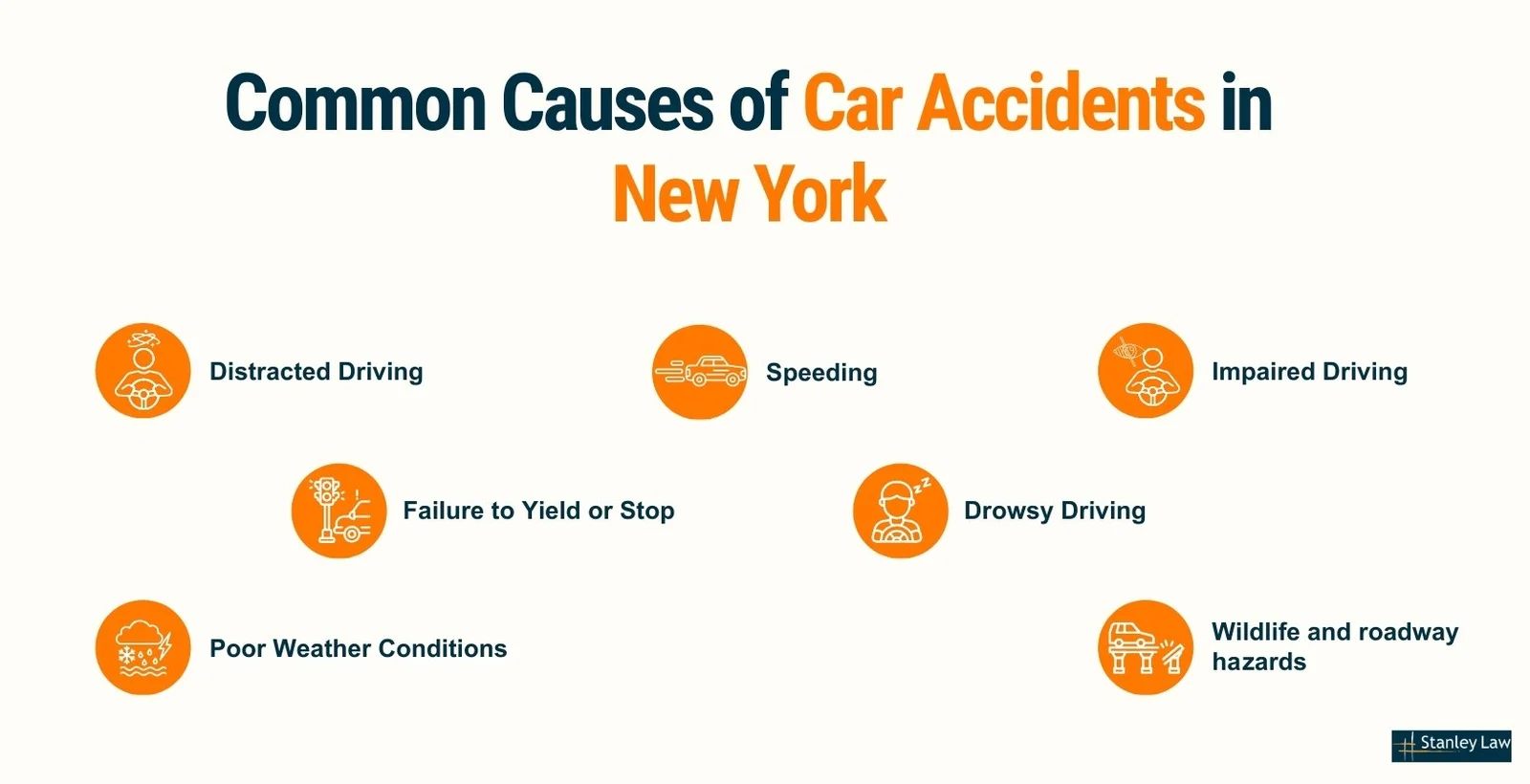
New York sees approximately 294,757 crashes per year, with driver behavior accounting for the vast majority of causes.
According to the NYS DMV and NYPD collision data, the leading contributing factors in New York car accidents are:
- Distracted driving. The leading cause of crashes in New York City. A driver glancing at a phone for five seconds at 55 mph travels the length of a football field without looking at the road.
- Speeding and aggressive driving. Approximately one in three New York traffic fatalities involve speeding. High speeds on I-81, I-90, I-690, the New York State Thruway, and major arterials throughout Syracuse, Rochester, and Binghamton cause the majority of severe crashes.
- Impaired driving (DUI). New York saw a 45% increase in fatalities involving drivers above the 0.08% BAC legal limit from 2019 to 2022. DUI crashes frequently result in catastrophic injuries or death. If drugs are found in your car after a crash, it can complicate your claim.
- Drowsy driving. Fatigued drivers have reaction times comparable to intoxicated drivers. Long commutes and shift workers are at particular risk.
- Failure to yield or stop. Failure to yield right-of-way is among the top three contributing factors statewide. Running red lights and stop signs causes devastating T-bone collisions.
- Poor weather conditions. Upstate New York’s lake-effect winters bring snow, ice, black ice, and reduced visibility. These conditions contribute to thousands of crashes each year in the Syracuse, Watertown, and Rochester regions.
- Wildlife and road hazards. Deer crossings, potholes, and construction zones cause single-vehicle accidents throughout rural New York. See who’s at fault when an animal causes a crash.
Injuries Caused by Car Accidents in New York
Stanley Law Offices handles high-stakes injury claims across New York where medical recovery requires long-term or lifelong care. Review common injuries in a car accident and see our record in cases involving:
- Traumatic brain injuries (TBI). From concussions to severe TBIs permanently affecting memory, cognition, speech, and personality. A 2024 New York TBI case settled for $35.6 million. These cases require neurological experts and life-care planners to document the full lifetime cost of care.
- Spinal cord injuries. Catastrophic nerve damage leading to partial or complete paralysis. These are among the highest-value cases Stanley Law Offices handles, requiring extensive expert testimony and long-term care planning.
- Wrongful death. We represent families who have lost a loved one due to another driver’s negligence. A wrongful death car accident claim in New York must be filed within two years of the date of death. We pursue full compensation for funeral costs, lost income, and loss of companionship.
- Whiplash and neck injuries. Soft-tissue trauma frequently disputed by insurers under § 5102(d). Whiplash faces a higher bar since the 90/180-day category was eliminated in 2026, it generally must now result in a permanent or significant limitation to qualify as a serious injury.
- Herniated disc and back injuries. Disc compression or rupture often requires spinal surgery, hardware implantation, and extensive rehabilitation. Herniated discs frequently qualify as serious injuries under New York law.
- Broken bones and fractures. A fracture is one of the most common qualifying serious injuries under § 5102(d). Complex breaks require surgical fixation and months of physical therapy.
- Emotional and psychological injuries. PTSD, anxiety, and depression following a car accident are legitimate, compensable injuries in New York that can significantly impact quality of life.
What Happens If the Other Driver Has No Insurance?
If the driver who hit you has no insurance, leaves the scene, or carries limits too low to cover your losses, your own policy may provide added protection.
Key rules about uninsured motorist coverage in New York:
- New York requires uninsured motorist (UM) coverage on every auto policy.
- Minimum required coverage is $25,000 per person and $50,000 per accident for bodily injury.
- You can file a UM claim against your own policy when the at-fault driver is uninsured.
- SUM coverage is optional but strongly recommended for additional protection when the at-fault driver is underinsured.
Coverage types available to you:
- UM Coverage (Uninsured Motorist). Required on all New York policies. Applies when the at-fault driver carries no insurance or flees the scene in certain hit-and-run situations.
- SUM Coverage (Supplementary Uninsured/Underinsured Motorist). Optional on New York policies. Applies when the at-fault driver’s limits are lower than your SUM limits.
- MVAIC (Motor Vehicle Accident Indemnification Corporation). A state-run fund at mvaic.com that may provide coverage in limited uninsured or hit-and-run cases where strict eligibility and notice rules are met, including prompt police reporting and a timely Notice of Intention filing.
Stanley Law Offices knows how to handle uninsured car accident claims and recovers compensation from every available source.
Naamu Harvey and paralegal Adam were efficient, communicative, and answered every question the same day.
Worked with Naamu and Adam on my car accident case. They both were very efficient and great with communication. If I had a question they answered the same day. They also kept me updated on everything.
Car Accident Client
Other Vehicle Accidents We Handle
While this page covers car accidents, Stanley Law Offices also has extensive experience with high-stakes claims involving commercial trucks and motorcycles. These cases involve unique laws, insurance policies, and liability structures that require specialized expertise.
Speak With a New York Car Accident Lawyer Today
Every hour after a crash matters. Skid marks fade. Witnesses relocate. Insurance adjusters move fast to build a defense that keeps your payout low. Delay gives them power. Swift action takes it back.
Stanley Law Offices – headquartered in Syracuse, New York, and serving clients statewide since 1982 – moves immediately to protect you. We stop insurance manipulation, secure your evidence, and fight for your full financial recovery. Our team, fluent in English and Spanish, ensures your voice is heard clearly in every negotiation and in every courtroom.
There is absolutely no risk to call.
- $0 Upfront Costs. All case and litigation expenses advanced by our firm.
- 24/7 Availability. Legal support any time, day or night.
- Free Case Review. A transparent assessment of your claim’s value in minutes.
Whether your crash happened in Syracuse, Binghamton, Watertown, Rochester, Oneonta, or Utica, our car accident lawyers are ready to help you take the next step. We serve all of New York and Pennsylvania. Call 1-800-608-3333 for your free consultation. We handle injury cases on a contingency fee basis, which means there is no upfront attorney fee, and our fee is paid only if compensation is recovered.
New York Car Accident FAQs
What is the legal deadline to file a car accident lawsuit in New York?
You must file a car accident lawsuit in New York within three years of the accident under CPLR § 214. For wrongful death claims, families have two years from the date of death. If your claim involves a government entity such as a city bus or state vehicle, you must first file a Notice of Claim within 90 days of the accident or the right to sue is permanently lost. If the injured party is a minor, the statute of limitations does not begin running until their 18th birthday, giving them until age 21 to file. Missing any of these deadlines permanently bars your claim.
Can I sue for pain and suffering after a car accident in New York?
Yes, but only if your injuries meet New York’s serious injury threshold under Insurance Law § 5102(d). A fracture qualifies as a serious injury in New York. Soft-tissue injuries like whiplash can qualify if they prevent substantially all daily activities for 90 of 180 days. Pain and suffering is not available through no-fault PIP coverage alone. You must step outside the no-fault system by proving a qualifying serious injury.
What if I was partially at fault for the accident?
You can still recover compensation, but how much depends on your share of fault. Since May 26, 2026, New York applies modified comparative negligence to car accident claims under CPLR § 1411(b). If you’re 50% or less at fault, your award is simply reduced by your percentage of fault. If you were 30% at fault and your damages total $100,000, you recover $70,000. But if you’re found more than 50% at fault, combined, you recover nothing.
Do not assume your share of fault, or the other driver’s, is settled just because an insurer says so. Call Stanley Law Offices before accepting any assignment of blame.
How soon should I contact a New York car accident lawyer?
Immediately. Dashcam footage is routinely overwritten within 48 to 72 hours. Skid marks fade. Witnesses relocate. Insurance companies activate their defense teams within hours of a crash. The sooner you have Stanley Law Offices protecting your claim, the stronger your case.
How much is a car accident settlement worth in New York?
Settlement value depends on injury severity, clarity of liability, and available insurance limits. New York car accident settlements range from $15,000 for minor soft-tissue injuries meeting the § 5102(d) threshold to over $1 million for catastrophic injuries. The statewide median jury award as of 2026 is $287,628 – more than eight times the national median. See what your case is worth and how Stanley Law Offices calculates your claim’s full value.
What does it cost to hire a car accident lawyer at Stanley Law Offices?
Nothing upfront. Stanley Law Offices works on a contingency fee basis. You pay nothing unless we win. All case expenses, including expert witnesses and accident reconstruction, are advanced by the firm and deducted only from a successful recovery.
Should I accept the first insurance settlement offer?
Almost never. Initial offers are intentionally low and designed to close your claim before you understand the full cost of your injuries — especially future medical expenses, ongoing rehabilitation, and lost earning capacity. Once you sign a release, you cannot reopen the claim regardless of how much your condition worsens. Always consult Stanley Law Offices before signing anything from an insurance company.
What if the other driver does not have insurance?
New York requires uninsured motorist (UM) coverage on all auto policies at minimums of $25,000 per person and $50,000 per accident. If the at-fault driver is uninsured, you file a claim against your own UM coverage. If you purchased optional SUM coverage, additional protection may be available. In limited circumstances, the Motor Vehicle Accident Indemnification Corporation (MVAIC) may provide a remedy for eligible uninsured victims.
Can I recover damages after a hit-and-run accident in New York?
Yes. Stanley Law Offices pursues hit-and-run cases through police investigations, surveillance footage, witness canvassing, and your own Uninsured Motorist (UM) coverage. Under MVAIC rules, you must report the accident to police promptly and file a Notice of Intention within strict deadlines. Contact us immediately after a hit-and-run to preserve your rights.
How long does a New York car accident case take to settle?
Most car accident cases in New York settle within 12 to 24 months of the accident. Cases that go to trial can take 2 to 4 years. The timeline depends on injury severity, the insurer’s willingness to negotiate fairly, and court scheduling in your county. Stanley Law Offices recommends waiting until you reach maximum medical improvement before settling. We push back aggressively against insurer delay tactics.
