





When a medical condition prevents you from working, federal law provides two programs that can replace lost income: Social Security Disability Insurance (SSDI) for those with a qualifying work history, and Supplemental Security Income (SSI) for those who meet the financial need standard. Both programs exist for exactly this situation, but the Social Security Administration (SSA) denies more claims than it approves, and the reason is almost always how the file was built.
At Stanley Law Offices, our Social Security disability lawyers bring 90 years of combined experience analyzing what SSA needs to approve a claim, identifying gaps before they become denials, and representing clients at every stage from initial application through Administrative Law Judge(ALJ) hearings and federal court if needed.
Because Attorney Shannon Doan spent nearly 19 years inside the SSA as an Attorney Advisor and Quality Review Specialist, she has reviewed claims from the same side that decides them, and that perspective shapes how every file at Stanley Law is built.
Why Massachusetts claimants choose Stanley Law Offices:
- 45+ years fighting for injured workers and disabled claimants
- 4.7 rating across 900+ verified reviews
- Led by dedicated SSDI Attorney Shannon Doan
- Available 24/7
- No recovery, no fee
We serve clients across Massachusetts and nationwide by phone and virtual appointment. There is no upfront fee and no cost unless benefits are awarded. Call 1-800-608-3333 or request a free case evaluation.
SSDI and SSI Eligibility Requirements in Massachusetts
Qualifying for Social Security Disability Insurance (SSDI) or Supplemental Security Income (SSI) in Massachusetts depends on two things: whether you meet the program’s financial or work-history rules, and whether your condition is severe enough under Social Security’s disability standard.
| Eligibility Factor | What It Means |
|---|---|
| Work history for SSDI | You must have enough work credits from Social Security-covered employment to remain insured for benefits. Most applicants need 40 credits total, with 20 earned in the last 10 years before becoming disabled. You can earn up to 4 credits per year. Younger workers may qualify with fewer credits depending on their age at onset. |
| Income and asset limit for SSI | SSI is needs-based. You do not need a work history, but your countable resources must stay below $2,000 for an individual or $3,000 for a couple. The maximum federal SSI payment in 2026 is $994 per month for an eligible individual and $1,491 for an eligible couple. Massachusetts provides an additional state supplement on top of the federal amount. |
| Medical disability standard | Your condition must prevent substantial work for at least 12 months or be expected to result in death. SSA looks at functional limitations, not diagnosis alone. |
| SGA earnings limit | Earning more than $1,690 per month in 2026 as a non-blind applicant will generally disqualify a claim regardless of medical severity. |
The payment rules are different, too. SSDI is based on your earnings history. SSI pays a fixed federal monthly benefit.
The Five-Step Sequential Evaluation Process
SSA then applies five steps to decide whether you qualify:
- Are you working above the earnings limit?
- Does your condition seriously limit basic work activity?
- Does your condition meet or equal an SSA-listed impairment, known as a Blue Book Listing?
- Can you still do any work you performed in the past 15 years?
- Can you adjust to other work given your age, education, and limitations?
One issue many people miss is the Date Last Insured. Work credits for SSDI expire. Waiting too long to file can eliminate SSDI eligibility even when the medical condition itself qualifies.
Compassionate Allowances for Severe Conditions
For conditions that are immediately and obviously disabling, such as ALS, stage IV cancers, or early-onset Alzheimer’s, SSA has a Compassionate Allowances program that can fast-track initial approval. These cases still require medical documentation, but the review timeline is significantly shorter.
If you are unsure whether you may qualify for SSDI, SSI, or both, Stanley Law Offices can review your situation and identify issues before they weaken the claim.
What the SSA Actually Looks for in Your Medical Evidence
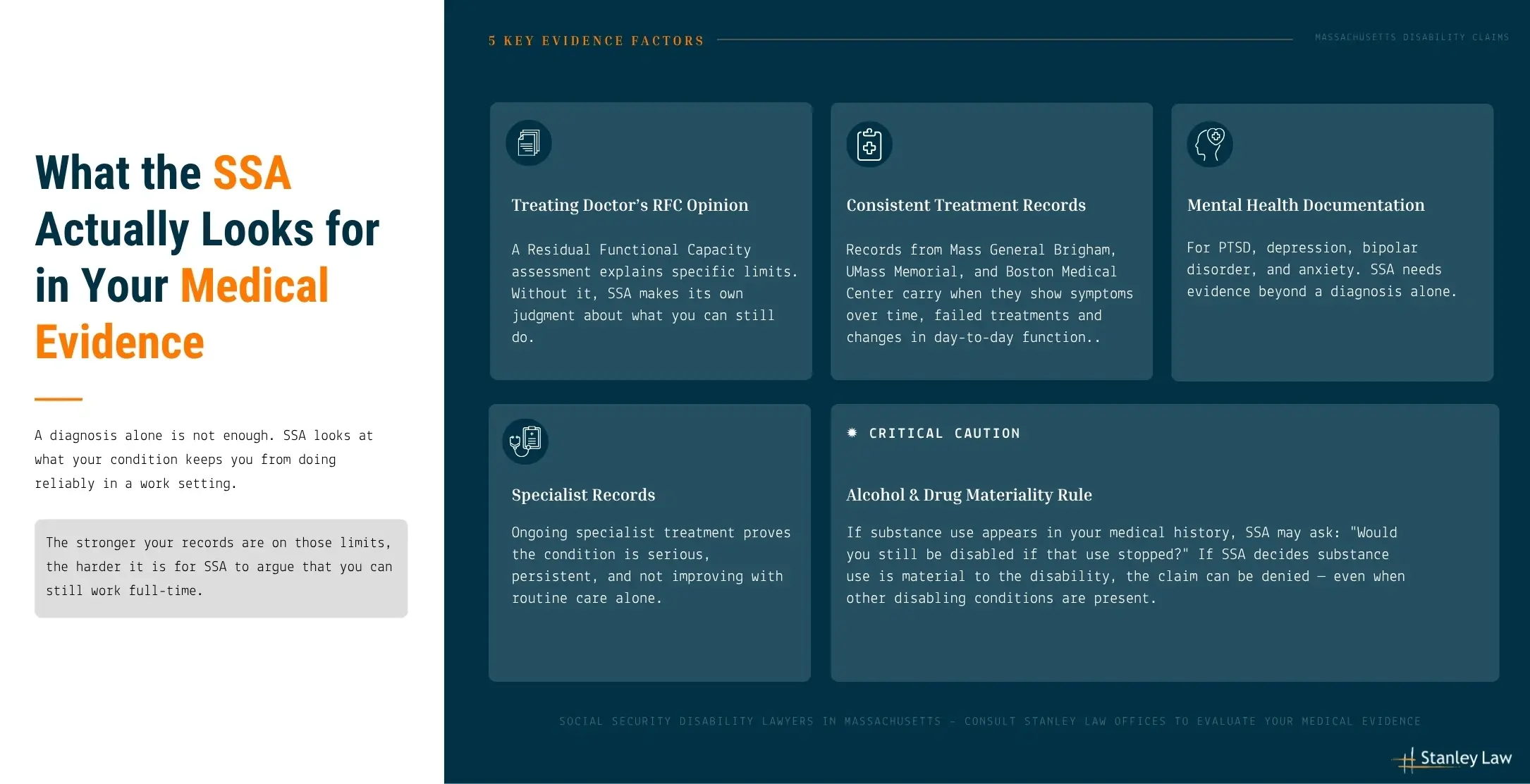
A diagnosis alone is not enough. SSA looks at what your condition keeps you from doing reliably in a work setting. The stronger your records are on those limits, the harder it is for SSA to argue that you can still work full-time.
- Why a treating doctor’s Residual Functional Capacity (RFC) opinion matters: A strong RFC assessment explains specific limits with sitting, standing, walking, lifting, concentration, attendance, and pace. Without that kind of opinion, SSA is left to make its own judgment about what you can still do.
- Why consistent treatment records matter: Records from providers such as Mass General Brigham, UMass Memorial, and Boston Medical Center are most helpful when they do more than confirm a diagnosis. Strong records show symptoms over time, failed treatment attempts, and changes in day-to-day function.
- What mental health records need to show: For Post-Traumatic Stress Disorder (PTSD), depression, bipolar disorder, and anxiety, SSA looks for evidence of how the condition affects concentration, persistence, reliability, and the ability to maintain a regular work schedule. A diagnosis by itself rarely carries the claim.
- How specialist records strengthen the file: Ongoing treatment from neurologists, orthopedic surgeons, cardiologists, or other specialists helps show that the condition is serious, persistent, and not improving with routine care alone.
Caution: alcohol and drug materiality: If substance use appears in your medical history, SSA may ask whether you would still be disabled if that use stopped. If it decides substance use is material to the disability, the claim can be denied even when other conditions are present.
What is the Activities of Daily Living Form and Why It Matters for Your Claim
The Activities of Daily Living (ADL) form is a questionnaire SSA sends to most applicants early in the process. It asks how you spend your day: whether you can cook, shop, drive, manage medications, handle finances, and maintain personal care. SSA uses your answers to assess how your condition affects real-world functioning, not just what your diagnosis says.
The form matters because inconsistencies between your ADL answers and your medical records can lead to a denial. Describe your limitations based on a typical day, not your best day. If your condition varies, note that. If a family member or caregiver helps with daily tasks, say so. What you write on the ADL form will follow your file through every stage of the process.
How the Massachusetts SSDI Application and Review Process Works
Massachusetts follows the federal SSDI process, but the medical review at the first two levels is handled by MassAbility Disability Determination Services, not by SSA decision-makers directly.
- Stage 1: Initial application: You can apply online, by phone, or through a local SSA office. MassAbility DDS reviews the medical evidence and decides whether your condition meets SSA’s disability standard. Initial decisions often take six to eight months. If approved, SSDI benefits are subject to a five-month waiting period, and back pay depends on the established onset date.
- Stage 2: Reconsideration: If your claim is denied, a different DDS examiner reviews it. This step is required before you can request a hearing. The appeal must be filed within 60 days of the denial notice. Missing that deadline can force you to start over.
- Stage 3: Administrative Law Judge (ALJ) hearing: For many claimants, the hearing is the strongest stage in the process. You can testify, submit updated evidence, and address vocational issues directly. At most hearings, SSA also calls a vocational expert (VE), an independent specialist who testifies about whether someone with your specific limitations could perform any jobs that exist in significant numbers in the national economy. How your attorney responds to that VE testimony can be decisive. Massachusetts hearings may be assigned through the Boston, Lawrence, Springfield, or Worcester hearing offices. Wait times vary. For claimants age 50 and older, the Grid Rules can sometimes support approval even without meeting a specific Listing.
- Stage 4: Appeals Council and federal court: If the ALJ denies the claim, you can request Appeals Council review. If that does not change the outcome, the next step may be filing in the U.S. District Court for the District of Massachusetts.
If you are unsure which stage your claim is at or what the next step requires, Stanley Law Offices can review your situation and help you move forward without missing a deadline.
What Massachusetts Residents Can Do Financially While Waiting for a Decision
The wait between filing and a final decision can stretch for months. Many Massachusetts residents do not realize that limited support may still be available during that period while an SSDI or SSI claim is pending.
- EAEDC, Emergency Aid to the Elderly, Disabled, and Children: EAEDC is a Massachusetts program administered through the Department of Transitional Assistance. For qualifying residents, it may provide modest cash assistance while a disability claim is still pending, which can help bridge the gap when work has stopped but SSA has not yet made a decision.
- MassHealth: MassHealth may be available to qualifying low-income Massachusetts residents during the wait. Keeping coverage in place does more than protect access to care. It also helps keep treatment records current, and consistent records are some
One more thing worth knowing: SSDI approval comes with Medicare coverage, but coverage does not begin immediately. There is a 24-month waiting period from the date you become entitled to benefits. MassHealth can help bridge that gap for qualifying residents during the interim.
If you are not sure where your claim stands or what support may be available while you wait, Stanley Law Offices can review your situation before a gap in income or treatment makes the case harder to prove.
Shannon and Jennifer were spectacular in helping me understand and proceed through the process of SSD! The entire process was simplified and uncomplicated with their help. We were able to get approval for my disability benefits very quickly without problem! I highly recommend using this law offices services! Thank you all again!
Why Massachusetts SSDI Claims Get Denied
Many Massachusetts SSDI claims are denied at the initial stage. That does not mean the condition is not real or that the claim cannot still be won. In many cases, the denial comes down to how the claim was documented and supported, not whether the claimant is genuinely unable to work.
Documentation failures that weaken the file
- No RFC opinion from a treating physician: Without a treating source opinion on functional limits, SSA is left to assess work capacity on its own, and those assumptions often do not favor the claimant.
- Diagnoses without documented functional limitations: A record that confirms the condition but does not show what it prevents the claimant from doing gives SSA little basis to approve the claim.
- Gaps in treatment history: Breaks in care can make SSA question whether the condition is as severe, persistent, or work-limiting as alleged.
- Inconsistencies between the Function Report and the medical record: When daily activity statements do not line up with the treatment file, SSA may treat the claim as less reliable even when the condition itself is legitimate.
- Inconsistencies on the Activities of Daily Living form: What you report on the ADL form must align with your medical records. If you describe your limitations as mild on the form but your treatment records show severe impairment, SSA may treat the file as unreliable. Accuracy and consistency across every document in the file matter.
Procedural mistakes that can sink the claim
- Missed MassAbility DDS consultative exam appointments: Missing a DDS exam without a valid reason can lead SSA to decide the case on an incomplete record or find that the evidence does not support disability.
- Earnings above the SGA threshold: Earning more than $1,690 per month in 2026 as a non-blind applicant triggers a denial at step one, regardless of medical severity.
A denial is not the end of the case. The appeal must be filed within 60 days to protect the original filing date and preserve any back pay tied to it. Do not restart the claim. Restarting resets the filing date and eliminates back pay tied to the original application. Use the time after a denial to strengthen the record, obtain missing RFC support, and address the exact weakness identified in the denial notice.
How Workers’ Compensation and SSDI Interact for Massachusetts Claimants
Workers’ compensation and SSDI are separate programs, but they often apply to the same person after a serious work injury. When both benefits run at the same time, the workers’ compensation claim can directly affect how much the SSA pays each month on the SSDI side.
| Issue | What It Means for Your Claim |
|---|---|
| Offset rule | If combined workers’ compensation and SSDI benefits exceed 80 percent of your average current earnings, SSA reduces the SSDI payment to bring the total back under that limit. The reduction is taken from SSDI, not workers’ compensation. |
| Lump-sum settlements | A lump-sum workers’ compensation settlement is prorated over time for offset purposes. If the settlement is not structured carefully, the SSDI reduction can last much longer than the claimant expected. |
| Settlement language | The wording in the settlement documents can affect how SSA calculates the offset. Weak drafting can extend the reduction and lower SSDI payments for months or even years. |
| Coordination between claims | When workers’ compensation and SSDI are handled separately, a decision in one case can quietly damage the other. The claimant often does not realize the problem until the SSDI payment arrives lower than expected. |
The main risk is not just receiving both benefits. It is receiving them without understanding how the offset will be calculated. When the workers’ compensation case is structured with the SSDI claim in mind from the start, it is often easier to protect the long-term value of both.
Common Mistakes That Weaken a Massachusetts SSDI Claim & How to Avoid Them
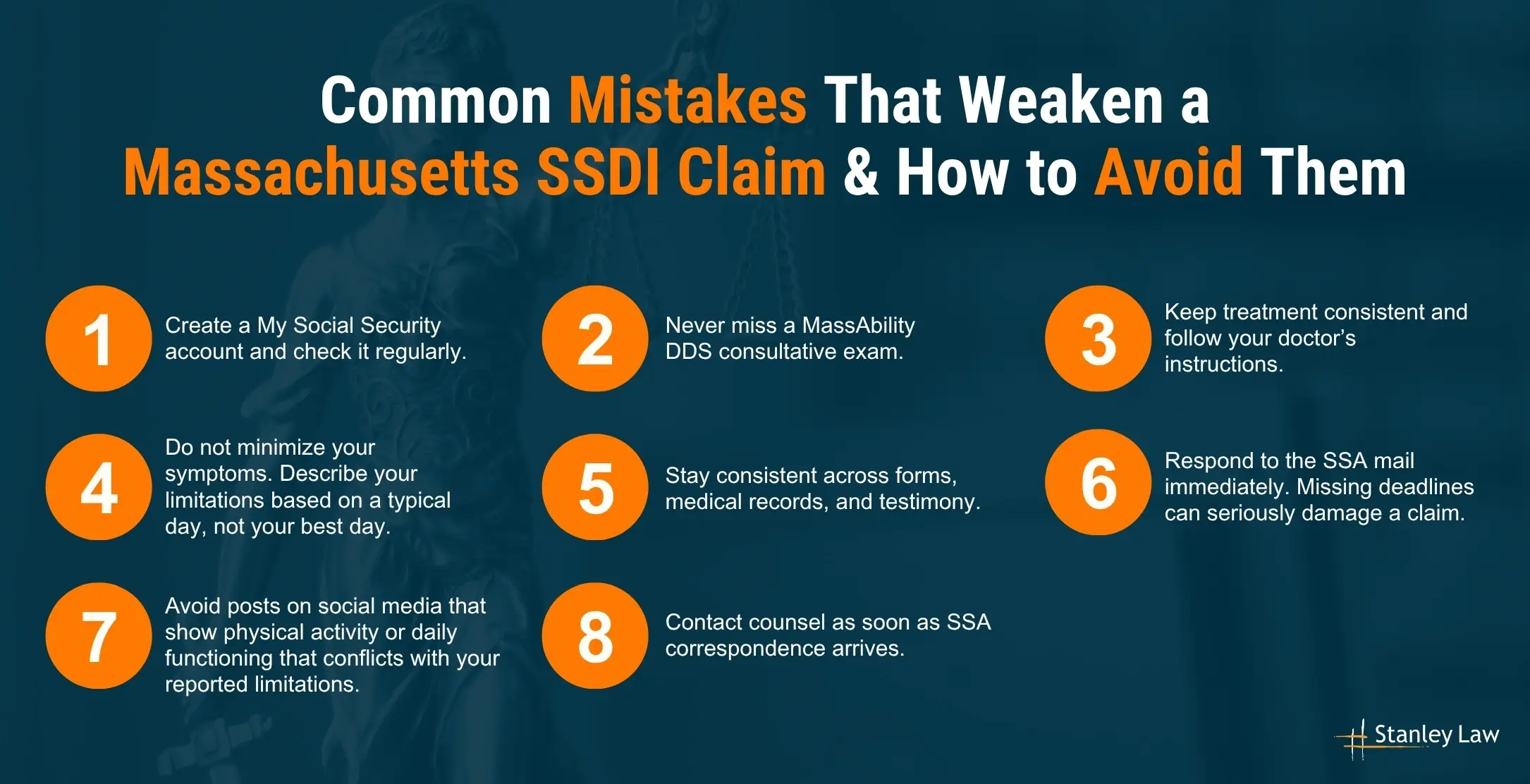
Many SSDI claims are weakened by avoidable mistakes, not because the condition is not serious, but because the claimant did not realize what SSA was watching.
- Create a My Social Security account and check it regularly. This account lets you verify your earnings record, track your application status, and catch errors in your work history before they affect your claim.
- Never miss a MassAbility DDS consultative exam. SSA arranges and pays for this appointment, and missing it without a valid reason can lead to a decision on an incomplete record. If you need to reschedule, contact SSA immediately.
- Keep treatment consistent and follow your doctor’s instructions.
- Do not minimize your symptoms. Describe your limitations based on a typical day, not your best day.
- Stay consistent across forms, medical records, and testimony.
- Respond to the SSA mail immediately. Missing deadlines can seriously damage a claim.
- Avoid posts on social media that show physical activity or daily functioning that conflicts with your reported limitations. SSA and administrative law judges do review this during hearings.
- Contact counsel as soon as SSA correspondence arrives.
Most of these mistakes are preventable. Small details often make a big difference in a Massachusetts SSDI claim.
Get Started: Speak With a Massachusetts Social Security Disability Lawyer Today
If a medical condition is affecting your ability to work, the next step is finding out where your claim stands before more time is lost. Work credits can expire, deadlines can pass, and treatment gaps can weaken the record.
- Call Stanley Law Offices at 1-800-608-3333.
- Gather any SSA letters, denial notices, or other correspondence.
- List your current treating providers and medications.
- Write down your job history for the past 15 years.
- Note any workers’ compensation claim, including the insurer, claim status, and settlement discussions.
We serve clients across Massachusetts by phone and virtual appointment. There is no upfront cost and no fee unless benefits are awarded.
The team at Stanley Law is there for you, by phone and virtual appointment, whenever you need guidance. You never know what’s just around the corner, so you need to know what to do next. Contact us now.
Excellent experience. I am glad I worked with Stanley Law and in particular with Shannon who has been pleasure to work with. She got my SSDI application approved within days.
Frequently Asked Questions About Social Security Disability in Massachusetts
What Is the Five-Year Rule for Social Security Disability?
The five-year rule refers to expedited reinstatement. If your SSDI ended because of work and you become unable to work again within five years, you may restart benefits without filing a new application.
How Long Does It Take to Get SSDI Approved in Massachusetts?
It depends on the stage. Initial decisions through MassAbility DDS take six to eight months. If the claim is denied and proceeds to an ALJ hearing, the full process can take much longer, depending on the Boston, Lawrence, or Springfield backlog.
What Happens to My SSDI Benefits if I Go Back to Work?
If you go back to work, your SSDI benefits continue during the Trial Work Period. You can test work for nine months before SSA decides whether your earnings are too high for ongoing benefits.
Can a Child Receive Disability Benefits Based on a Parent’s SSDI Record?
Yes. A child can receive disability benefits based on a parent’s SSDI record. For a disabled adult child, the disability generally must begin before age 22, and other SSA eligibility rules still apply.
What Is the Date Last Insured and Why Does It Matter?
The Date Last Insured is the last date you still meet SSDI insured-status rules. It matters because you must prove your disability began on or before that date.
What Is the Difference Between SSDI and SSI in Massachusetts?
The difference between SSDI and SSI in Massachusetts is that SSDI is based on work credits, while SSI is based on disability plus limited income and resources. Massachusetts may also add a state supplement to SSI.
What Is the Blue Book and Does My Condition Qualify?
The Blue Book is SSA’s official Listing of Impairments – a catalog of medical conditions and severity criteria that can qualify someone for disability benefits. If your condition matches a listing and you meet the required criteria, SSA can approve your claim at step three of its evaluation without needing to separately assess your ability to work. If your condition is not listed, you can still qualify if the evidence shows your impairment is medically equivalent to a listed condition, or if your functional limitations prevent any kind of substantial work.
What Is a Consultative Exam in an SSDI Case?
A consultative examination (CE) is a medical appointment scheduled by SSA, usually when your own treatment records are incomplete, outdated, or insufficient to support a disability decision. SSA selects and pays for the independent examiner. Attending is important – missing the appointment without a valid reason can lead to SSA deciding your case on an incomplete record, which rarely favors the claimant.
What Is a Consultative Exam in an SSDI Case?
Yes. For claimants age 50 and older, SSA’s Grid Rules, formally called the Medical-Vocational Guidelines, can support approval even when no listed impairment is met. The Grid Rules factor in your age, education, work history, and residual functional capacity to assess whether you can realistically transition to other work. For claimants age 55 and older, the threshold becomes even more favorable. An ALJ hearing is often where Grid Rule arguments are most effectively made.
