





If your condition keeps you from working and you are not sure where to start, or a denial letter has already arrived, you are not alone in finding this process confusing. The Social Security Administration reviews hundreds of thousands of claims each year in Connecticut and across the country, and many valid claims are denied on the first try simply because the record was incomplete or the evidence was not presented the way the SSA needs to see it.
At Stanley Law Offices, Attorney Shannon Doan and our Connecticut Social Security disability lawyers team have 90 years of combined legal experience helping residents with SSDI and SSI applications, denied claims, appeal strategy, and hearings before an Administrative Law Judge. We serve clients throughout Connecticut and across all 50 states, with consultations available by phone or online. Home or hospital visits are available when needed.
Here’s why hiring Stanley Law Offices makes the difference:
- 45+ years fighting for the injured
- 4.7 rating across 900+ verified reviews
- Millions recovered in verdicts & settlements every year
- Available 24/7
- No recovery, no fee
Call 1-800-608-3333 or request a free case evaluation today – there is no cost to speak with us and no fee unless your claim is approved.
How a Connecticut Social Security Disability Lawyer Can Help
The SSA process has multiple stages, and a misstep at any one of them can weaken or delay a legitimate claim. Whether you are filing for the first time, responding to a denial, or preparing for a hearing, having an attorney involved means fewer gaps in your record and fewer missed deadlines.
- First-time applications: We help you understand what the SSA requires, identify gaps in your medical record before you file, and make sure you are prepared to submit a complete and accurate application from the start. The most common early problems, such as missing information, forms that conflict with medical records, and an incomplete picture of your functional limitations, are addressed before the claim reaches a reviewer at Connecticut’s Disability Determination Services (DDS).
- After a denial: A disability appeal lawyer in Connecticut can review the decision notice to identify exactly what the SSA found lacking, gather stronger evidence, and build the argument for the next stage. Most successful SSDI claims are won at the hearing level, not the initial application stage, so how the record is built during the appeal matters.
- Administrative Law Judge (ALJ): You are prepared for testimony before an ALJ, the federal official who conducts disability hearings at the Office of Hearings Operations in Hartford or New Haven, the two hearing venues that serve Connecticut claimants. An ALJ hearing is not a courtroom trial, but how you explain your limitations and how your medical evidence is presented directly affects the outcome.
- Workers’ compensation coordination: When a workplace injury is also involved, workers’ compensation and SSDI require coordinated handling. The way a workers’ comp settlement is structured can affect how Social Security calculates any benefit offset, which is why managing both claims together matters.
Who Can Qualify for SSDI or SSI Benefits in Connecticut
To qualify for SSDI or SSI in Connecticut, your condition must be medically documented, must prevent you from doing substantial paid work, and must be expected to last at least 12 months or result in death. Which program, SSDI or SSI, applies depends on your work history and financial situation. Learn what SSDI is.
- Social Security Disability Insurance (SSDI) is funded by the payroll taxes you paid during your working years. To qualify, most applicants aged 31 or older need work credits from at least five of the last ten years in Social Security-covered employment. The monthly payment amount is calculated from your lifetime earnings record.
- Supplemental Security Income (SSI) does not require a work history. Instead, it is based on financial need, limited income, and limited resources. In 2026, the federal SSI base rate is $967 per month for individuals. Connecticut also provides a State Supplement on top of that federal amount for qualifying recipients.
You can qualify for both at the same time, called concurrent benefits, if your SSDI payment is low enough that SSI’s income and resource rules are also met.
The Social Security Fairness Act, signed into law in January 2025, eliminated two rules, the Windfall Elimination Provision (WEP) and the Government Pension Offset (GPO), that had previously reduced Social Security benefits for people who also receive a public pension. This directly affects Connecticut teachers, state employees, and municipal workers who were impacted by those reductions. This change applies to Social Security retirement and survivor benefits, not SSDI, so its impact depends on which program or combination of programs applies to your situation. If that applies to you, your benefit amount may have changed and is worth reviewing.
How the SSA Decides Whether You Qualify
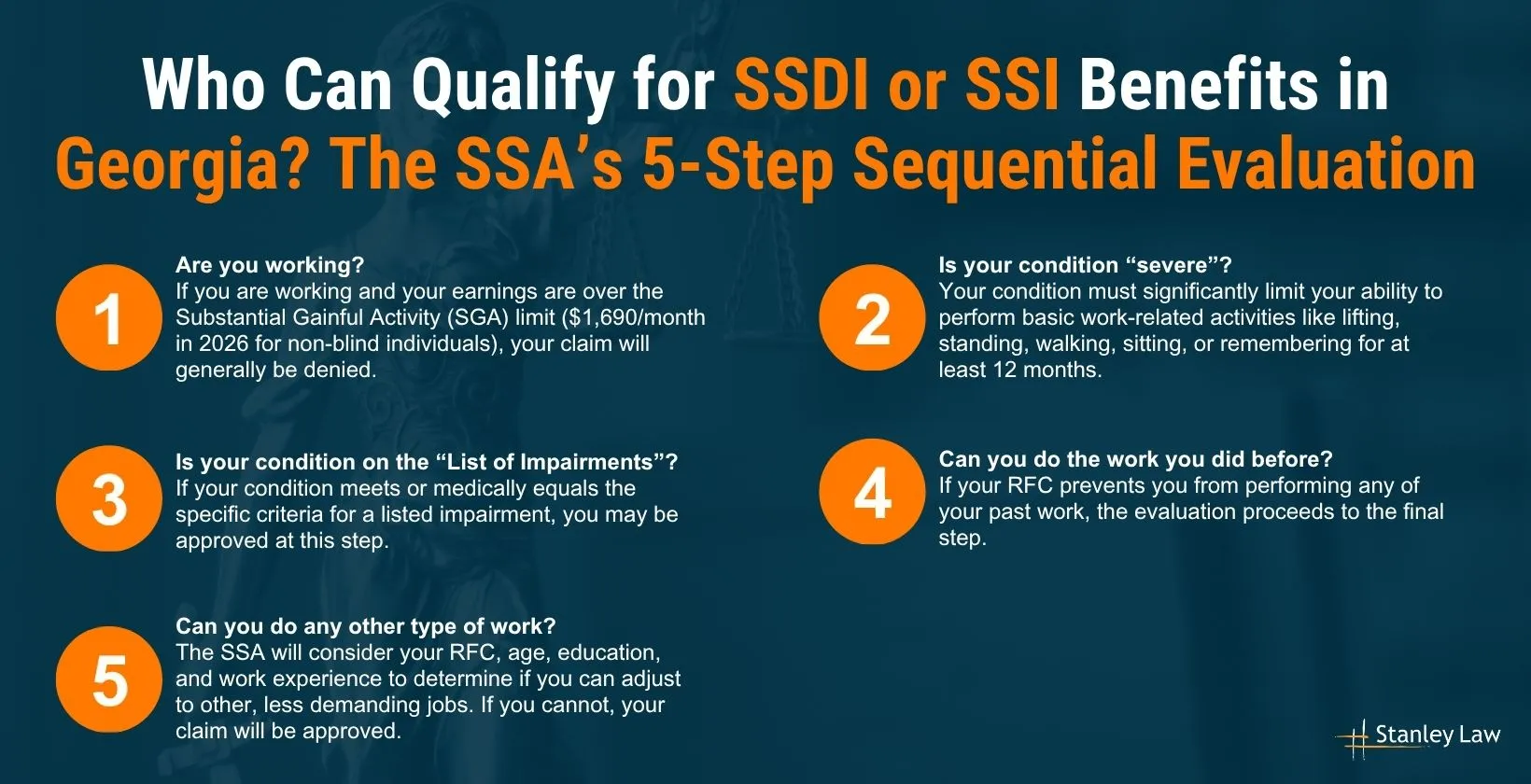
The SSA uses a five-step evaluation process to decide whether you meet the medical standard for disability:
- Are you working? If your earnings exceed the Substantial Gainful Activity (SGA) threshold – $1,690 per month for most applicants in 2026, the SSA may find you not disabled, regardless of your medical condition.
- Is your condition severe? It must significantly limit your ability to perform basic work functions such as standing, concentrating, or following instructions.
- Does your condition meet a Listing? The SSA’s Blue Book lists specific impairments that automatically qualify if the medical criteria are met. If your condition is not listed, the SSA continues to the next steps.
- Can you do your past work? If you can still perform any job you held in the past 15 years, the SSA may deny the claim.
- Can you adjust to any other work? The SSA considers your age, education, work history, and Residual Functional Capacity (RFC), a formal assessment of what you can still do despite your condition, to decide whether any other work exists that you could perform.
Your initial claim is evaluated by Connecticut’s Disability Determination Services, which applies federal SSA standards to determine eligibility.
Why Disability Claims Get Denied and What to Do Next
Meeting the eligibility standard is necessary, but it is not enough on its own. Many claims that should qualify are denied the first time because of how the case was built and presented, not because the condition failed to meet the medical standard.
The most common reasons Connecticut disability claims are denied include:
- Insufficient medical evidence: The record shows a diagnosis, but does not clearly document how the condition limits your ability to work. A diagnosis alone is not enough; the SSA needs functional detail.
- Incomplete or inconsistent application: Errors, omissions, or contradictions between forms and medical records can undermine the claim during SSA review, even when the underlying condition is genuine.
- Weak proof of functional limitations: The SSA needs to see how your condition affects your ability to sit, stand, concentrate, lift, and carry out basic tasks, not just that a condition exists. This is often the gap between a denied claim and an approved one.
- Earning above the SGA limit: Any income the SSA interprets as substantial work activity can result in an automatic denial, regardless of your medical condition.
- Missed SSA notices or requests: Failing to respond to SSA correspondence during review can seriously damage or end the claim in progress.
- Insufficient work history for SSDI: If your earnings record does not satisfy the work credit requirement, SSDI may not be available, though SSI may still apply.
If your claim has been denied, the deadline matters. A denied disability claim attorney in Connecticut can review the decision, identify what the SSA found lacking, gather stronger evidence, and file a timely appeal before that window closes.
Why SSA Deadlines, Paperwork, and Missed Notices Can Hurt Your Claim
A strong medical record alone is not enough to carry a Connecticut disability claim. Many legitimate claims stall or fail during review because of missed forms, unanswered SSA notices, or skipped consultative exams, not because the condition fails to qualify. Administrative problems are responsible for more denials than most applicants expect. Understanding what to expect throughout the disability process can help you stay ahead of these issues.
Common claim management problems that can hurt your case:
- Missed consultative exam appointments: The SSA may schedule an exam with one of its own medical providers. If you do not attend without an acceptable reason, the SSA can decide your claim on the existing record, which is rarely enough, or find you not disabled.
- Unanswered SSA notices: Requests for additional records, updates, or scheduling notices that go without a response can delay the claim or leave critical gaps in the file.
- Incomplete or late form responses: Function reports and questionnaires must be completed accurately and returned on time. Partial or late responses create avoidable gaps that the SSA uses against the claim.
- Inconsistent statements: When your function reports, work history, or daily activity descriptions do not align with your medical records, the SSA may treat the claim as less credible even when the condition is serious.
- Unexplained treatment gaps: If your treatment history has breaks, the SSA may question the severity or persistence of the condition without an explanation in the record.
The appeal deadline is not flexible. Most appeals must be filed within 60 days of the notice date (plus five days for mail delivery). Missing it means starting over with a new application, which resets the onset date and eliminates any potential back pay from the original filing.
A Connecticut SSD lawyer can manage communications with the SSA, track deadlines, prepare form responses, and help make sure nothing falls through the cracks.
What Evidence Can Strengthen Your Disability Case
The SSA does not approve claims on a diagnosis alone. What matters is whether your medical evidence clearly shows why your condition prevents you from maintaining substantial work activity on a consistent, ongoing basis.
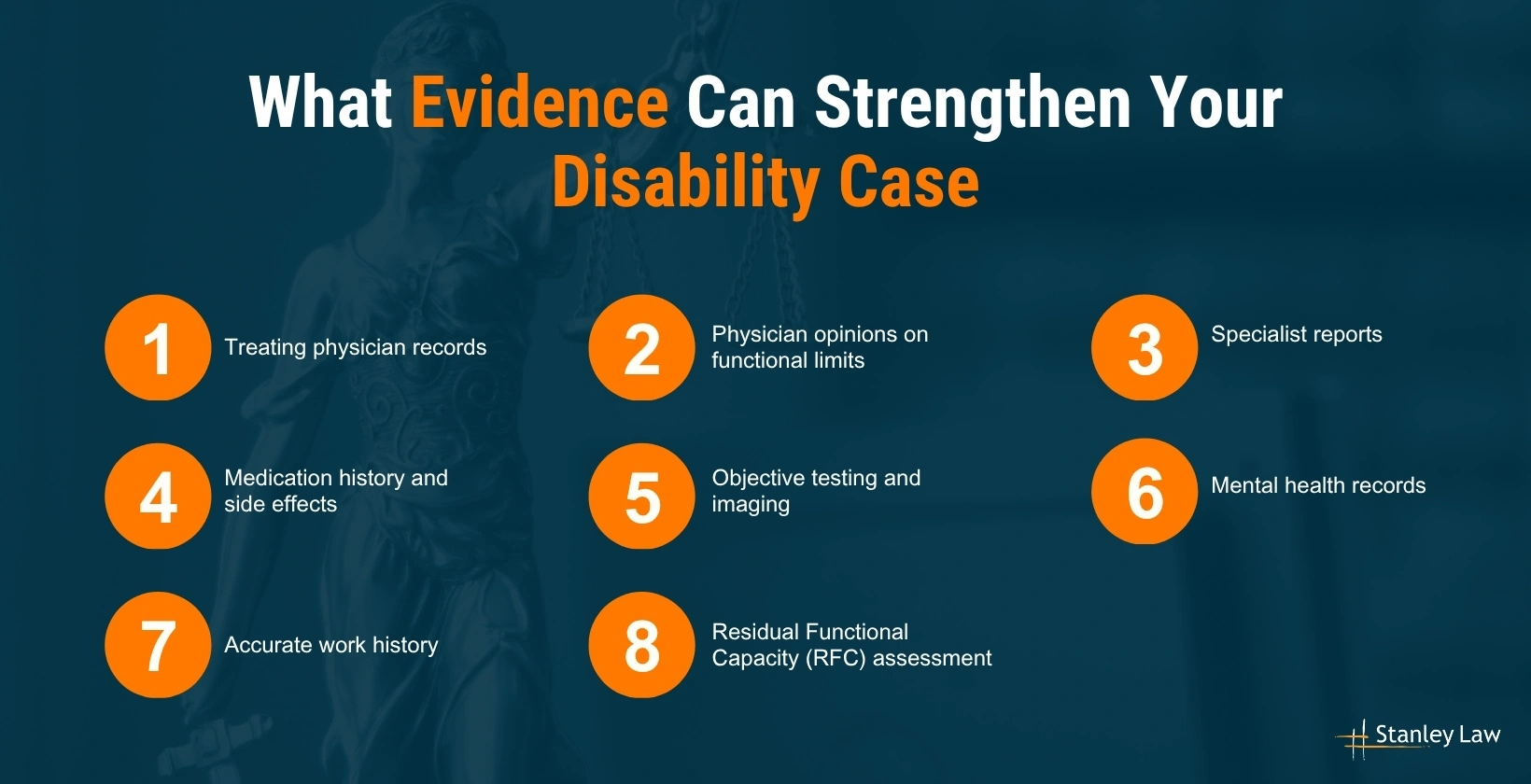
Key evidence that can strengthen your disability case:
- Treating physician records: Consistent, ongoing clinical notes that document your condition over time, not just a single visit, carry significant weight. Gaps in treatment raise questions; steady records build credibility.
- Physician opinions on functional limits: Written statements from your doctors describing what you can and cannot do physically or cognitively. These opinions are often the difference between a denied and approved claim, particularly at the ALJ hearing stage.
- Specialist reports: Evaluations from neurologists, orthopedic surgeons, psychiatrists, cardiologists, or other relevant providers that corroborate and add clinical depth to the primary diagnosis.
- Medication history and side effects: A documented record of prescribed medications, dosage changes, and treatment responses, including side effects like fatigue, cognitive fog, or pain that affect daily function.
- Objective testing and imaging: X-rays, MRIs, lab results, nerve conduction studies, and other objective findings that support reported symptoms and cannot be easily disputed.
- Mental health records: Documentation of anxiety, depression, Post-Traumatic Stress Disorder (PTSD), cognitive impairment, or other mental conditions that affect concentration, persistence, or the ability to maintain a regular work schedule. Mental impairments are frequently underrepresented in disability claims.
- Accurate work history: A clear, detailed record of past job duties, the physical and mental demands of those roles, and how your condition affects your ability to perform that work or adjust to any other work.
- RFC assessment: The SSA will prepare its own RFC evaluation. Having your treating physician complete their own detailed RFC form, one that reflects your actual daily limitations, gives the ALJ a clinically supported counterpoint to the SSA’s assessment. This is one of the most underused tools in disability claims.
For more on building a strong record, see our tips for building a strong disability case.
Other Benefits That May Come With SSDI Approval
For many Connecticut residents, approval also affects healthcare access, family benefits, and how other programs interact with the SSDI award. See a full breakdown of benefits available after SSDI approval.
- Medicare access: Most SSDI recipients become eligible for Medicare after 24 months of disability entitlement, regardless of age. The 24-month clock starts from your entitlement date, which is typically five months after your established onset date. If there is a gap between your approval date and when Medicare coverage begins, healthcare.gov can help you find coverage in the interim.
- Family and dependent benefits: A spouse, qualifying ex-spouse, or dependent child may be eligible for auxiliary benefits based on your Social Security earnings record. An unmarried child under 18 or under 22 if disabled before that age may also qualify.
- Back pay: If your claim is approved, you may receive past-due benefits going back to your established onset date, subject to the standard five-month waiting period that applies to SSDI. The further back the onset date, the more significant the back pay can be, which is one reason establishing the correct onset date matters from the very beginning of the claim. Learn more about what happens after a fully favorable disability decision.
- Connecticut State Supplement: Connecticut supplements the federal SSI payment for qualifying recipients through a state-funded addition to monthly benefits. This is separate from the federal SSI rate and is not available in every state.
- Workers’ compensation interaction: Receiving both workers’ compensation and SSDI is possible, but the SSA may reduce SSDI payments if the combined total exceeds 80% of your average pre-disability earnings – a rule known as the workers’ compensation offset. How a workers’ comp settlement is structured can directly affect how that offset is calculated, which is one reason coordinated handling of both claims matters when a workplace injury is involved.
- Tax considerations. SSDI benefits may be partially taxable at the federal level, depending on your total household income. Connecticut does not tax Social Security income at the state level.
Why Choose Stanley Law Offices for Your Connecticut Disability Claim
When a disability claim becomes more complicated, practical judgment and responsive communication matter. What sets us apart:
- An attorney who knows the SSA from the inside: Attorney Shannon Doan spent nearly 19 years working within the Social Security Administration itself, holding positions as Attorney Advisor, Senior Attorney Advisor, and Attorney Advisor/Quality Review Specialist, among others. She also served on SSA national training cadres and reviewed disability decisions as part of SSA’s quality review process. That background means she understands how the SSA evaluates claims, where records get questioned, and what a well-prepared file actually needs to contain.
- Disability representation across all 50 states: Stanley Law Offices handles Social Security disability claims nationwide, which means our team is experienced with SSA processes across different hearing offices, including the Hartford and New Haven hearing offices that serve Connecticut claimants.
- Practical experience across the full claims process: Our team handles matters at every stage – initial applications, reconsiderations, ALJ hearings, Appeals Council reviews, and workers’ comp coordination when a workplace injury is part of the picture.
- Clear communication throughout: Clients receive updates and practical answers at each stage of the process. You will not be left guessing what a notice means or what needs to happen next. Read client testimonials.
- No upfront cost: SSDI lawyer fees are regulated by the SSA. Our fee is 25% of any past-due benefits awarded, with a cap currently set at $9,200, and is collected only if your claim is approved. There is no charge to speak with us and nothing owed if the claim does not succeed.

Talk to Stanley Law Offices About Your Connecticut Disability Claim Today
Living without income while a disability claim moves through the SSA process is hard. The process takes time, and when you are already managing a serious medical condition, the paperwork, the deadlines, and the uncertainty can feel like too much.
We help Connecticut residents with SSDI and SSI claims, denials, appeals, and hearings. We also handle Social Security disability claims in New York, New Jersey, and Georgia.
Consultations are available by phone or online, and home or hospital visits can be arranged when travel is not possible.
If we take your case, you pay nothing unless benefits are approved.
Make the first call to Stanley Law Offices or request your free case evaluation today.
Frequently Asked Questions About Connecticut Disability Lawyers
Is It Easier to Get Social Security Disability With a Lawyer?
Yes, represented claimants statistically have higher approval rates, particularly at the ALJ hearing stage. A lawyer helps ensure the medical record is complete, deadlines are met, and testimony is prepared before the hearing. The SSA allows legal representation at every stage of the disability process, including before the initial application is filed.
What Should You Avoid Saying When Applying for Social Security Disability?
When applying for Social Security disability, avoid overstating what you can do on a good day, understating the severity of your symptoms, or making statements that conflict with your forms, work history, or medical records. Three specific problems come up often: describing your activity level as higher than your medical records support, saying you “can get around fine” when your records document significant mobility limitations, and minimizing pain or fatigue because you do not want to seem like you are complaining. The SSA compares every statement you make against your full claim file, so consistency across all forms, exams, and testimony matters throughout the process.
What Is the 5-Year Rule for Social Security Disability?
The five-year rule means that if you were previously approved for SSDI, stopped receiving benefits because you returned to work, and later became disabled again, you may be able to restart your SSDI payments without having to re-establish your insured status through new work credits, as long as the new disability begins within five years of when your prior benefits ended. This is known as the re-entitlement period. It can significantly shorten the process for someone who previously qualified and has since deteriorated or developed a new disabling condition.
How Much Can Social Security Disability Pay in Connecticut?
For SSDI, the monthly payment is calculated from your lifetime earnings record, specifically, your average indexed monthly earnings from years when you paid Social Security taxes. There is no fixed amount; it varies by individual. For SSI, the 2025 federal base rate is $967 per month for individuals, with Connecticut adding a state supplement on top of that for qualifying recipients. SSDI recipients also become eligible for Medicare after 24 months, and Connecticut does not tax Social Security income at the state level, which affects the net value of the benefit.
Can You Get Workers’ Compensation and Social Security Disability at the Same Time?
Yes. You can receive both workers’ compensation and SSDI at the same time. The SSA may reduce your SSDI payment if combined benefits exceed 80% of your average pre-disability earnings, and how a settlement is structured affects that calculation. If both apply to your situation, handling them together rather than separately is worth discussing with your attorney.
Can I Speak With a Disability Lawyer for Free Before I File a Claim?
Yes. Stanley Law Offices offers free consultations for Connecticut residents at any stage, including before the initial application is filed, which can help you identify and address gaps in your medical record or work history before the SSA ever sees the claim.
How Do I Choose the Right Social Security Disability Attorney in Connecticut?
Look for a lawyer or firm with direct SSDI and SSI experience across multiple claim stages, not just initial filings. Specific things worth asking about: their experience with denied claims and appeals, whether they have handled hearings before an ALJ, how they communicate with clients during the process, and what their fee structure looks like. If workers’ compensation is part of your situation, ask whether they have experience handling both claims together. A free initial consultation should give you a clear sense of whether the attorney understands your specific situation before you commit to working with them.