





If you can no longer work and need disability benefits to stay afloat, knowing how Ohio handles these claims and how to navigate them is what separates an approval from another denial. The state ranked 44th nationally for initial Social Security Disability Insurance (SSDI) approvals in 2024, according to the Social Security Administration (SSA) Annual Statistical Report. If you have already received a denied Social Security Disability(SSD), the 60-day appeal clock is running, and reconsideration approvals are only 10 to 15 percent in Ohio cases. Restating the same application does not change the outcome.
That is where a social security disability lawyer in Ohio makes the difference. Shannon Doan spent 19 years as an attorney inside the SSA and now brings that insider knowledge to every case she handles at Stanley Law Offices. She knows how examiners evaluate claims and what evidence moves a case from denial to approval. Here is what we bring to your case:
- 45+ years fighting for the injured
- 4.7 rating across 900+ verified reviews
- Millions recovered in verdicts & settlements every year
- Available 24/7
- No recovery, no fee
We cover initial applications through federal appeals across Ohio and all 50 states. Call 1-800-608-3333 or request a free case evaluation online today.
What Are SSDI Approval Rates by the Ohio Hearing Office?
Reconsideration approves roughly 10 to 15 percent of Ohio claims, making it a procedural requirement more than a genuine second chance. Most Ohio claimants do not win until the administrative law judge (ALJ) hearing level, and the hearing office and the judge who handles the case matter more than most claimants realize.
Six hearing offices serve the state: Akron, Cincinnati, Cleveland, Columbus, Dayton, and Toledo. Columbus runs above the national average at 57.4 percent. Dayton sits at 63.3 percent. Cleveland comes in at 53.1 percent overall, but individual judges within that office range from 18 percent approval to well above average. The office assignment alone does not determine the outcome. The judge assignment does.
Hearing office and judge-level data are publicly available through the SSA ALJ Disposition Dataset. Stanley Law Offices reviews that data for every Ohio case and prepares accordingly.
I had an excellent experience working with Shannon Doan at Stanley Law Offices. From the very beginning, Shannon approached my case with professionalism, clarity, and real care. Navigating the Social Security process can be overwhelming, but Shannon made sure I understood each step and always knew what to expect. What stood out most was her attention to detail and persistence. She was thorough in preparing my case, responsive when I had questions, and truly committed to advocating on my behalf. I never felt like just another case. Thanks to Shannon’s expertise and dedication, I felt confident throughout the process and grateful for the outcome. I highly recommend Shannon Doan and Stanley Law Offices to anyone in need of strong, reliable legal representation.
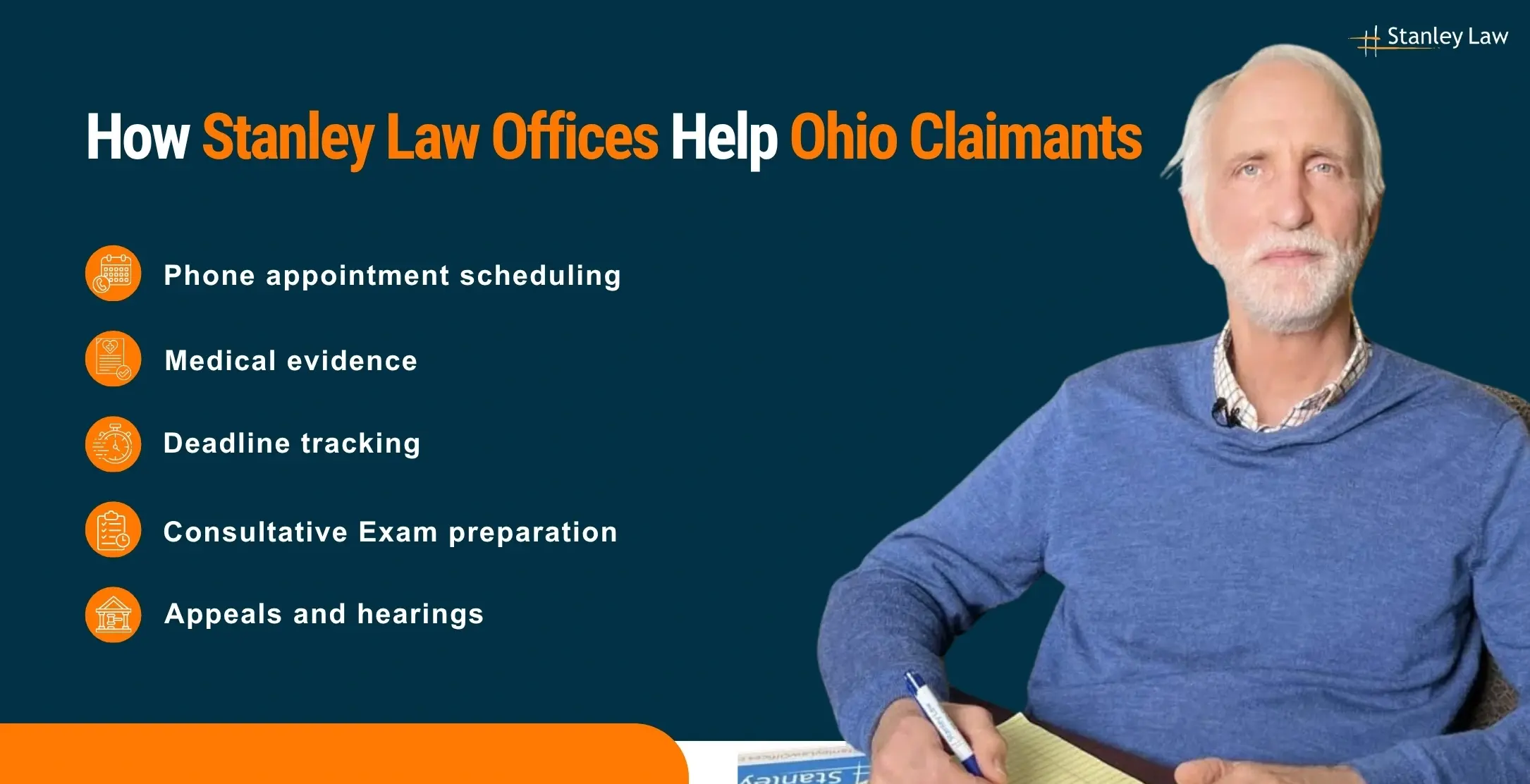
How Stanley Law Offices Help Ohio Claimants
From the first phone call to the final decision, Stanley Law Offices manages every stage of your Ohio Social Security Disability Insurance (SSDI) or Supplemental Security Income (SSI) case so nothing falls through the cracks.
- Phone appointment scheduling: We schedule your phone appointment with SSA and walk you through what is required so your application is complete and accurate from the start.
- Medical evidence: We gather records from your treating providers and identify the functional limitation documentation the SSA needs.
- Deadline tracking: We monitor every SSA notice, response window, and appeal deadline.
- Consultative Exam preparation: We prepare you for any SSA-scheduled exam, so you know what to expect and how to respond accurately.
- Appeals and hearings: We handle reconsideration, ALJ hearing representation (including preparation for vocational expert testimony), Appeals Council review, and federal court, if needed.
Not ready to call yet? Shannon’s free SSDI webinar walks you through what to expect at every stage of the process.
Who Qualifies for SSDI or SSI
SSDI is a federal program with the same eligibility rules in every state. Most claimants need 40 work credits, with 20 earned in the 10 years before the disability onset date. In 2026, one credit equals $1,890 in covered earnings. Younger workers may qualify with fewer.
SSI requires no work history. It is based on financial need. Both programs can run simultaneously when SSDI payments fall below SSI income thresholds.
Two additional benefit types apply in specific circumstances: disabled adult children may qualify for benefits on a parent’s Social Security record if the disability began before age 22, and widows or widowers with disabilities may qualify between ages 50 and 60 based on their spouse’s record. If you are unsure which applies, call before you file.
The SSA’s 5-Step Sequential Evaluation
The SSA runs every claim through five questions in order. A no at any step ends the review.
Step 1: Are you working above the substantial gainful activity (SGA) limit?
Earning more than $1,690 per month in 2026 results in denial at this step. The limit for blind applicants is $2,830 per month.
Step 2: Is your condition severe?
It must significantly limit basic work activities such as standing, sitting, lifting, or concentrating.
Step 3: Does your condition meet a Blue Book listing?
Ohio Disability Determination Operations reviews this at the state level. A match here can mean approval without going further.
Step 4: Can you do your past work?
The SSA evaluates whether your Residual Functional Capacity (RFC) allows you to return to any job held in the last 15 years.
Step 5: Can you do any other work?
The SSA must show that other jobs exist in significant numbers given your age, education, and RFC. Claimants over 50 may qualify under the Medical-Vocational Grid Rules even without a Blue Book match.
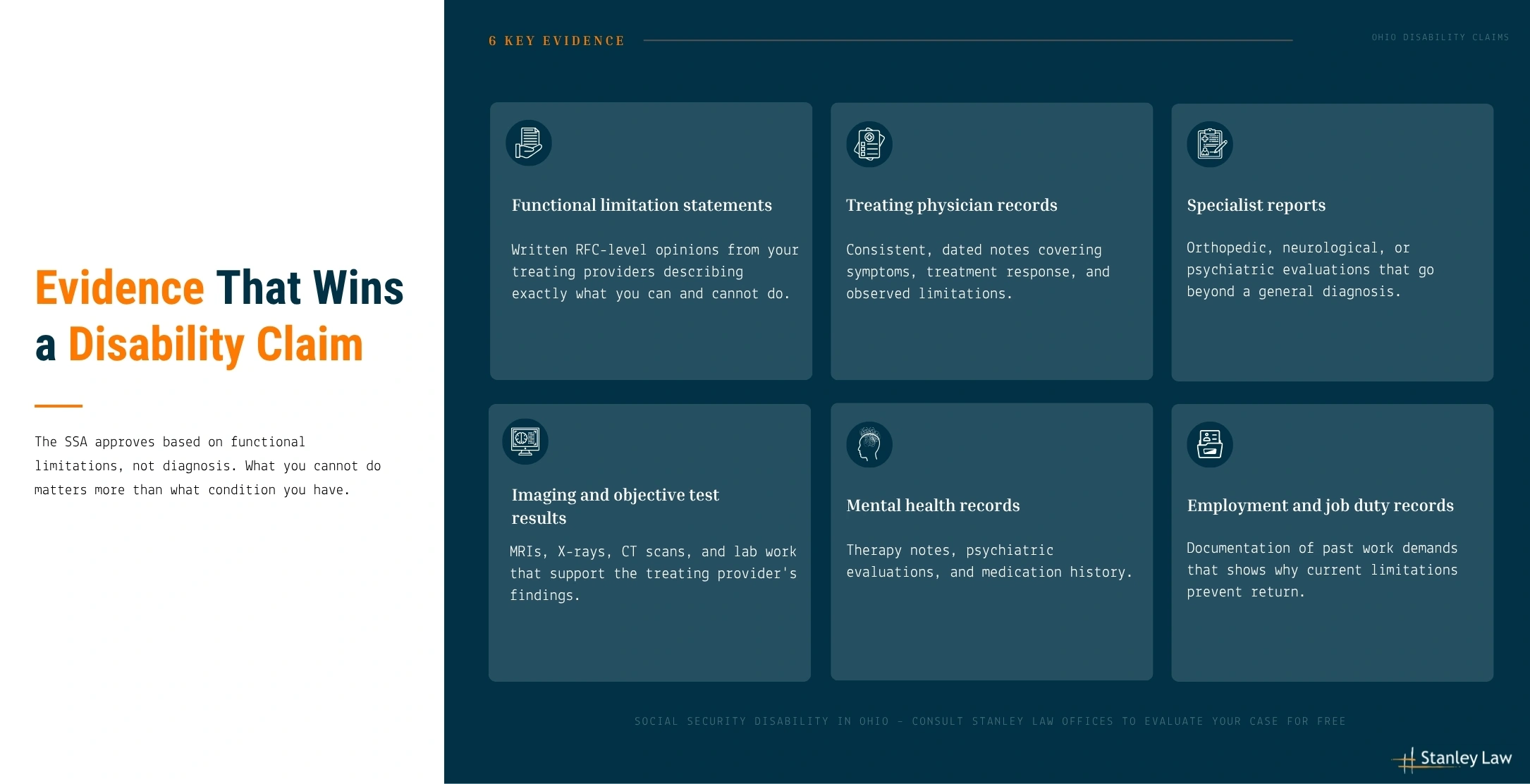
Evidence That Wins a Disability Claim
The SSA approves based on functional limitations, not diagnosis. What you cannot do matters more than what condition you have.
- Functional limitation statements: Written RFC-level opinions from your treating providers describing exactly what you can and cannot do. This is the single most important document in any claim.
- Treating physician records: Consistent, dated notes covering symptoms, treatment response, and observed limitations.
- Specialist reports: Orthopedic, neurological, or psychiatric evaluations that go beyond a general diagnosis.
- Imaging and objective test results: MRIs, X-rays, CT scans, and lab work that support the treating provider’s findings.
- Mental health records: Therapy notes, psychiatric evaluations, and medication history.
- Employment and job duty records: Documentation of past work demands that shows why current limitations prevent return.
One step most Ohio claimants miss: apply for Ohio Benefits and Medicaid at the same time as your SSDI application. SSDI processing takes months. Medicaid protects your healthcare coverage during that gap.
For a full breakdown of what makes a claim strong from the start, see our 10 tips for building a strong Social Security disability case.
Common Reasons Disability Claims Are Denied
Most Ohio claims are denied for the same preventable reasons.
- Insufficient medical evidence: A diagnosis exists, but no RFC statement documents how it limits function. Without that, the SSA has no path to approval.
- Incomplete or inconsistent application: Gaps in work history, inconsistent symptom descriptions, or missing provider information give examiners grounds to question the record.
- Earnings above the SGA limit: Earning more than $1,690 per month in 2026 closes the claim at Step 1 regardless of medical severity.
- Failure to follow prescribed treatment: Missed appointments or stopped medication without a documented medical reason signals to the SSA that the condition is manageable.
- Missed SSA deadlines or Consultative Exams: Noncompliance results in denial based on failure to cooperate, not medical evidence.
Ohio’s 10-15% reconsideration approval rate means the specific denial reasons from the initial decision must be directly addressed in the appeal. A denial starts a 60-day clock. Contact us before that window closes.
What Happens After You File in Ohio
Choosing the right representation at the right stage of your Ohio claim directly affects the outcome. Here is what Stanley Law Offices brings to every case.
- SSA Insider Knowledge: Shannon Doan spent 19 years working as an attorney inside the SSA, reviewing claims and applying the same evaluation criteria used to decide cases today. That experience directly shapes how we build and argue every claim.
- Recognized Experience: Our team is recognized by Super Lawyers, The National Trial Lawyers Top 100, the American Board of Trial Advocates, and the National Association of Personal Injury Lawyers. 45+ years of combined experience across Social Security disability, workers’ compensation, and personal injury.
- No Fee Unless You Win: No upfront cost. No out-of-pocket fee. The contingency fee is 25% of back pay, capped at $9,200, and paid only when benefits are awarded.
Every day without benefits is a day the bills keep coming. Make the first call to Stanley Law, and we will tell you exactly where your case stands and what to do next. Call 1-800-608-3333.
Workers’ Compensation and Social Security Disability in Ohio
Ohio’s manufacturing, construction, and warehouse workforce means on-the-job injuries frequently produce overlapping workers’ comp and SSDI claims.
| Category | Workers’ Compensation | Social Security Disability |
|---|---|---|
| Program Type | State program | Federal program |
| What It Covers | Medical bills and partially lost wages during recovery | Monthly benefits when the condition prevents any sustained work long-term |
| Built For | Temporary injury and recovery | Permanent or long-term disability |
| When Both Apply | Workplace injury severe enough that full recovery never happens | The same injury qualifies for SSDI when work is no longer possible |
| The 80% Offset Rule | Combined payments above 80% of pre-disability earnings trigger an SSA reduction | SSA reduces SSDI benefits to bring the combined total back to 80% threshold |
| Settlement Impact | A lump sum prorated correctly can reduce or eliminate the offset | Done without coordination, the claimant loses hundreds of dollars monthly permanently |
Speak With a Social Security Disability Lawyer Today
Stanley Law Offices represents SSDI and SSI claimants across all 50 states. Ohio clients are served by phone, video, and virtual consultation, with home or hospital visits available when travel is not possible. Every Ohio claimant gets the same level of attention as every client who walks through the door. If your claim has been approved, find out what happens after a fully favorable disability decision.
Call 1-800-608-3333 or request a free case evaluation online today.
Excellent experience. I am glad I worked with Stanley Law and in particular with Shannon who has been pleasure to work with. She got my SSDI application approved within days.
Frequently Asked Questions About Social Security Disability in Ohio
How Does Back Pay Work for Ohio SSDI Claimants?
If your claim is approved, the SSA pays retroactive benefits going back to your established onset date, minus a five-month waiting period for SSDI. The further back your onset date, the larger the back pay amount. SSI back pay is calculated differently and may be paid in installments if the amount is large. This is why the original filing date matters and why missing an appeal deadline directly reduces what you are eligible to receive.
Does Osteoarthritis Qualify for Disability?
Yes. Osteoarthritis can qualify under musculoskeletal disorders in the SSA Blue Book, specifically Listing 1.18. The SSA evaluates functional limitations, not the diagnosis alone. Claimants over 50 may qualify under the Medical-Vocational Grid Rules even without meeting a specific listing if documented limitations prevent sustained work.
What Disqualifies You From Receiving Disability Benefits?
Four things disqualify most applicants: earning above $1,690 per month in 2026, a condition expected to last fewer than 12 months, fewer than 40 total work credits with 20 earned in the 10 years before disability onset, and failure to cooperate with the SSA, including missing Consultative Exams or not responding to record requests.
How Much Does a Social Security Disability Lawyer Cost in Ohio?
The fee is 25% of back pay, capped at $9,200, paid only if benefits are awarded. No upfront cost. The SSA controls and approves the fee directly. You never pay your attorney out of pocket. If you are ready to start, here is how to apply for Social Security disability benefits.
What Is the Fastest Way to Get Approved for Disability?
Three paths accelerate approval: Compassionate Allowances for serious conditions like ALS and advanced cancer, critical case status for terminal illness or severe financial hardship, and strong initial documentation with complete RFC statements at the application stage. Each eliminates the denial that adds one to three years to the timeline.
