
New York rewrote its car accident injury laws on May 26, 2026, and the changes are not minor. Soft-tissue and whiplash claims lost an entire category of eligibility. A driver found 51% or more at fault now recovers nothing instead of a reduced award. An injured claimant who shares fault for the crash and was also uninsured or impaired at the time now faces a $100,000 ceiling on pain-and-suffering damages.
These rules apply to any car accident lawsuit filed on or after May 26, 2026, regardless of when the crash happened.
If you were hurt in Syracuse, Binghamton, Rochester, Watertown, Oneonta, Utica, or anywhere else, the reform reaches across Upstate New York; the questions below decide whether your case clears the new injury threshold and whether a fault dispute can wipe out your recovery entirely.
Call 1-800-608-3333 for a free case review before you say anything to an insurance adjuster about how the crash happened.
What Changed in New York’s 2026 Car Accident Law Reform (At a Glance)
Here is how the old rules compare to the new legal framework:
| Area of Law | Before May 26, 2026 | Starting May 26, 2026 |
|---|---|---|
| Serious injury threshold | 9 categories, including the 90/180-day rule for temporary injuries | 8 categories. The 90/180-day rule no longer qualifies as a serious injury |
| Comparative negligence (car accident claims) | Pure comparative negligence. Recovery is reduced by your fault percentage, never barred, even at 99% at fault | Modified comparative negligence. Recovery is barred entirely if your fault is greater than the combined fault of the people you’re suing |
| Non-economic damages (pain and suffering) | No statutory cap tied to the at-fault claimant’s own conduct | Capped at $100,000 for at-fault injured claimants who were uninsured, or who were convicted of driving impaired or of a felony committed at the time of the crash |
| Order of proceedings | Fault and the serious injury threshold could be argued together | A jury must decide fault first, before addressing whether the injury meets the threshold |
The clearest place to start is the change every car accident victim in New York should understand first: what actually counts as a serious injury now.
Attorney Joe Stanley walks through these changes in a recent episode of That’s the Law, including why juries now decide fault before anything else, how the new rules complicate even property damage claims, and why he tells every client to get a dash cam. He also covers the workers’ compensation updates that took effect alongside the car accident reforms, including inflation-indexed weekly benefits.
New York Eliminated the 90/180-Day Injury Category
Under New York Insurance Law § 5102(d), a claimant generally cannot sue for pain and suffering after a car accident unless their injury meets the state’s “serious injury” threshold. Effective May 26, 2026, New York entirely eliminated the 90/180-day qualifying category, which previously allowed lawsuits for non-permanent injuries that prevented a claimant from performing substantially all of their usual daily activities for at least 90 of the 180 days following a crash.
Now, the eight categories that remain are:
- Death
- Dismemberment
- Significant disfigurement
- Fracture
- Loss of a fetus
- Permanent loss of use of a body organ, member, function, or system
- Permanent consequential limitation of use of a body organ or member
- Significant limitation of the use of a body function or system
This change directly impacts soft-tissue and whiplash-type injuries. Because the 90/180-day rule was the primary fallback for non-permanent injuries, claimants with non-fracture, resolving conditions face a significantly higher legal bar to pursue compensation for non-economic loss. If your injury is not permanent and does not fit those remaining categories, filing a lawsuit against the other driver for pain and suffering is no longer available the way it was before May 26, 2026.
Clearing this threshold is only the first hurdle. Even once your injury qualifies, how much you can recover now depends on a fault rule that changed just as significantly.
Whether a specific injury still clears this bar is rarely obvious from the outside, especially for soft-tissue and whiplash cases that used to lean on the 90/180 category. Our car accident lawyers in Upstate New York review the medical record early, often within days of taking a case, so you know where you stand before an insurer gets the chance to argue otherwise.
New York Adopted Modified Comparative Negligence for Car Accident Claims
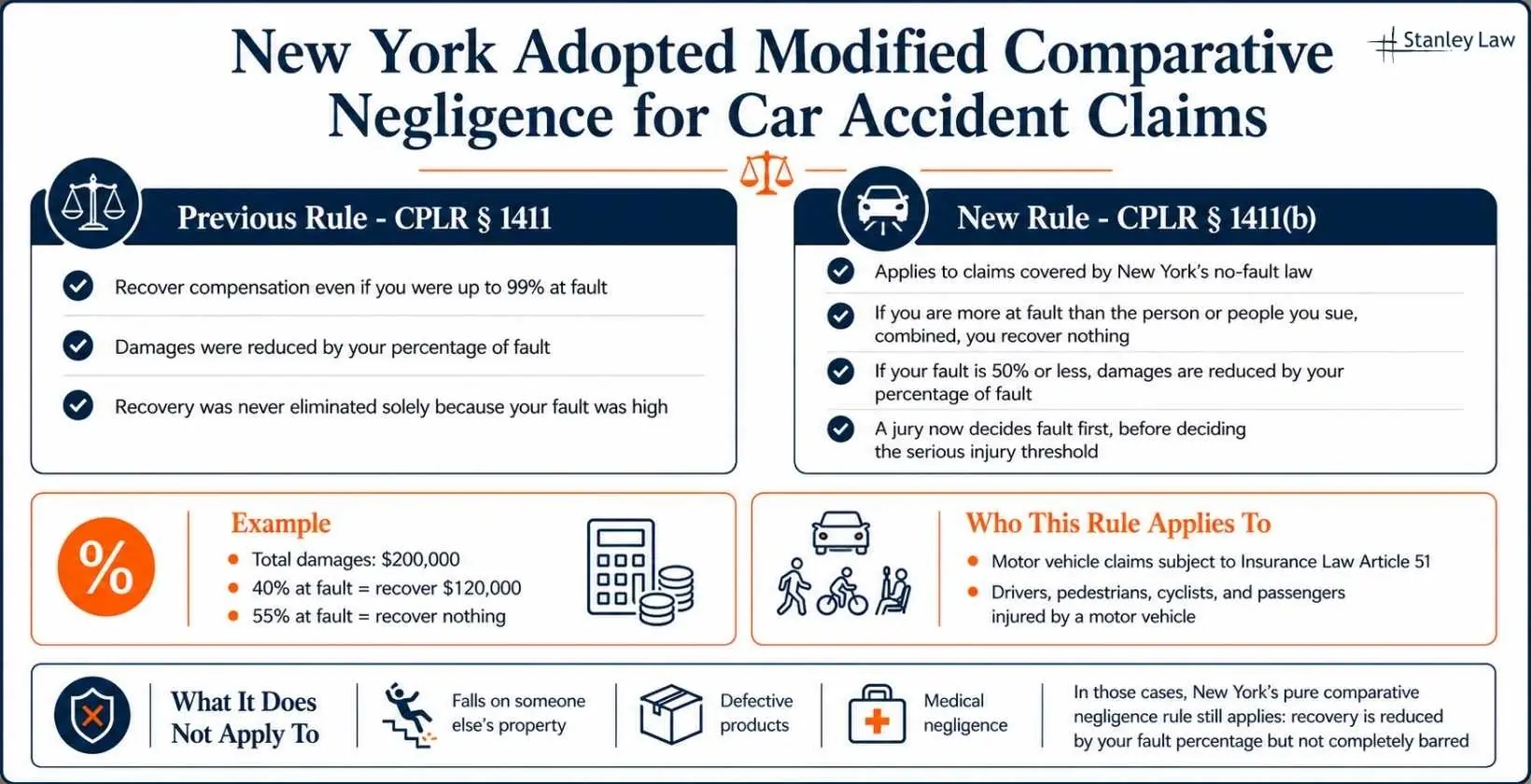
New York has rewritten how shared fault affects recovery, and this is the change most likely to be misunderstood. Under the previous rule, CPLR § 1411, you could recover compensation no matter how much of the crash was your fault, even 99%. Your damages were reduced by your percentage of fault, but never eliminated.
A new provision, CPLR § 1411(b), changes that for claims covered by New York’s no-fault law. If a jury finds you more at fault than the person or people you’re suing, combined, you recover nothing. If your fault is 50% or less, your damages are still just reduced by your percentage of fault, the same as before. Only crossing that line changes the outcome.
Example: If your damages total $200,000 and you’re found 40% at fault, you still recover $120,000. If you’re found 55% at fault under the new rule, you recover nothing.
The law also changed the order in which these questions are decided. A jury must now determine fault first, before it decides whether your injury meets the serious injury threshold. This sequencing matters most when a car accident case goes to court, where both questions get put to a jury.
This modified fault rule is not limited to drivers suing other drivers. It applies to any personal injury claim subject to Insurance Law Article 51, New York’s no-fault law, which covers pedestrians, cyclists, and passengers struck or injured by a motor vehicle. If you were walking, biking, or riding as a passenger when you were hurt, the same fault line applies to your claim.
The rule does not extend past motor vehicle claims. If your injury came from a fall on someone else’s property, a defective product, or medical negligence, New York’s original pure comparative negligence rule still applies. Your recovery is reduced by your fault percentage but never barred entirely.
The New $100,000 Cap on Pain and Suffering for At-Fault Claimants
New York has added a cap that limits an injured claimant’s own pain-and-suffering recovery under Insurance Law § 5104(d). The cap applies only to a claimant who is at fault for the crash and not already barred from recovery. For that claimant, non-economic damages are capped at $100,000 if, at the time of the accident, they were:
- Driving without required insurance (unless the policy had lapsed for fewer than 30 days);
- Legally impaired by drugs or alcohol, resulting in a conviction; or
- Committing or fleeing a felony while driving, resulting in a conviction.
This cap applies strictly to the claimant’s own recovery for pain and suffering. It does not apply to economic damages like medical bills and lost wages, and it does not apply to wrongful death actions.
Who Else Do These Changes Affect: Pedestrians, Cyclists, and Motorcyclists
The 2026 legal reforms apply to anyone classified as a “covered person” under New York’s no-fault system. If you were walking or biking when you were hit by a motor vehicle, you are bound by the same no-fault rules, the revised serious injury threshold, and the 50% modified comparative negligence fault limit as drivers.
- The Motorcycle Exception: Motorcyclists are not subject to the serious injury threshold at all, including any of the eight categories above. New York’s no-fault law does not classify motorcycles as motor vehicles under Insurance Law § 5102(f), so a rider injured by a negligent driver can pursue a lawsuit for any injury, without proving fracture, disfigurement, permanent limitation, or any other category on that list.
However, whether the new 50% modified comparative negligence rule extends to motorcycle accident lawsuits is currently an open legal question. Because the new fault restrictions are explicitly tied to the no-fault statute, it is unclear how courts will treat a rider who sits outside that system.

What Hasn’t Changed
Three things about a New York car accident claim stayed the same:
- No-fault coverage itself. You still file with your own insurer first, regardless of fault, and no-fault coverage still provides up to $50,000 in medical bills and lost wages.
- Your filing deadlines. You still have three years from the date of the accident to file a personal injury lawsuit, and two years from the date of death to file a wrongful death claim. Claims against a government entity, such as a city bus or a state vehicle, still require a Notice of Claim within 90 days.
- Where this law applies. These changes come from New York State law and only govern claims filed in New York courts. If your accident happened in Pennsylvania, or your claim will be filed under Pennsylvania law, these 2026 changes do not apply to your case. Pennsylvania has its own separate rules for fault and injury claims.
How to Protect Your Claim Under New York’s New Rules
With a stricter injury threshold and a fault rule that can eliminate your recovery entirely, what you do immediately after a crash matters more than it used to.
- Get medical care immediately, and follow through on treatment. Gaps in treatment are one of the first things insurers use to argue an injury doesn’t meet the threshold, and objective medical evidence is what proves a qualifying injury now that the 90/180 category is gone.
- Preserve evidence of fault before it disappears. Dashcam and traffic camera footage is often overwritten within days. Photograph the scene, the vehicles, and your injuries before anything is repaired, moved, or healed.
- Decline recorded statements. Do not give a recorded statement to any insurance company, including your own, before speaking with a lawyer. Under the new fault rule, a sentence that shifts even a few percentage points of blame onto you carries more weight than it used to, since crossing the fault line eliminates recovery rather than just reducing it.
- Review your own auto insurance coverage. Supplementary uninsured and underinsured motorist coverage becomes more valuable when a claimant’s own recovery can be capped or barred, since it protects you if the other driver was uninsured, underinsured, or found more at fault than you.
None of these steps requires you to have already decided whether to bring a claim. They protect your options while you figure that out.
If you’d rather not deal with the insurance company alone while you decide, request a free case review and have someone in your corner from the start.
FAQs About New York Car Accident Law Changes
Does This Apply to Car Accidents That Happened Before May 26, 2026?
It depends on when your lawsuit is filed, not when the accident happened. The new rules apply to any action or proceeding commenced on or after May 26, 2026. If you were hurt before that date but haven’t filed a lawsuit yet, these changes likely apply to your case. If you already had a lawsuit pending before May 26, 2026, it continues under the prior rules.
Am I Barred From Recovery if I Was Partly at Fault for My Crash?
Not necessarily. You’re only barred from recovery if a jury finds you more at fault than the combined fault of everyone you’re suing. If your share of fault is 50% or less, you can still recover, and your damages are simply reduced by your percentage of fault, the same as before.
Does the New Fault Rule Apply if I Was Hit as a Pedestrian or Cyclist?
Yes. The modified comparative negligence rule applies to any personal injury claim covered by New York’s no-fault law, and pedestrians and cyclists struck by a vehicle are covered persons under that law, the same as drivers and passengers.
I Was Hurt in a Truck or Rideshare Accident. Do These Changes Apply to Me?
Generally, yes, if your claim is a personal injury action subject to New York’s no-fault law, which covers most rideshare accidents and truck accidents involving passenger-type vehicles the same way it covers standard car accidents. Commercial truck claims can involve additional layers of insurance and liability, so have an attorney confirm how these rules apply to your specific case.
Will These Changes Affect My Car Insurance Premium?
New York’s Department of Financial Services has directed insurers to reflect these changes, including reduced fraud exposure and new damages limits, in future rate filings. Any effect on premiums will show up gradually as insurers submit new rates, not immediately.
Do These Rules Apply to Me If My Accident Happened in Pennsylvania?
No. These are New York State law changes and only apply to claims filed in New York. Pennsylvania has its own statute of limitations and fault rules, which are different from New York’s, both before and after this reform.
Talk to a New York Car Accident Lawyer About How These Changes Affect Your Claim
New York’s 2026 reforms raised the stakes on two of the most contested parts of any car accident case: whether your injury qualifies to sue, and how much a shared-fault argument can cost you. Both are exactly the kind of questions insurance adjusters are trained to argue against you throughout the car accident lawsuit process.
Stanley Law Offices has represented car accident victims across Upstate New York since 1982, with offices in Syracuse, Binghamton, Rochester, Watertown, and Oneonta. Call 1-800-608-3333 for a free, no-obligation case review, or fill out our online consultation form to have your claim evaluated under New York’s current law.