
The employer, the general contractor, the property owner, and subcontractors can all be liable for a construction accident in Upstate New York. New York Labor Law 200, 240, and 241(6) assign each party an independent legal duty to protect workers on site. When any of those duties is breached, and a worker is injured, the law does not limit recovery to the immediate employer. Every party whose obligation was violated faces independent civil liability.
Most injured construction workers do not know this. They file a workers’ compensation claim, assume the employer is the only responsible party, and stop there, leaving the general contractor, the property owner, and the full available insurance coverage untouched. Joe Stanley, ABOTA Board Certified trial attorney, 19-year Super Lawyer, and founder of Stanley Law Offices, has represented injured construction workers across Upstate New York since 1982. There is no fee unless we win.
Key Takeaways
- Multiple parties can be simultaneously liable in a single construction accident; the employer, general contractor, and property owner each carry independent legal duties under New York Labor Law.
- NY Labor Law 240 (the Scaffold Law) imposes strict liability on property owners and general contractors for gravity-related injuries, with no proof of negligence required.
- Workers’ compensation covers medical bills and partial lost wages, but excludes pain and suffering. A third-party lawsuit against the contractor or site owner fills that gap and runs concurrently.
- The statute of limitations is 3 years from the date of injury for most Upstate New York construction accident claims. If a government entity owns the site, a separate 90-day Notice of Claim deadline applies.
- If a government entity owns the site, a Notice of Claim must be filed within 90 days under NY General Municipal Law 50-e; missing this deadline eliminates the right to sue entirely.
- Never admit fault at the scene. New York follows pure comparative negligence; any percentage of fault attributed to the worker reduces the damages award by that same percentage.
What Are the Most Common Types of Construction Accidents in Upstate New York?
The accidents that generate the most construction injury claims in Upstate New York fall into six categories, each triggering distinct liability theories under NY Labor Law.
- Falls from heights are the most common. Scaffold falls, ladder failures, roof collapses, and falls from elevated work platforms all potentially qualify under NY Labor Law 240’s strict liability framework.
- Scaffold collapses are a distinct category; structural failure of the scaffold itself, as opposed to a worker falling off an intact one, carries the same absolute liability under 240.
- Crane and rigging accidents involve some of the most severe injuries on Upstate construction sites. Equipment failure, operator error, and improper load rigging can injure workers at ground level and in elevated positions simultaneously.
- Struck-by and falling object accidents occur when tools, materials, or debris fall onto workers below. Section 240 covers falling objects as well as falls from heights.
- Electrical accidents from contact with uninsulated lines, improperly grounded equipment, or unsafe wiring by electrical subcontractors regularly produce serious burns, cardiac injuries, and wrongful death claims.
- Trench and excavation cave-ins are governed by specific OSHA shoring requirements. When those standards are ignored, and a trench collapses, the general contractor faces both federal regulatory violations and civil liability under 241(6).
Why Do Construction Accidents in Upstate New York Involve More Than One Liable Party and Who Bears Ultimate Responsibility?
New York Labor Law assigns separate, independent legal duties to the employer, the general contractor, and the property owner. All three can be named defendants in the same lawsuit, and an injured worker does not choose one over the others; liability is not either/or.
The reason multiple parties face simultaneous liability is the non-delegable duty doctrine. NY Labor Law treats certain safety obligations as permanently attached to the general contractor and the property owner, regardless of who actually performed the unsafe work. A general contractor who hires a scaffolding subcontractor does not shed 240 liability when that scaffold fails. The law does not allow the party with the most control to pass its obligations to the party with the least.
On a typical Upstate New York construction site, a property developer owns the land, a general contractor manages the project, and multiple subcontractors execute specialized trades. When any obligation is breached, and a worker is injured through a fall from height, a scaffold collapse, or a crane failure, New York law holds every party with a breached duty independently accountable. A laborer employed by a subcontractor had no role in scaffold design, anchor placement, or load calculations. The non-delegable duty doctrine assigns liability to the parties who had that control.
When Is an Employer Liable for a Construction Site Injury?
An employer’s primary liability runs through workers’ compensation insurance, not civil negligence. Workers’ comp pays medical treatment and approximately two-thirds of lost wages regardless of fault, but it excludes pain and suffering and bars a direct lawsuit against the direct employer.
New York Workers’ Compensation Law requires virtually every construction employer to carry coverage. That policy activates the moment a worker is injured. The trade-off is the exclusive remedy rule: the worker generally cannot sue the direct employer in civil court. That exclusion applies only to the employer. A general contractor, a property owner, or a negligent subcontractor on the same site remains fully exposed to a direct civil lawsuit.
In most serious construction accidents, both a workers’ compensation claim and a third-party personal injury lawsuit should be filed. They are not mutually exclusive, and the two claims run concurrently, but how they are sequenced and coordinated affects the final net recovery, which is why construction accident claims benefit from legal counsel with experience in both.
What Makes a General Contractor Liable Under New York Labor Law?
A general contractor in Upstate New York faces liability under three statutes: 200 for negligent site supervision; 240 for gravity-related injuries, regardless of personal fault; and 241(6) for violations of specific safety regulations during construction, demolition, or excavation.
- Section 200 requires the general contractor to identify and correct hazardous conditions on the worksite. When a contractor knew or should have known about a danger and failed to act, 200 creates direct liability.
- Section 240 of the Scaffold Law reaches further. It imposes absolute liability on general contractors for ladder falls, scaffold collapses, and falling-object injuries. The contractor does not need to have been present when the accident occurred. The statute itself creates the obligation, and a worker’s comparative fault does not reduce recovery under 240.
- Section 241(6) extends comparable protection to violations of enumerated industrial codes. Together, these statutes make the general contractor the most consistently liable party at any Upstate New York construction site.
The three statutes carry different evidentiary burdens. Section 200 requires proof that the contractor knew or should have known about the hazard. Section 241(6) skips that knowledge requirement; a proven violation of a specific Industrial Code regulation is enough. Section 240 goes furthest: no knowledge and no code violation required, only the fall and the safety failure. Attorneys plead all three simultaneously because the same accident can be stronger under one theory than another.
In this free webinar, Attorney Joe Stanley breaks down the three Labor Law sections above and explains why New York gives construction workers stronger protections than almost any other state. He walks through Section 240, the “scaffolding law,” and why liability for ladder and scaffold injuries is absolute, meaning the worker’s own fault generally doesn’t reduce the claim. He then covers Section 241(6), which applies to construction, demolition, and excavation work but does allow comparative negligence, and Section 200, the general duty to provide a reasonably safe workplace. Joe also explains the exception every homeowner asks about: owner-occupied one- and two-family homes are generally exempt unless the owner directed or controlled the work. Because most construction injuries trigger a workers’ compensation claim at the same time, he covers why the two cases must be managed together. Facts developed in workers’ comp court can make or break the personal injury lawsuit. These cases are almost always litigated, which is why gathering facts, identifying witnesses, and framing the case correctly from day one matters so much. If you’ve been hurt on a construction site anywhere in Upstate New York, call 1-800-608-3333 for a free case review. No fee unless we win.
When Does a Property Owner Bear Strict Liability for a Construction Accident?
Under NY Labor Law 240, property owners who authorize construction work on their land carry the same strict liability as general contractors for gravity-related injuries, even without any active role in supervising the work. The only exemption covers owner-occupied one- and two-family homes where the owner did not direct or control the construction.
If a worker falls from an improperly secured scaffold on a commercial site, the property owner faces liability alongside the contractor. That liability is automatic once the fall and the safety failure are established.
Commercial developers, municipalities, schools, and corporations conducting construction in Syracuse, Rochester, Binghamton, Watertown, and Utica all fall within 240’s reach. In practice, property owners typically carry significantly larger insurance policies than subcontractors. Naming the property owner as a defendant in a construction accident claim often determines whether a full damages award is actually collectible, not just legally awarded.
Can Subcontractors, Equipment Manufacturers, and Design Professionals Also Be Held Liable?
Yes. A subcontractor whose negligent work injures an employee of a different company faces direct civil liability. An equipment manufacturer whose defective product causes an injury faces product liability independent of any claim against the general contractor or property owner. Design professionals, architects, and engineers face independent liability when defective plans or specifications create the unsafe condition that causes the injury.
Construction sites involve multiple specialty subcontractors working in parallel. When a crane operation error injures a laborer employed by a separate company, or when an electrocution accident results from an electrical subcontractor’s unsafe wiring, the injured worker pursues the negligent subcontractor directly in a third-party claim.
Equipment manufacturers face exposure when defective tools, faulty harnesses, or malfunctioning machinery contribute to the injury. The Occupational Safety and Health Administration (OSHA) sets mandatory federal safety standards for construction equipment. Documented violations of those standards reinforce both the product liability claim and a related civil action for OSHA violations.
What Are the 4 Things Required to Prove Negligence in a Construction Accident?
Proving which party is liable for a construction accident in New York requires establishing four elements: (1) the defendant owed a duty of care, (2) that duty was breached, (3) the breach directly caused the injury, and (4) the injury produced measurable damages.
- Duty: NY Labor Law 200, 240, and 241(6) codify specific duties for general contractors and property owners. The duty exists by statute; the worker does not need to prove it was voluntarily assumed.
- Breach: The defendant failed to meet that duty. Safety violations, ignored inspection reports, defective equipment, absent fall protection, and inadequate worker training all constitute breaches.
- Causation: The breach directly caused the injury. Attorneys establish causation through accident reports, site inspection records, OSHA investigation findings, witness testimony, and expert engineering analysis.
- Damages: The worker suffered concrete, compensable harm, medical costs, lost income, permanent disability, or wrongful death. New York imposes no cap on compensatory damages in personal injury cases.
Stanley Law Offices has documented recoveries of $750,000 for a scaffold fall requiring herniated disc surgery and $625,000 for a fall from height that shattered a 41-year-old worker’s heel and permanently ended his construction career. Both results are documented in the firm’s verdicts and settlements.
The four-element framework above applies to Section 200 and Section 241(6) claims. Section 240 is different: once a qualifying fall or falling object is confirmed, liability attaches automatically, no negligence required. In serious construction accidents, attorneys plead both simultaneously. Section 240 covers gravity-related injuries; Section 200 covers broader site conditions. Together, they close every gap.
Is New York a Strict Liability State for Construction Accidents?
Yes, for gravity-related injuries. NY Labor Law 240 makes liability automatic against property owners and general contractors when a worker falls from a height or is struck by a falling object. No negligence is required. Liability attaches the moment the fall occurs, and the safety failure is confirmed. The defendant cannot escape by pointing to safety policies, an absent supervisor, or the worker’s momentary error.
New York’s Scaffold Law is uniquely protective compared to other states, which is why insurance companies litigate Section 240 claims with maximum resources. The threshold question in every case is whether the accident qualifies. Falls from ladders, scaffold failures, falling tools, and fire and explosion events caused by improperly secured materials each require individual analysis.
The main defense raised is that the worker’s own conduct, not a safety violation, caused the injury. To succeed, the defendant must prove adequate equipment was available, the worker knew how to use it, and deliberately refused. Courts apply it narrowly; it rarely succeeds. When it fails, Section 240 eliminates the hardest element of any construction accident lawsuit.
Why Should You Never Admit Fault After a Construction Accident?
Upstate New York follows pure comparative negligence. Any fault attributed to the injured worker reduces the total damages award by that exact percentage. A statement made at the scene to a supervisor, insurer, or safety officer becomes evidence used to shift that percentage onto the worker.
Insurance adjusters and defense attorneys treat post-accident statements as evidence, not conversation. A worker who tells a site supervisor, “I wasn’t watching where I was going,” hands the defense a comparative negligence argument. Under New York’s pure comparative negligence rule, a 25% fault finding reduces a $500,000 recovery to $375,000. A 50% finding cuts it in half.
After an accident, report that an injury occurred: state where and when. Nothing more. Do not speculate about causes, agree with a supervisor’s account of events, or give a recorded statement before consulting an attorney. This applies to statements made to OSHA investigators and insurance company representatives equally. Workers’ compensation does not require proving fault, but the third-party civil lawsuit does, and every statement made at the scene can be used against that claim.
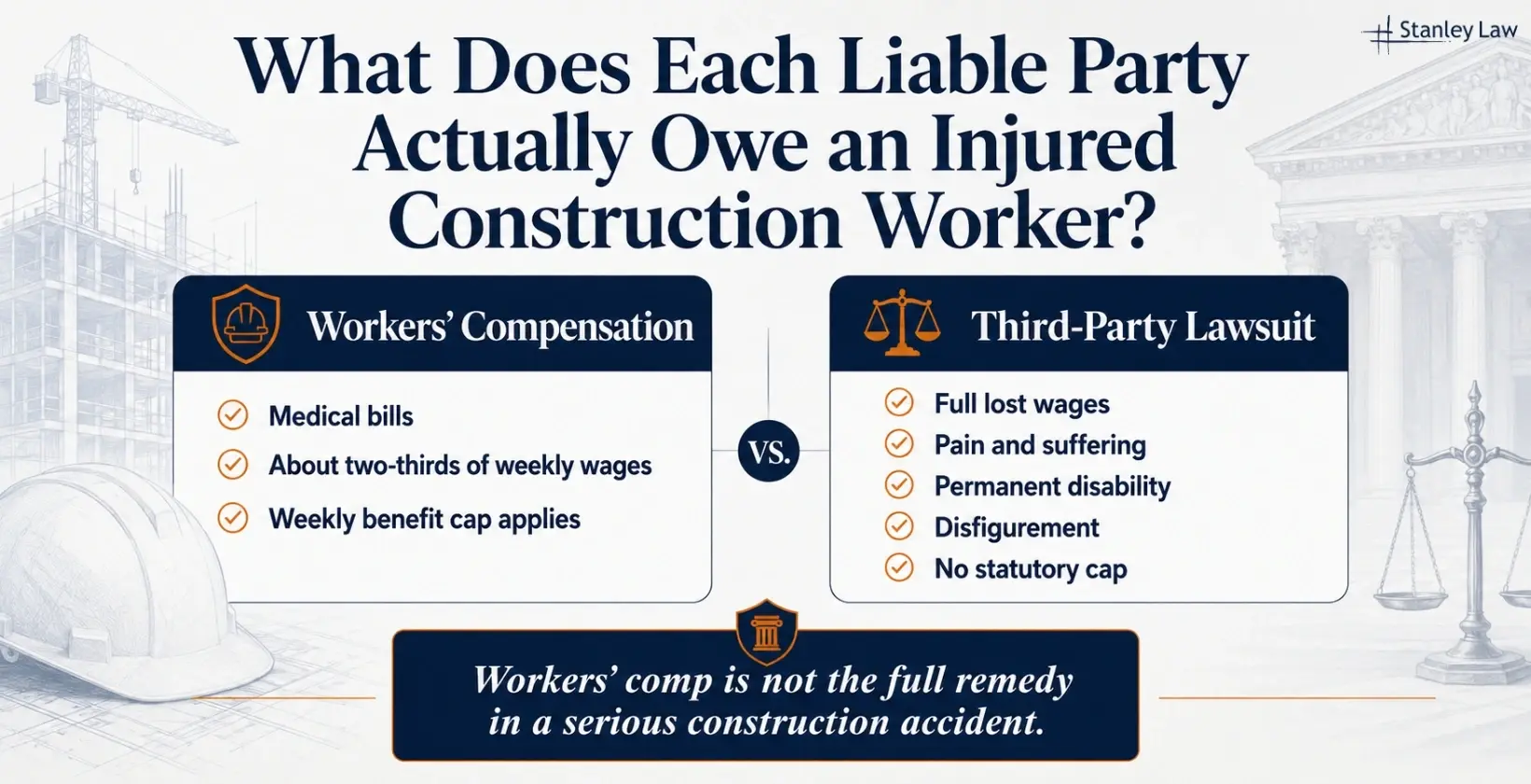
What Does Each Liable Party Actually Owe an Injured Construction Worker?
Workers’ compensation paid by the employer covers medical bills and approximately two-thirds of weekly wages. The types of workers’ compensation benefits available in New York detail what qualifies and what falls outside coverage. A third-party lawsuit against the general contractor, property owner, or subcontractor recovers full lost wages, pain and suffering, permanent disability, and disfigurement with no statutory cap.
New York’s maximum workers’ comp weekly benefit is capped at the state average weekly wage. A skilled tradesperson earning above that cap takes a pay cut from day one of a workers’ comp claim. In serious construction accidents involving permanent spinal injuries, traumatic brain injuries, and amputations, the gap between what workers’ comp pays and what a third-party recovery delivers routinely exceeds six figures.
Treating workers’ compensation as the complete remedy leaves the general contractor and property owner financially unaccountable for the full harm they caused.
How to Protect Your Rights Against Every Liable Party After an Accident
The first 72 hours determine what evidence survives. Report the injury to a supervisor in writing the same day; a properly filed construction accident report documents the details that protect every claim that follows. Seek medical treatment immediately; spinal injuries and traumatic brain injuries routinely present hours after impact. Photograph the equipment, the hazard, and every visible injury before the scene is altered. Do not give any recorded statement before consulting an attorney.
Two separate deadlines begin the moment the accident occurs. New York’s statute of limitations for personal injury claims is 3 years from the date of injury. When the site is owned or operated by a government entity, a school district, public authority, or municipal agency, NY General Municipal Law 50-e requires a Notice of Claim within 90 days. Missing that deadline does not reduce the claim; it eliminates it entirely. Identifying government ownership is the first determination an Upstate New York construction accident attorney makes. The detailed steps are covered in our guide to what to do after a construction accident.
Speak With a Construction Accident Attorney Who Knows Upstate New York
Joe Stanley, ABOTA Board Certified trial attorney, 19-year Super Lawyer (2008–2026), and founder of Stanley Law Offices, has handled construction accident claims under NY Labor Law 200, 240, and 241(6) across Upstate New York since 1982, pursuing the employer, the general contractor, and the property owner simultaneously so no liable party escapes accountability.
Call 1-800-608-3333 or get your free case review now. There is no fee unless we win, and we advance all case costs.