






A motorcycle crash changes everything overnight. Medical bills pile up, income stops, and insurance companies start working against you before you’ve left the hospital. At Stanley Law Offices, we make sure injured riders in Upstate New York don’t face that alone. Our Upstate New York motorcycle accident lawyers fight to recover the maximum compensation available under New York law, from the first call to the final settlement.
- 45+ years fighting for the injured
- 4.7 rating across 900+ verified reviews
- Millions are recovered in verdicts and settlements every year
- Available 24/7
- No recovery, no fee
Founded in 1982 by Joe Stanley, JD, Summa Cum Laude, Syracuse University Law School, our firm has spent over four decades as an Upstate New York personal injury lawyer fighting for injured riders across the region. We have offices in Syracuse, Rochester, Watertown, Oneonta, and Binghamton.
How a Motorcycle Accident Lawyer Helps You Build a Strong Claim
After a motorcycle collision, important details can disappear fast. Video gets overwritten, witnesses become harder to reach, and the condition of the motorcycle and road can change. A motorcycle accident lawyer helps lock down evidence early, identify who is responsible, and build a claim that reflects the full impact of your injuries.
- Investigate fault and right-of-way: Review the crash report, interview witnesses, and analyze vehicle damage, sight lines, and intersection or lane positioning.
- Preserve time-sensitive proof: Request video before it’s overwritten; secure photos, phone records when relevant, and keep the motorcycle, helmet, and gear available for inspection.
- Control insurance communications: We handle calls and paperwork so you are not pushed into recorded statements or rushed releases.
- Document damages the right way: Tie treatment, restrictions, and future care to the claim; confirm missed work and reduced earning ability with supporting records.
- Present a demand supported by evidence: Build a clear, well-documented demand that forces a real evaluation instead of a lowball response.
- File suit when it makes sense: If the carrier won’t act reasonably, we prepare for litigation and track court deadlines from day one.
Call 1-800-608-3333 or contact Stanley Law Offices for a free case review.
From day 1, I have had nothing but a positive experience with the team at Stanley Law. I was in a motorcycle accident back in October of 2019, where I suffered excruciating injuries, permanent scars, and was out of work for a good amount of time. I was initially referred an attorney by a friend at DIFFERENT law office than Stanley Law, who, for several months, had done nothing except obtain the police report from my accident. It was then, that a family member of mine told me that was absurd and that I needed to turn my case over to Mellissa Murphy, an attorney at Stanley Law. It was the best advice I could have received. The very first time I spoke with Mellissa, she spent over and hour and a half with me, answering all my questions, explained the law, and outlined in clear and understanding terms the steps in the process that needed to be done. Since that day, both Melissa and her paralegal, Kortney Burdin, have been hardworking, articulate, reassuring, knowledgeable, caring, and effective. They went above and beyond to frequently keep me updated on the stages we were at, what still needed to be done, to ensure peace of mind and to do everything in their power to fight for the outcome I deserved. I strongly recommend the team at Stanley Law Office and am very blessed that I turned my case over to them. My only regret is that I wish went with them from the very beginning!
Common Types of Motorcycle Wrecks Across Upstate New York
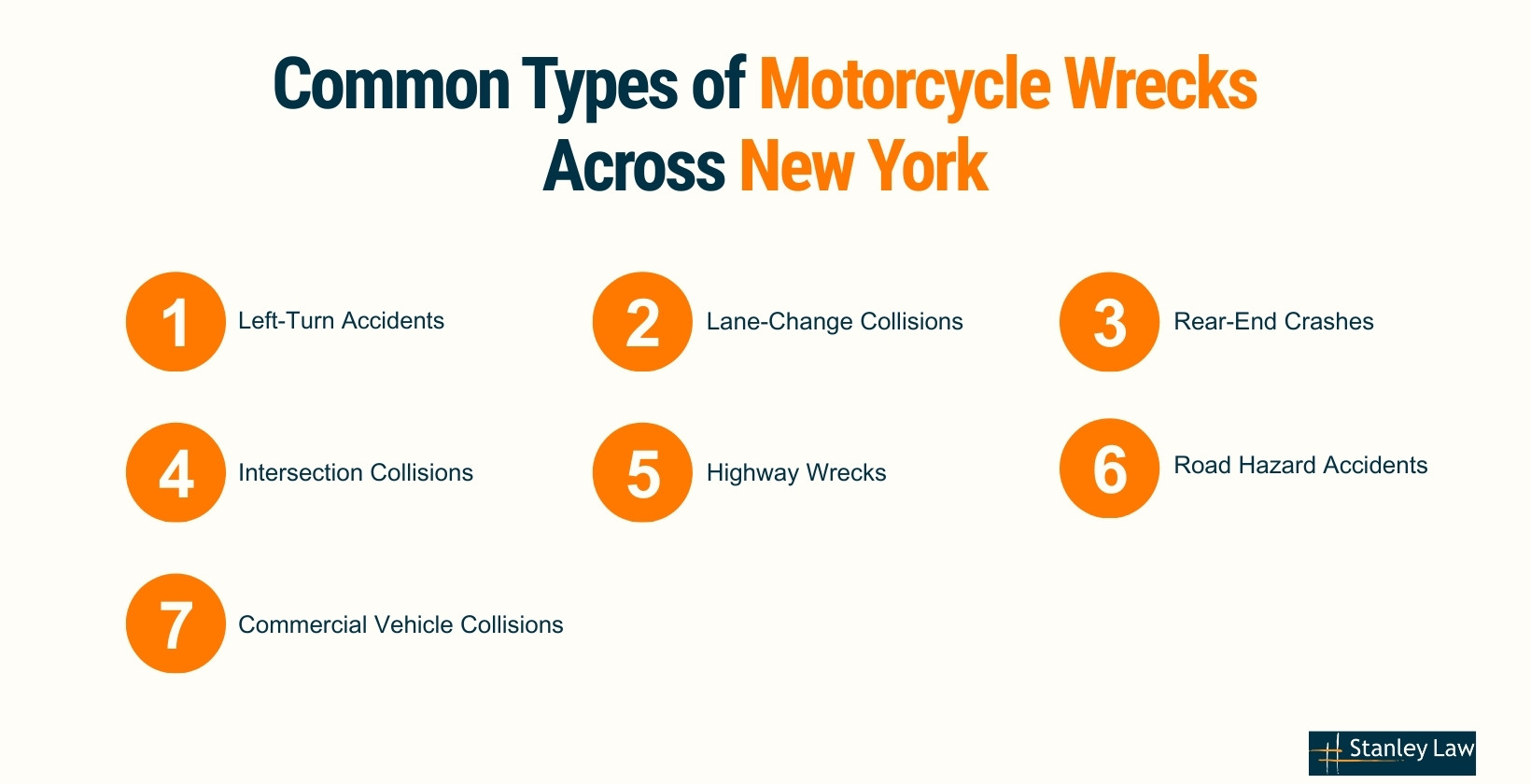
Motorcycle crashes usually follow recognizable patterns. Naming the crash type helps clarify right-of-way, lane position, and which traffic rule likely caused the impact, key details when liability is contested.
Our motorcycle crash attorneys regularly represent injured motorcyclists in cases involving:
- Left-Turn Accidents: Drivers fail to yield at intersections and turn directly into an oncoming rider.
- Lane-Change Collisions: Motorists move into a motorcyclist’s lane without checking blind spots.
- Rear-End Crashes: Even low-speed impacts can cause serious injury due to limited rider protection.
- Intersection Collisions: Signal violations and distracted driving frequently lead to severe crashes.
- Highway Wrecks: High-speed impacts on major New York roadways often result in catastrophic injuries.
- Road Hazard Accidents: Potholes, debris, and uneven pavement can cause riders to lose control.
- Commercial Vehicle Collisions: Crashes involving delivery trucks or company vehicles may involve complex liability and larger insurance policies.
If fault is being disputed, we can explain how New York law typically applies to this type of motorcycle wreck.
Leading Causes of Motorcycle Crashes
Motorcycle crashes often happen because a driver makes a preventable mistake, not because the rider “took a risk.” Identifying the cause helps explain how the crash unfolded and why it was preventable.
Common causes include:
- Distracted Driving: Texting, phone use, or inattention behind the wheel.
- Failure to Yield: Especially at intersections and during left turns.
- Unsafe Lane Changes: Drivers failing to check blind spots.
- Speeding: Reduces reaction time and increases crash severity.
- Impaired Driving: Alcohol or drug-related impairment.
- Dangerous Road Conditions: Potholes, debris, or poor road maintenance.
- Dooring: A driver or passenger opens a door into a rider’s path
- Vehicle or Equipment Defects: Brake failure, tire blowouts, or mechanical issues.
Once the cause is clear, our motorcycle crash lawyers can identify the liable parties and pursue compensation under New York law.
Who Can Be Held Liable in a Motorcycle Collision?
In many cases, it is not just the driver who made contact with the motorcycle. A crash can involve multiple decisions, vehicles, and conditions, and liability may extend to more than one person or entity.
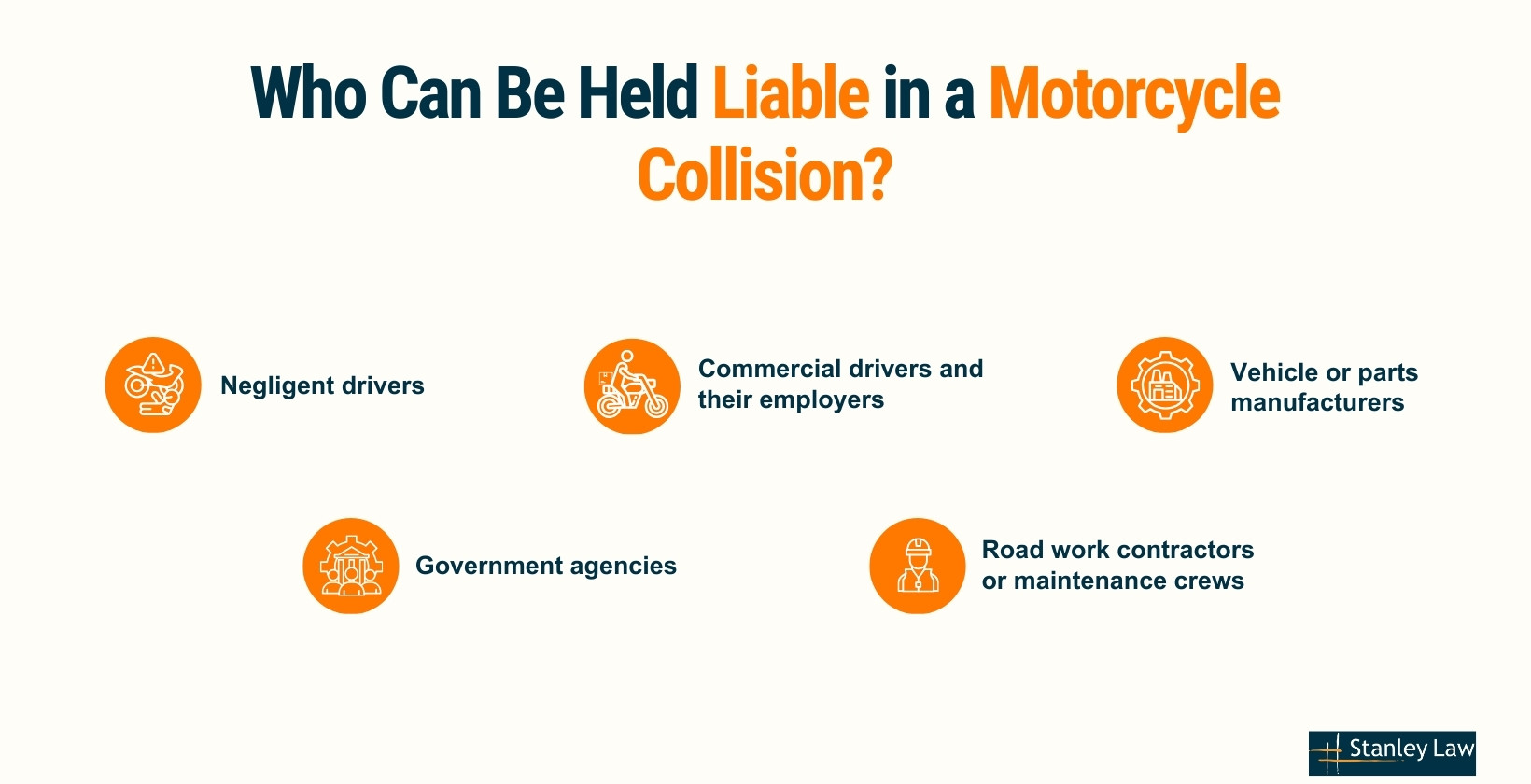
Potentially liable parties may include:
- Negligent drivers: Motorists who were distracted, speeding, following too closely, impaired, or failed to yield the right of way.
- Commercial drivers and their employers: If the at-fault vehicle was a delivery truck, service vehicle, rideshare, or company car, the employer may share responsibility for on-the-job driving.
- Vehicle or parts manufacturers: If a defective tire, brake, steering component, or other mechanical failure contributed to the crash or made the injuries worse.
- Government agencies: If dangerous road design, poor maintenance, missing signage, or known hazards played a role.
- Road work contractors or maintenance crews: When a work zone is poorly marked, leaves debris, creates abrupt pavement edges, or fails to use safe temporary traffic control.
New York follows comparative fault rules, so identifying every responsible party can directly affect the value of the claim. If you are not sure who may be responsible, we can review the crash report and walk you through the possibilities.
Serious Injuries Caused by Motorcycle Crashes
Motorcyclists have little physical protection in a collision, which is why injuries are often severe and life-altering. Our experienced motorcycle accident attorneys represent riders facing extensive medical treatment and long recovery periods after serious crashes.
Common motorcycle crash injuries include:
- Traumatic brain injuries (TBI): Concussions or more serious brain trauma that can affect memory, focus, mood, and long-term function.
- Spinal cord injuries: Damage that may cause chronic pain, loss of sensation, or partial or permanent paralysis.
- Fractures and orthopedic injuries: Broken bones and joint injuries that may require surgery, hardware, physical therapy, and extended rehab.
- Severe road rash: Deep abrasions that can lead to infection, nerve damage, skin grafts, and permanent scarring.
- Burns: Injuries from friction, hot surfaces, or fire that may require ongoing wound care and can leave lasting scarring.
- Degloving injuries: Severe soft-tissue injuries where skin and tissue are torn away, sometimes requiring surgery, grafts, or amputation.
- Arm and shoulder injuries: Fractures, dislocations, or nerve damage from bracing during impact or being thrown from the bike.
- Leg, hip, and knee injuries: Damage that can affect walking and mobility, including fractures, ligament tears, and crush injuries.
- Internal organ damage: Injuries that may not be obvious at the scene but can be life-threatening without prompt treatment.
- Amputations: Traumatic limb loss or surgical amputation caused by crushing impact or severe tissue damage.
Schedule a free consultation to discuss your case.
What to Do After a Motorcycle Accident in Upstate NY
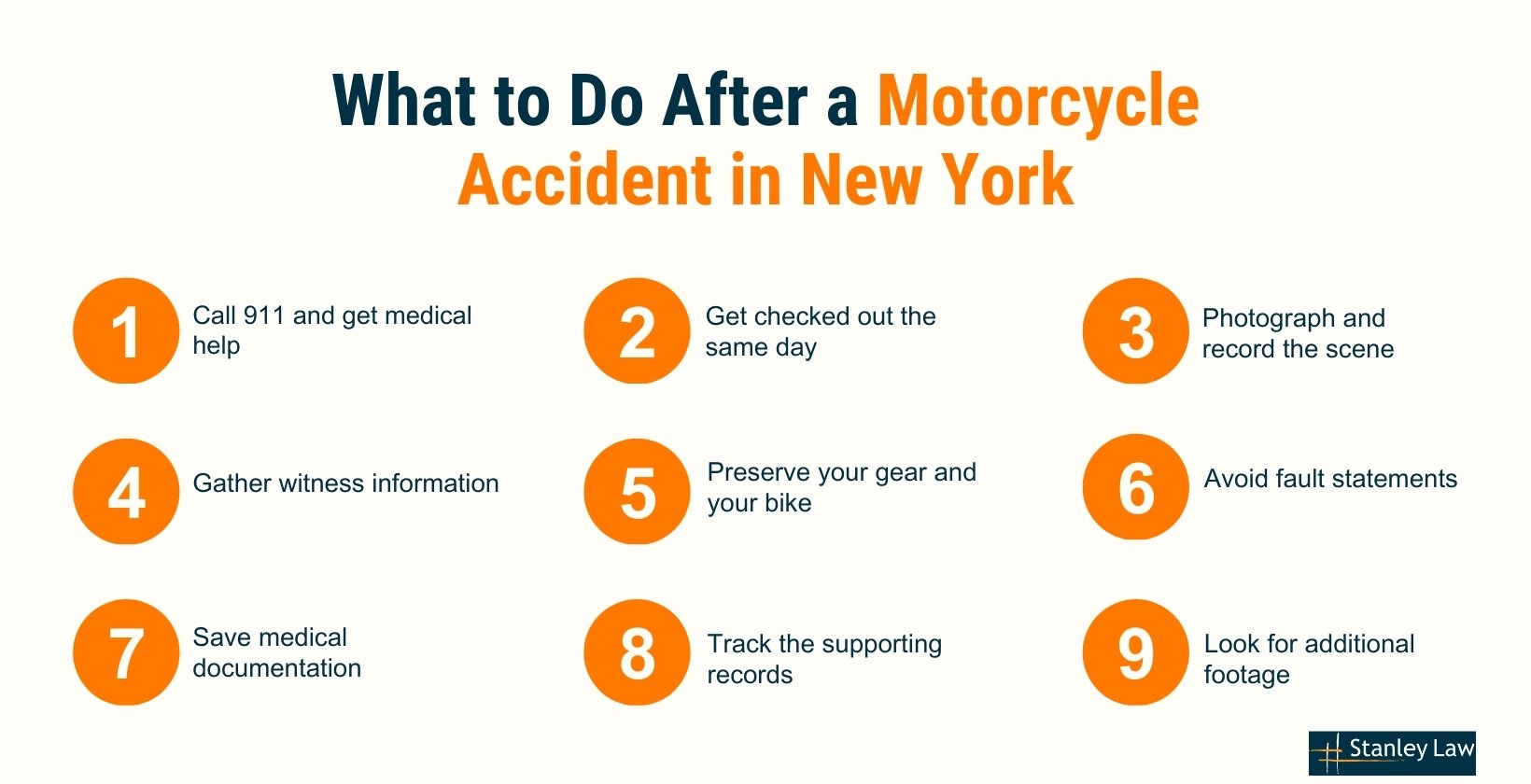
What you do in the first hours and days after a motorcycle crash can protect your health and prevent avoidable problems with your claim later. Focus on safety first, then document what happened while the details are still fresh.
- Call 911 and get medical help: Ask for police response and emergency care. Make sure the crash is documented and request the police crash report number before you leave the scene.
- Get checked out the same day: Even if you feel “okay,” get evaluated. Head injuries, internal injuries, and soft tissue damage do not always show up right away.
- Photograph and record the scene: Take photos or video of vehicle positions, damage, skid marks, debris, road hazards, traffic signals, and weather or lighting conditions.
- Gather witness information: Get names, phone numbers, and a short description of what they saw.
- Preserve your gear and your bike: Do not discard your helmet, jacket, gloves, boots, or protective gear. Keep them in the condition they were in after the crash.
- Avoid fault statements: Do not guess or apologize at the scene. If an insurance adjuster calls, you do not need to give a recorded statement right away.
- Save medical documentation: Keep discharge papers, follow-up instructions, medical imaging, orthopedic notes, and any concussion or TBI screening results.
- Track the supporting records: Save towing and repair estimates, bike inspection documentation, and receipts for out-of-pocket expenses.
- Look for additional footage: Nearby businesses, doorbell cameras, traffic cams, and dashcams may have video. A 911 call log or dispatch notes may also help confirm timing and early observations.
Before you accept any settlement, make the first call to Stanley Law. You can also learn how to file a personal injury claim in New York before your first call.
How Insurance Coverage Works in Upstate New York Motorcycle Cases
Insurance in motorcycle cases is rarely one policy and one check. The available coverage may depend on who caused the crash, whether the vehicle was commercial, and whether additional protections apply through your own policy.
Coverage may include:
- Bodily Injury Liability (at-fault driver): The other driver’s liability policy is often the starting point. It may cover losses like medical expenses, lost income, and pain and suffering, up to the policy limits.
- Uninsured Motorist (UM) coverage: UM protection applies in certain uninsured and hit-and-run situations.
- Supplementary Uninsured/Underinsured Motorists (SUM) coverage: Insurers must offer SUM coverage, which can add protection when the at-fault driver has no insurance or not enough insurance to cover a serious injury.
- Umbrella or excess liability policies: In high-injury cases, there may be additional coverage beyond the basic auto policy, including umbrella/excess layers (for an at-fault driver, an employer, or a commercial policy structure).
The right approach is to identify every available policy and layer of coverage early, then build the claim around clear liability and full damages documentation.
New York Motorcycle Laws Riders Should Know After a Crash
Motorcycle claims in New York follow a few rules that can shape how your case is handled and how quickly you need to act. Knowing these basics helps you avoid preventable mistakes and keep the focus on what caused the crash.
- No-Fault does not apply to motorcycles: If you were hurt while operating or riding as a passenger on a motorcycle, New York’s No-Fault benefits generally do not cover you. That usually means you can pursue a claim directly against the at-fault driver for your losses, including pain and suffering, without the No-Fault “serious injury” threshold that applies in many car cases.
- Helmet and eye protection are required: New York requires a DOT-compliant helmet and goggles or a face shield for motorcycle operators and riders. Not wearing them does not automatically erase your claim, but it can become a dispute point, especially in head injury cases.
- Lane splitting is not legal in New York: New York law prohibits operating a motorcycle between lanes or between rows of vehicles, and it also prohibits overtaking and passing in the same lane as another vehicle.
- A valid motorcycle license matters: New York requires a Class M or Class MJ credential to operate a motorcycle. Licensing issues can become an argument in some cases, so it helps to address it early.
- Insurance, registration, and inspection requirements can come up: Motorcycles must be insured when operated on public roads, and New York ties renewals to compliance. Motorcycles are registered annually, and registrations commonly expire on April 30. Motorcycles must be inspected at least once every 12 months.
- Deadlines: Most New York motorcycle injury lawsuits must be filed within three years of the accident. If the crash may involve a public entity, such as a roadway defect, missing signage, or a government vehicle, a Notice of Claim may be required within 90 days in many situations.
Motorcycle crash victims often face unfair insurer bias that undervalues their injuries.
How Long Do You Have to File a Motorcycle Accident Claim in Upstate New York?
Missing a filing deadline permanently ends your case.
| Claim Type | Deadline | Legal Authority |
|---|---|---|
| Personal injury lawsuit | 3 years from the crash date | CPLR § 214 |
| Wrongful death lawsuit | 2 years from the date of death | EPTL § 5-4.1 |
| Claim against city, county, or state | Notice of Claim within 90 days | General Municipal Law § 50-e |
| Minor injured party | Tolled until age 18, then 3 years | CPLR § 208 |
A wrongful death claim must be filed within two years of the date of death.
- If a government vehicle or road defect caused the crash, you have 90 days to file a Notice of Claim, not three years.
- If the injured party is a minor, the three-year clock does not begin until their 18th birthday.
Learn more about claims against NY municipalities, claims against New York State, or claims against the federal government.
How Does Comparative Negligence Apply to Motorcycle Accidents in Upstate NY?
New York follows pure comparative negligence under CPLR § 1411.
- You can recover compensation even if you were partially at fault.
- Your damages are reduced by your percentage of fault, not eliminated.
- You can recover even if you were 99% at fault.
Example: You were 25% at fault. Your total damages are $200,000. You recover $150,000.
Insurance companies argue comparative fault aggressively against motorcyclists, citing speeding, lane-splitting, or gear violations even when evidence does not support it. Stanley Law Offices builds the counter-evidence before they make the argument.
Compensation Available to Injured Motorcyclists in Upstate New York
A serious motorcycle crash can affect far more than your medical bills. Our Upstate NY personal injury attorneys apply NY law to pursue every available damage category.
Recoverable damages may include:
Economic Damages
- Medical expenses: Ambulance care, ER treatment, hospital stays, surgery, follow-up visits, rehabilitation, medications, and future treatment needs.
- Lost income: Paychecks missed while recovering, including time away for appointments.
- Loss of earning capacity: Reduced ability to work in the future because of lasting limitations.
- Property damage: Repair or replacement of your motorcycle, helmet, and riding gear.
Non-Economic Damages (Pain and Suffering)
Because motorcyclists are not covered by No-Fault, pain and suffering is available without the serious injury threshold required in most car accident cases. These damages include physical pain, emotional distress, PTSD, loss of enjoyment of life, and loss of companionship.
Punitive Damages
Punitive damages apply when the conduct was reckless or criminal, such as a DUI driver or a commercial operator with a documented violation history. Stanley Law Offices pursues punitive damages when the facts support it.
See what your case may be worth before accepting any offer.
Why Injured Riders Across Upstate NY Choose Stanley Law Offices
Injured motorcyclists choose Stanley Law Offices because they want experienced, results-driven representation. Here is what sets our firm apart:
- Proven Experience: 90 years of combined experience handling serious motorcycle injury claims.
- Thorough Case Preparation: Detailed assessment of fault, evidence preservation, and strategic case building from day one.
- Strong Insurance Negotiation: Skilled handling of the insurance claim process to counter low settlement offers.
- Litigation Readiness: Every case is prepared as if it may proceed to trial, strengthening your position.
- Clear Communication: Honest guidance and consistent updates so you understand your options at every stage.
- No Fee Unless We Win: We work on a contingency basis, so you pay no attorney fees unless compensation is recovered.
The Team at Stanley Law is there for you. Call 1-800-608-3333 for a free consultation.
Everyone in Stanley Law was terrific, from the attorney that did the on-boarding, Quintessah Murdock and her paralegal, Hunter, to the attorney who picked up my case and eventually negotiated the settlement, Naamu Harvey and her paralegal, Adam. Quintessah was extremely empathetic, which as sorely needed after the other driver denied responsibility and my insurance company couldn’t have care less about me. Then Naamu took over with a huge heart, professionalism, and proved to be an amazing negotiator to get more from the insurance company than I expected. Thank you Naamu. I hope I never need you again, but if I do you will be my first call!!
Contact an Upstate New York Motorcycle Accident Attorney Today
After a motorcycle crash, it’s hard to know what matters most when you are trying to heal, get back to work, and keep up with bills. A quick conversation can give you clarity on your options and help you avoid mistakes that can weaken a claim later.
Stanley Law Offices represents injured riders and families across Upstate New York. Our motorcycle accident lawyer handles the legal work, keeps you updated, and helps you make informed decisions at every stage. No fee unless we recover compensation for you.
Fill out the contact form or reach us by phone at 1-800-608-3333.
We have offices in Syracuse, Binghamton, Rochester, Watertown, and Oneonta.
Frequently Asked Questions About Upstate New York Motorcycle Accident Claims
Can I Recover Compensation If I Was Partially Responsible for the Crash?
Yes. You can recover compensation if you were partially responsible for the crash. Under New York’s comparative negligence rule, your compensation is reduced by your percentage of fault, but you are not barred from filing a claim.
What Happens If the At-Fault Driver Is Uninsured or Underinsured?
If the at-fault driver is uninsured or underinsured, you may file a claim under your own uninsured or underinsured motorist coverage. This coverage can provide compensation when the other driver lacks sufficient insurance.
How Long Does a Motorcycle Injury Lawsuit Take in Upstate New York?
It depends. A motorcycle injury lawsuit in New York may take months if settled early, or longer if litigation is required. The timeline depends on injury severity, disputed liability, and court scheduling.
Can I Still File a Claim If I Was Not Wearing a Helmet?
Yes. You can still file a claim if you were not wearing a helmet. However, the insurance company may argue comparative fault, which could reduce the compensation awarded.
What Determines the Value of My Motorcycle Injury Case?
The value of your motorcycle injury case is determined by injury severity, medical costs, lost income, long-term impact, and available insurance coverage. Clear proof of liability also significantly affects the amount recovered.
What If the Driver Fled the Scene (Hit-and-Run)?
Yes. A hit-and-run motorcycle accident claim may still be possible. Start with a police report, then review whether Uninsured Motorist coverage applies under your policy’s requirements. We can help identify coverage and preserve proof quickly.
How Much Insurance Is Required in New York?
New York requires minimum liability coverage of $25,000 for bodily injury to one person, $50,000 for bodily injury to two or more people, and $10,000 for property damage per accident. Uninsured motorists protection is generally required at similar bodily injury minimums.
What If the Crash Caused a Wrongful Death?
It depends. In New York, a wrongful death claim is generally brought by the personal representative of the estate, and the filing deadline is often two years. We can explain how wrongful death damages and deadlines apply to your situation.