
Hiring a Social Security Disability (SSD) attorney costs nothing upfront. SSD attorneys work on contingency; the Social Security Administration (SSA) controls the fee, and if your claim is denied, you owe nothing. Most claimants pay between $3,000 and $4,000. The $9,200 cap you see on other pages is the ceiling, not what most people actually pay.
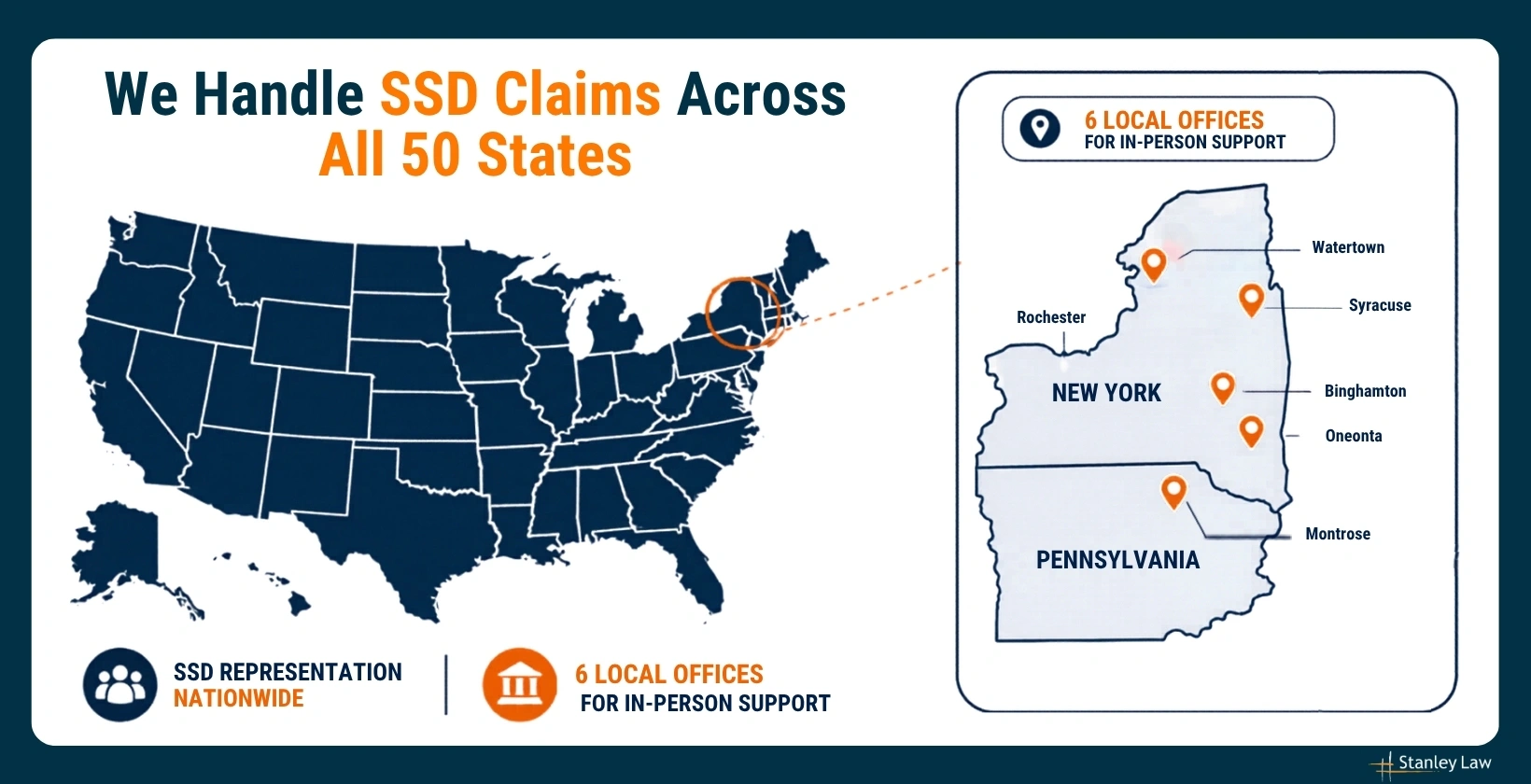
Shannon Doan, who brings an almost 19-year career with the SSA to every claim she handles, manages SSD cases at every stage from initial application through federal appeal with no reassignment. Stanley Law Offices operates six offices across New York and Pennsylvania and represents claimants in all 50 states.
Key Takeaways
- No upfront fees, no hourly rates, nothing owed unless your claim is approved.
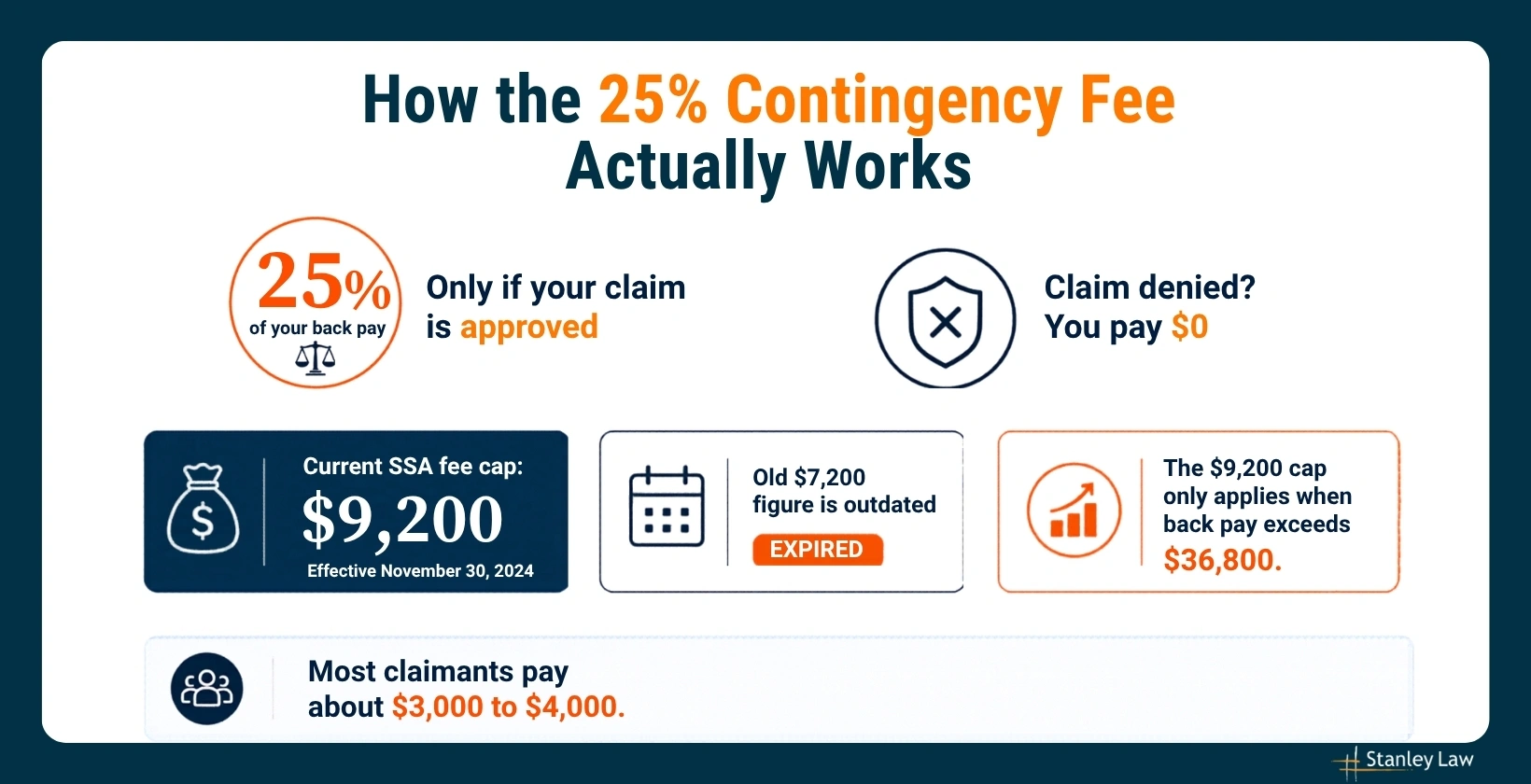
- Your attorney receives 25% of back pay, capped at $9,200 as of November 30, 2024. Many pages still show the expired $7,200 figure.
- Most claimants pay $3,000–$4,000 because back pay rarely exceeds the $36,800 cap threshold.
- The SSA withholds the attorney’s fee directly from your back pay and pays your attorney separately. You never touch that money.
- Claimants with legal representation at the ALJ hearing stage win at higher rates than those without. The record built before the hearing matters more than any other single factor.
How the 25% Contingency Fee Actually Works
Social Security Disability attorneys work on a contingency fee: 25% of your back pay if your claim is approved, nothing if it is denied. The current SSA fee cap is $9,200, effective November 30, 2024. Many competing pages still display the expired $7,200 figure. The cap only activates when back pay exceeds $36,800, which is why most claimants end up paying $3,000–$4,000.
Back Pay and How It Is Calculated
Back pay is the lump sum of monthly Social Security Disability Insurance (SSDI) benefits owed from your established onset date to the date the SSA approves your claim. Your attorney’s fee is 25% of this number, which is why understanding back pay matters before anything else.
For SSDI, a five-month waiting period applies before back pay begins, and back pay can be paid retroactively for up to 12 months before your application date. For Supplemental Security Income (SSI), there is no waiting period, but back pay only runs from the month following your application date; it does not go back to an earlier onset date.
The SSA reports the average monthly SSDI benefit for disabled workers at $1,633 as of January 2026. (SSA Monthly Statistical Snapshot, January 2026, released February 2026) Using $1,500 as a conservative round figure, nine eligible months of back pay equals $13,500. The attorney receives 25%, which is $3,375. The claimant keeps $10,125. The attorney receives no share of future monthly payments.
| Monthly Benefit | Eligible Months | Total Back Pay | Attorney Fee (25%) | You Receive |
|---|---|---|---|---|
| $1,200 | 6 | $7,200 | $1,800 | $5,400 |
| $1,500 | 9 | $13,500 | $3,375 | $10,125 |
| $1,800 | 14 | $25,200 | $6,300 | $18,900 |
| $1,800 | 21 | $37,800 | $9,200 (capped) | $28,600 |
The Other SSD Costs
Attorney fees and case expenses are two different things, and most claimants conflate them at the start. Case expenses cover the actual costs of building your claim file: medical records, copying, and mailing. Most straightforward SSD claims run under $200 in total expenses. Expert witness fees apply in complex cases involving vocational or medical testimony. Ask before you sign whether the firm waives expenses on denied claims. Stanley Law Offices discloses its expense policy at the start of every engagement.
Collecting Workers’ Compensation and SSD at the Same Time in New York
New York claimants who suffered a workplace injury often pursue workers’ compensation and SSDI simultaneously. The workers’ compensation offset rule reduces your SSDI benefit when combined income from both sources exceeds 80% of your pre-disability earnings. That reduction lowers your back pay, which directly lowers the 25% attorney fee.
We handle both workers’ compensation and SSD claims. Coordinated strategy across both systems is available from one firm, something a single-practice disability firm cannot offer.
The SSA Controls What Your Attorney Gets Paid
Claimants regularly ask whether their attorney can overcharge them or bill directly. The SSA prevents this entirely. Every attorney’s fee goes through SSA review and approval before any payment is issued. Your attorney cannot collect independently, set their own amount, or bill you outside this process.
You Never Pay Your Attorney Directly
Before work begins, your attorney submits a written fee agreement to the SSA for review. The SSA approves it. When your claim is approved, the SSA withholds the attorney’s fee directly from your back pay and issues a separate payment to your attorney. You receive the remaining balance. You cannot be overbilled, billed directly, or charged anything beyond the agreed case expenses.
When the $9,200 Cap Does Not Apply
The $9,200 cap applies to the vast majority of SSD claims. The exception is when a case reaches a federal district court or involves extraordinary complexity requiring a fee petition, a formal request submitted when no automatic cap applies. In federal district court, fees are typically awarded by the court under the Equal Access to Justice Act (EAJA) and are often paid by the government, not taken from the claimant’s back pay. For extraordinary complexity cases that remain within the SSA process, the attorney files a fee petition that the SSA reviews and approves. Most claims never reach federal court.
| Situation | Fee Structure | Cap Applies |
|---|---|---|
| Standard approved claim | 25% of back pay | Yes, $9,200 max |
| Federal district court | Court-awarded fee (EAJA), often govt. paid | No automatic cap |
| Extraordinary complexity | Fee petition, SSA reviewed | No automatic cap |
| Denied claim, at any stage | No fee owed | No |
For most claimants, the cap holds, and the realistic fee lands between $3,000 and $4,000.
Are Disability Lawyers Worth the Cost?
The overall ALJ allowance rate was 51% nationally in FY2024, per the SSA’s public workload data. Claimants with legal representation consistently show higher approval rates than those without, driven primarily by stronger medical evidence and better hearing preparation rather than the hearing itself.
The attorney’s fee comes only from benefits already won. If your claim is denied, you owe nothing. Going unrepresented is the most significant financial risk a claimant faces in this process. The fee is identical regardless of when you hire, so there is no financial reason to wait.
We Handle SSD Claims Across All 50 States
Shannon Doan handles SSD claims at every stage, from initial application through federal appeal, without handing cases off. Her almost 19-year career inside the SSA as Attorney Advisor, Senior Attorney Advisor, and member of the National Senior Attorney Cadre means she knows precisely what the SSA looks for in a claim file, where medical documentation falls short, and what errors get disability applications denied before they reach a hearing.
Stanley Law Offices offers a free SSD webinar covering what the SSA actually evaluates, why medical records determine outcomes more than any other factor, the most common denial mistakes, and how to document your functional limitations correctly.
Six offices serve local clients in person: Syracuse, Binghamton, Watertown, Rochester, and Oneonta in New York, and Montrose in Pennsylvania. SSD representation extends to all 50 states. Call 1-800-608-3333 or request a free review online.
What Does a Free SSD Case Review Cover?
A free review with Stanley Law Offices covers the following areas.
- Claim strength assessment based on your medical history and work record.
- Denial analysis identifies why a prior application was rejected.
- Medical evidence gaps that need to be closed before a hearing.
- Next steps in the SSD appeals process.
- A realistic timeline based on your claim stage.
Shannon Doan has handled SSD claims nationwide across every stage of the appeals process, from initial application through federal court. There is no fee unless you win, whether your case is in New York or anywhere else in the country. Call 1-800-608-3333 or start your free review online.