
Most people reaching this stage have already been denied once. Some twice. The fear of another denial is real, and the confusion about what happens in that room makes it worse.
A disability hearing is a private, informal proceeding before an Administrative Law Judge (ALJ). Not a courtroom. Not a trial. The ALJ who hears your case was not involved in the earlier denials. That matters more than most claimants realize.
The judge will ask about your work history, your treatment, and how your condition affects your ability to function day to day. A vocational expert (VE) is usually present. A written decision follows later, rarely the same day. Preparation before you walk into that room is the single most controllable factor in the outcome.
Stanley Law Offices’ Social Security Disability (SSD) attorney Shannon Doan spent nearly 19 years working inside the Social Security Administration, holding positions as Attorney Advisor, Senior Attorney Advisor, and Attorney Advisor/Policy Compliance, before joining the firm to represent claimants. She has prepared clients for these hearings across all 50 states. What follows is exactly what she tells every client before they face one.
Key Takeaways
- A disability hearing is private and informal, not a courtroom trial, and typically runs 30 to 60 minutes.
- The ALJ focuses on your functional limitations and work capacity, not your diagnosis alone.
- A vocational expert is present in most hearings, and their testimony can determine whether you win or lose.
- Most claimants do not receive a decision the same day. A written decision follows weeks or months later.
- Preparation before the hearing, updated records, consistent testimony, and VE strategy directly affect the outcome.
Why Many Valid Disability Claims Reach the Hearing Stage
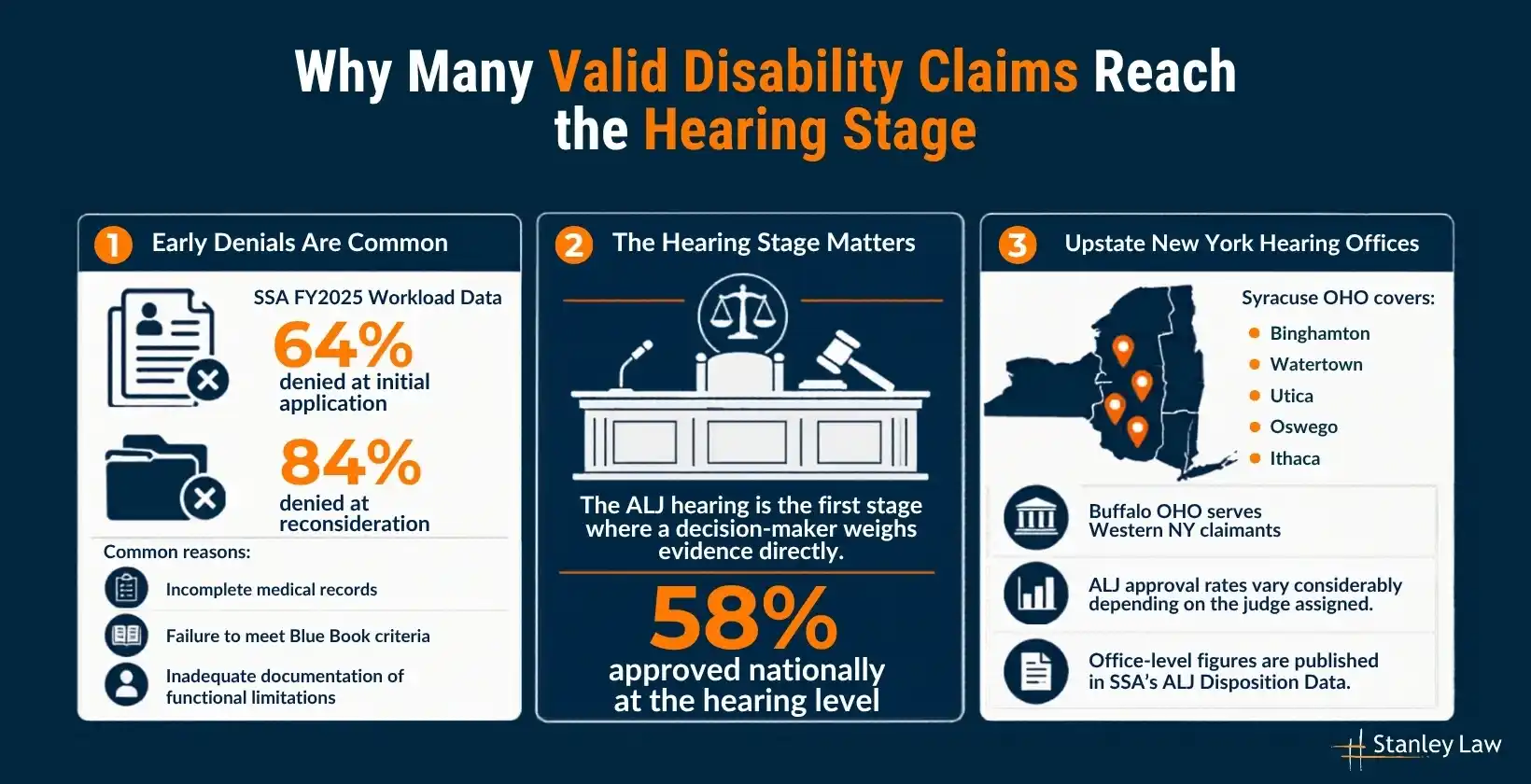
Most valid claims are denied Social Security Disability benefits before the claimant ever speaks to a judge. According to SSA FY2025 Workload Data, the SSA denies 64% of initial applications nationally, and 84% at reconsideration, typically due to incomplete medical records, failure to meet Blue Book criteria, and inadequate documentation of functional limitations. The ALJ hearing is the first stage where a decision-maker weighs evidence directly. At this level, approximately 58% of cases are approved nationally.
For Upstate New York claimants, local hearing office data tells a different story. The Syracuse Office of Hearings Operations (OHO) covers Binghamton, Watertown, Utica, Oswego, and Ithaca. The Buffalo OHO serves Western NY claimants. Individual ALJ approval rates within both offices vary considerably above and below national averages, depending on the judge assigned. Current office-level figures are published in SSA’s ALJ Disposition Data and updated by reporting period. Shannon Doan reviews those figures directly when preparing every case. Call 1-800-608-3333 to request a free case review.
Who Is in the Room at a Disability Hearing
Six people at most. Usually fewer.
| Participant | Role |
|---|---|
| Administrative Law Judge | Presides, asks questions, issues the written decision |
| Hearing Monitor | Records the proceeding |
| Claimant | You |
| Attorney or Representative | Advocates for you cross-examine the vocational expert |
| Vocational Expert | Classifies past work, answers hypothetical questions about job availability |
| Medical Expert | Present occasionally for clinical clarification |
The ALJ had no involvement in your prior denial. That decision came from the Disability Determination Services (DDS). Your hearing is a fresh, independent review. No jury. No gallery. Typically, 30 to 60 minutes.
What the Judge Will Ask at a Disability Hearing
The ALJ’s questions follow a predictable pattern. Work history first: what you did, why you stopped. Then treatment: doctors, medications, side effects. Then, daily life: what you can and cannot do, and for how long. Expect specific questions about bad days. How often do they happen? What do they look like hour by hour?
Answer in specific terms. “I can sit for about 20 minutes before the pain forces me to stand” is useful testimony. “I have back pain” is not. Stay consistent with your medical records. Contradictions between your testimony and your treatment history give the ALJ grounds to question your credibility. If you attempted to return to work, explain exactly why it failed.
| Topic | What the ALJ Is Looking For |
|---|---|
| Work history | Physical and mental demands of past jobs |
| Medical treatment | Visit frequency, current medications, side effects |
| Daily activities | Duration limits and what specifically interrupts the function |
| Symptoms | Severity and frequency on bad days vs. typical days |
| Return to work attempts | Why the attempt failed, and for how long it lasted |
How the Judge Decides Your Case at the Hearing
The ALJ does not decide based on your diagnosis. The decision turns on three specific questions.
Does your condition meet or equal an SSA Listing?
The SSA maintains a list of conditions severe enough to qualify automatically. If your medical evidence meets the exact criteria, the judge approves the claim at this step without going further.
What does your Residual Functional Capacity (RFC) show?
If no Listing applies, the judge assesses what you can still do on a sustained basis despite your impairments. That RFC assessment becomes the framework for everything that follows.
Can you still perform work?
The judge uses your RFC alongside vocational evidence to determine whether you can return to past work or perform any other work that exists in significant numbers in the national economy.
Most contested claims turn on the second and third questions. That is where preparation, medical evidence, and how your attorney handles the vocational expert determine the outcome. Knowing what to expect from the complete Social Security Disability hearing and appeals process before you reach the ALJ stage makes every step more manageable.
The Five-Step Process the Judge Uses to Reach a Decision
The ALJ follows a fixed five-step evaluation sequence. The judge stops as soon as a step produces a definitive answer. Steps 4 and 5 are where most contested claims are won or lost, which is why RFC and the vocational expert carry so much weight at the hearing stage.
| Step | Question | Who Carries the Burden |
|---|---|---|
| Step 1 | Is the claimant doing substantial gainful activity? | Claimant must show they are not engaged in substantial gainful activity |
| Step 2 | Is the condition severe and expected to last 12 months or result in death? | Claimant |
| Step 3 | Does the condition meet or equal an SSA Listing? | Claimant |
| Step 4 | Can the claimant still perform past work, given their RFC? | Claimant |
| Step 5 | Can the claimant perform any other work in significant numbers in the national economy? | SSA |
How SSA Listings Can Affect Your Hearing
The SSA’s Blue Book lists medical conditions severe enough to qualify automatically. If your evidence satisfies every criterion for a listed condition, the judge approves the claim at Step 3 without assessing work capacity. Meeting a Listing is the fastest path to approval. Most claims do not qualify this way.
Not meeting a Listing does not mean denial. The judge can also find that your condition medically equals a Listing, meaning it is not identical but equivalent in severity and duration. Specialist notes, imaging results, lab values, and treating physician opinions carry more weight here than a general diagnosis.
If neither path applies, the claim moves to the RFC analysis. For claimants over 50, the Medical-Vocational Grid Rules offer an additional approval path by accounting for age, education, and past work experience alongside RFC. A limited education and history of physical labor can satisfy New York Social Security Disability eligibility requirements under the Grids without meeting a Listing or proving complete inability to work.
| Body System | Example Listed Conditions |
|---|---|
| Musculoskeletal | Spine disorders, joint dysfunction, and amputation |
| Cardiovascular | Chronic heart failure, ischemic heart disease |
| Respiratory | Chronic Obstructive Pulmonary Disease (COPD), asthma, cystic fibrosis |
| Mental Disorders | Depression, anxiety, schizophrenia, Post-Traumatic Stress Disorder (PTSD) |
| Neurological | Epilepsy, Parkinson’s disease, multiple sclerosis |
| Immune System | Lupus, HIV/AIDS, inflammatory arthritis |
How the ALJ Evaluates Your Residual Functional Capacity
RFC is not a measure of how sick you are. It is the most you can still do on a sustained basis despite your impairments. The ALJ uses it to answer one question: what work capacity remains? That answer drives the hearing when no Listing applies.
The assessment covers four limitation categories. Each one maps to the type of work the vocational expert can identify as available. The more categories that carry restrictions, the narrower that list becomes, sometimes to zero.
RFC preparation is not a paperwork exercise. It determines every hypothetical question the vocational expert will be asked at your hearing.
| Limitation Type | What It Covers | Work Capacity Impact |
|---|---|---|
| Exertional | Lifting, carrying, standing, walking, sitting | Determines sedentary, light, medium, or heavy work level |
| Postural | Bending, stooping, crouching, and climbing | Restricts jobs requiring physical position changes |
| Manipulative | Handling, fingering, reaching, feeling | Limits jobs requiring hand and arm use |
| Mental | Concentration, persistence, pace, adaptation | Restricts jobs requiring sustained attention or social interaction |
The Role of the Vocational Expert at Your Hearing
The vocational expert classifies your past work by skill level and physical demand, then answers the ALJ’s hypothetical questions about whether someone with your limitations could perform your past work or any other work in significant numbers nationally. The VE’s answer directly shapes the judge’s decision. Most claimants do not realize that testimony is challengeable.
An attorney narrows the hypothetical during cross-examination by adding limitations one by one until the VE concedes no jobs remain. That concession, on the record, is one of the strongest paths to a favorable decision.
| Limitation Added | Effect on Job Availability |
|---|---|
| Sedentary work, no additional limits | Jobs available in significant numbers |
| Add: off-task 15% of the workday | Job numbers drop materially |
| Add: one unplanned absence per month | Most employers would not tolerate |
| Add: extra breaks beyond the standard schedule | Competitive employment not viable |
| Add: unable to maintain pace 20% of the day | VE concedes no jobs remain |
These are examples of vocational issues commonly raised at hearings, not fixed SSA thresholds.
When Workers’ Compensation and SSD Benefits Overlap
Receiving New York workers’ compensation benefits does not disqualify you from Social Security Disability Insurance (SSDI). Under the federal offset rule, combined payments cannot exceed 80% of your average pre-disability earnings. When they do, SSA reduces SSDI by the excess. If your pre-disability earnings were $4,000 per month, the threshold is $3,200. Workers’ comp paying $2,000 reduces SSDI to $1,200.
Lump sum settlements complicate this further. SSA prorates the settlement over your life expectancy in months and treats that figure as ongoing workers’ comp income. That extends the offset period well beyond the settlement date. How the settlement is structured, specifically how the payment is described and allocated in the agreement, determines how long and how much SSDI is reduced.
Structuring a workers’ compensation lump sum settlement without accounting for the SSDI offset can cost claimants significantly more than the settlement gained. If you are unsure of the difference between SSDI and SSI benefit payments and how each interacts with a workers’ compensation award, clarifying that before signing is essential.
| Scenario | SSDI Impact |
|---|---|
| Combined benefits below 80% threshold | No offset, both paid in full |
| Combined benefits exceed 80% threshold | SSDI is reduced by the excess amount |
| Lump sum settlement, standard structure | Prorated over life expectancy, offset period extended |
| Settlement structured to minimize proration | Reduces or eliminates offset impact |
How Stanley Law Offices Help You Prepare for a Social Security Disability Hearing
What you do in the weeks before the hearing matters as much as what you say in the room. Shannon Doan reviews every one of these steps with every client before their hearing date. For a broader foundation before you reach the ALJ stage, the firm’s guide on building a strong Social Security Disability case from the start covers the groundwork that makes hearings winnable.
| Task | When | Why It Matters |
|---|---|---|
| Review your complete claim file | 4 weeks before | Identifies evidence gaps before the deadline |
| Update all medical records | 4 weeks before | Stale records give the ALJ grounds to question the current severity |
| Prepare medication and side effect details | 2 weeks before | Side effects affecting concentration and stamina are functional limitations |
| Review all prior SSA statements | 2 weeks before | Contradictions between past statements and testimony damage credibility |
| Practice testimony focused on limitations | 1 week before | Diagnosis-focused answers do not satisfy the ALJ’s functional questions |
| Submit all evidence to OHO | 5 business days before | Missing the deadline risks exclusion of key evidence |
| Raise format barriers early | As soon as known | Transportation, connectivity, or health issues require advance notice |
Mistakes That Can Hurt Your Disability Hearing Outcome
Five mistakes consistently damage otherwise winnable cases.
- Inconsistent testimony: Contradictions between your hearing answers and your medical records give the ALJ grounds to question your entire account, not just the inconsistent answer.
- Minimizing symptoms: “I can still work some days,” “my pain comes and goes,” and “I think I could do a desk job” each give the ALJ grounds to argue residual work capacity. If you can walk ten minutes before pain stops you, say exactly that. Specific, functional language is the only testimony that holds.
- Stale medical records: An ALJ cannot find disability on outdated evidence. Gaps in treatment history signal the condition may not be as limiting as claimed.
- Failing to challenge VE assumptions: An unchallenged VE conclusion supporting work availability is extremely difficult to overcome on appeal. If the attorney does not cross-examine, the job list stands.
- Missing the hearing without good cause: The result is dismissal. The original filing date is lost, and the back pay tied to it disappears with it.
What Happens After the Hearing
Most claimants do not receive a decision the same day. Written decisions typically follow the hearing within several weeks to a few months. Current processing times by office are published in the SSA Hearing Office Average Processing Time report and vary by reporting period. Silence after the hearing is normal, not an indicator of outcome.
If the decision is unfavorable, the 60-day Appeals Council clock starts from the date you receive the written decision. Missing that window closes the appeal path at this level. Knowing how to appeal an unfavorable ALJ Social Security Disability decision within that window is the difference between preserving your rights and losing them entirely. Beyond the Appeals Council, the next step is the appropriate U.S. District Court, then the Second Circuit Court of Appeals.
| Outcome | What It Means | Next Step | Timeline |
|---|---|---|---|
| Fully Favorable | Full approval from the established onset date | SSA issues Notice of Award, back pay processed | Varies by office and case complexity |
| Partially Favorable | Approved with amended onset date | Back pay adjusted to the new onset date | Varies by office and case complexity |
| Closed Period | Benefits for a defined past period only | Current condition reviewed for ongoing eligibility | Varies by office and case complexity |
| Unfavorable | Denied at the ALJ level | 60 days to request Appeals Council review | Varies by office and case complexity |
Talk to Stanley Law Offices About Your Disability Hearing
If your hearing is approaching after one or more denials, the preparation you do now changes what happens in that room. The claimants who walk in ready are not the ones who waited to prepare.
Shannon Doan and the Stanley Law Offices Social Security Disability team handle disability hearings, appeals, and overlapping workers’ compensation issues across all 50 states. The firm was founded by personal injury and disability attorney Joe Stanley in 1982. Read what Stanley Law Offices clients say about their SSD cases. No fee unless you win.
