
Report the injury to your employer the same day, seek medical treatment immediately, and document the scene before you leave. New York law is specific: NY WCL 18 requires written notice to your employer within 30 days, and NY WCL 28 gives you two years to file a C-3 claim with the NYS Workers’ Compensation Board. Both deadlines are strictly enforced.
What you say, sign, and do in the days that follow matters equally. Statements given without legal guidance, missed filings, and misunderstood paperwork are among the most consistent reasons valid claims are denied or settled far below their worth across construction sites in Syracuse, manufacturing floors in Rochester, and warehouses in Binghamton. The workers’ compensation attorneys at Stanley Law Offices have seen this pattern across Upstate New York.
Key Takeaways
- Written notice to your employer is required within 30 days of the injury under NY WCL 18; a same-day verbal notice is the safest start.
- Your C-3 Employee Claim form must be filed with the NYS Workers’ Compensation Board; early filing activates benefits faster.
- Every medical provider you see must document that the injury is work-related.
- Never give a recorded statement to an insurance adjuster without consulting an attorney first.
- A denial is not a final decision; you have the right to a hearing before a Workers’ Compensation Law Judge.
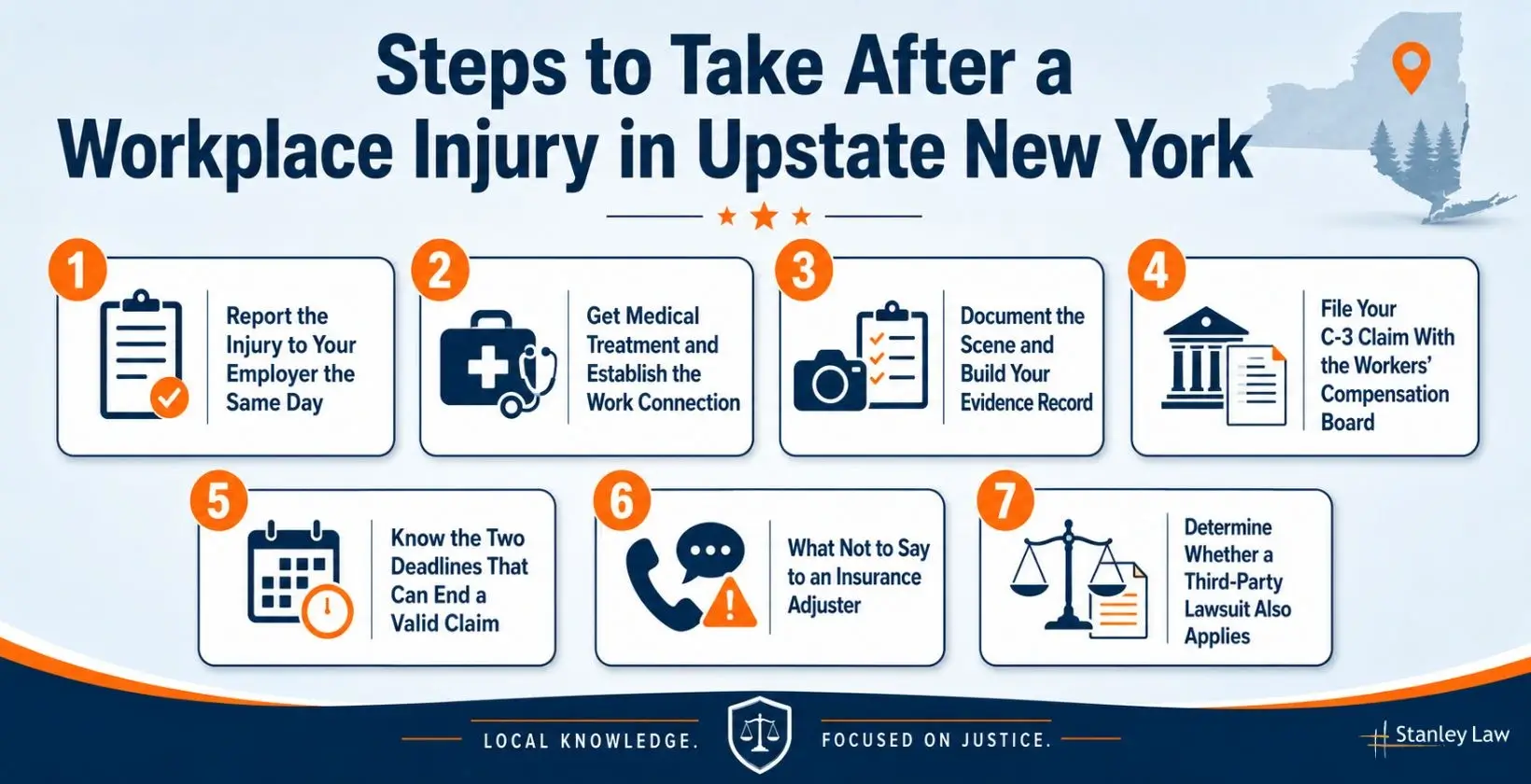
Steps to Take After a Workplace Injury in Upstate New York
New York law requires each of these steps; the order matters as much as the action.
Step 1: Report the Injury to Your Employer the Same Day
NY Workers’ Compensation Law 18 requires written notice to your employer within 30 days. Report verbally the same day and follow up in writing; email creates a timestamp that is difficult to dispute.
What your report must include:
- Date, time, and exact location of the injury
- How the accident happened, and every body part affected
- Names of any witnesses present
Your employer must then file a C-2F with the NYS Workers’ Compensation Board within 10 days of receiving your notice. Confirm it was filed; do not assume.
A Workers’ Compensation Law Judge can excuse a missed 30-day window if the employer had actual knowledge of the injury or if the delay caused no prejudice to the investigation, but that requires independent legal argument after the fact. Reporting the same day eliminates that fight entirely.
Step 2: Get Medical Treatment and Establish the Work Connection
See a doctor the same day, or first thing the next morning, for non-emergency injuries. Tell every provider: this injury happened at work. Those words must appear in your records; their absence gives insurers grounds to argue the injury is personal or pre-existing rather than occupational.
In Upstate New York, you choose your own Board-authorized provider: physicians, chiropractors, physical therapists, podiatrists, psychologists, acupuncturists, and nurse practitioners, who are all eligible. The employer’s insurer does not control that choice, and your medical care, prescriptions, and travel to appointments are all covered.
Repetitive stress conditions such as bursitis, carpal tunnel syndrome, and plantar fasciitis also qualify when a treating physician establishes a causal link to your job duties. Work need not be the sole cause; a contributing cause is sufficient. Which conditions qualify, and what benefits you can claim, often becomes the central fight at your first Board hearing.
Step 3: Document the Scene and Build Your Evidence Record
Photograph the hazard, location, equipment involved, and your visible injuries before leaving the worksite. Collect witness names and contact information immediately, as they become harder to locate with each passing day. Write your own account of the accident the same day, while the sequence is still precise.
Keep a running log from this point: every medical appointment, symptom change, missed workday, and communication from your employer or their insurer.
Step 4: File Your C-3 Claim With the Workers’ Compensation Board
The C-3 is your Employee Claim form, separate from the C-2F your employer files. Submit it through the NYS Workers’ Compensation Board eForms portal (current as of 2026), by mail to your regional WCB district office, or through your attorney.
A wrong injury date, missing body parts, or incomplete employment information are the most common C-3 errors, and any one of them can stall benefits for weeks. If you’re filing on your own, here’s how to file a workers’ comp claim.
After the C-3 is filed, the Board indexes the case and notifies the carrier. The carrier must begin paying benefits within 18 days of your disability, or, if it disputes the claim, file a notice of controversy within 25 days of the Board’s notice of indexing. That is the start of a longer process with predictable stages.
Step 5: Know the Two Deadlines That Can End a Valid Claim
Missing either deadline established in Steps 1 and 4 can permanently bar your claim regardless of injury severity or how clearly the workplace caused it.
- 30 days to notify your employer in writing under NY WCL 18.
- 2 years to file your C-3 with the Workers’ Compensation Board under NY WCL 28.
For occupational diseases such as carpal tunnel syndrome or bursitis, the two-year clock starts from the date of disablement or from when the worker knew or should have known the condition was work-related, whichever is later.
Courts allow narrow exceptions for medical incapacitation, but these require independent legal argument and are never guaranteed.
If a property owner, subcontractor, or equipment manufacturer contributed to the injury, a separate 3-year personal injury statute of limitations applies under New York civil law, running independently of the workers’ comp clock.
Step 6: What Not to Say to an Insurance Adjuster
Once a claim is filed, the insurer assigns an adjuster whose role is to protect the carrier’s exposure, not to ensure you receive what you are owed. Many adjusters contact injured workers within 24 to 48 hours of the accident before a doctor has been seen and before the full scope of the injury is known. You are not legally required to provide a recorded statement without an attorney present. Declining to give one is not an admission of anything; it is a standard legal protection.
Statements that consistently damage claims:
- “It wasn’t that serious” can be submitted as evidence that your injury is not disabling.
- “I may have caused it” opens a fault argument that is legally irrelevant in New York’s no-fault system but operationally damaging to a claim.
- “I’ve had something like this before” invites a pre-existing condition defense.
Do not sign any settlement agreement or benefit waiver before understanding the full scope of care you may still need. A signature on a release can’t be undone, and some situations call for a lawyer’s eyes first, which is exactly when hiring a workers’ comp attorney pays off.
Step 7: Determine Whether a Third-Party Lawsuit Also Applies
Workers’ compensation is the exclusive remedy against your direct employer, not against every responsible party. If a property owner, subcontractor, or equipment manufacturer contributed to the injury, a separate civil lawsuit may recover what workers’ comp does not cover, including pain and suffering and loss of future earning capacity.
For construction workers injured on Upstate New York job sites, NY Labor Law 240(1) and 241(6) impose absolute liability on property owners and general contractors for elevation-related falls, entirely independent of the workers’ comp system. A workers’ comp claim and a personal injury lawsuit recover different things, worth knowing before you accept any offer.
The Occupational Safety and Health Administration (OSHA) also requires employers to report work-related fatalities within 8 hours and hospitalizations, amputations, or eye losses within 24 hours, creating an independent documentation record that supports both claims.
Types of Benefits You May Receive
The benefits available in a New York workers’ compensation claim depend on how serious and how lasting your injury is. Most claims fall into one of four categories.
- Temporary total disability: Complete inability to work while you recover, with wage-replacement benefits for that period.
- Temporary partial disability: Reduced ability to work while you recover, and benefits that cover part of your lost wages.
- Permanent partial disability: Lasting impairment after you reach maximum medical improvement, often paid as a scheduled loss of use award for the affected body part.
- Permanent total disability: Total loss of the ability to do any gainful work, with benefits that may continue long term.
Understanding a Section 32 Settlement
Many New York workers’ compensation claims end in a negotiated settlement rather than ongoing weekly checks. A Section 32 agreement is the most common way that happens, and it pays to understand it before you sign anything.
A Section 32 settlement resolves your claim for a lump sum, a structured payout, or a mix of both. In return, you usually give up the right to reopen the claim or collect future benefits for that injury, sometimes including future medical coverage. Because the agreement is typically final, New York law requires the Workers’ Compensation Board to review and approve it at a hearing, and the Board can reject terms it finds unfair to the worker. Whether a lump sum serves you better than continued benefits depends on your injury, your future treatment needs, and your ability to return to work.
When an Employer or Insurer Disputes Your Claim
Denied claims are common in New York workers’ compensation. Typical grounds include disputes over work-relatedness, missed notice deadlines, independent contractor misclassification, and challenges to medical causation. Under New York law, a pre-existing condition does not bar a claim if work activity aggravated, accelerated, or combined with it to produce the disability. A denial is not a final decision; it opens a formal dispute process under state law with the right to a hearing before a Workers’ Compensation Law Judge and legal representation at every stage.
Whether your employer can legally terminate you while on workers’ comp is a question with a precise legal answer every injured worker should know before assuming they have no recourse. For workers weighing a settlement offer, whether settling your workers’ compensation case makes sense depends on factors that go beyond the dollar amount on the table.
Frequently Asked Questions
Is Workers’ Compensation Taxable in New York?
No. Workers’ compensation benefits are not taxable in New York or under federal law. The only exception is when Social Security Disability offsets your benefits, which can make a small portion taxable.Can I Collect Unemployment and Workers’ Compensation at the Same Time?
It depends on your disability status. You cannot collect unemployment and workers’ compensation at the same time while on total disability, since unemployment requires you to be able to work. On a partial rate and cleared to work, both are possible.Can I Work Light Duty While on Workers’ Compensation?
Yes. You can work light duty while on workers’ compensation if your doctor clears it. If you refuse suitable light-duty work, your benefits can be reduced or stopped. Lower light-duty pay may still earn partial benefits.Will I Lose My Health Insurance While on Workers’ Compensation?
It depends on your leave protection. Workers’ compensation does not cancel your health insurance by itself. During Family and Medical Leave Act leave, up to 12 weeks, your employer must keep coverage. Otherwise, an employer may drop it.Can I Leave New York or Travel While on Workers’ Compensation?
Yes. You can leave New York or travel while on workers’ compensation. Your benefits continue as long as you attend every medical exam and Board hearing. Missing a scheduled exam can pause your payments, so notify the carrier first.
When to Talk to a Workers’ Comp Attorney
If you are unsure whether a step was missed, a deadline is at risk, or a denial can be challenged, a conversation costs nothing. The workers’ compensation attorneys at Stanley Law Offices offer free consultations by phone, at any of five offices across Upstate New York, or at your home or hospital if you cannot travel.
When you’re hurt and out of work, we’re on the job when you can’t be. Don’t go it alone. Make the first call to Joe Stanley’s team at 1-800-608-3333, or request a free case review.