
If the insurance carrier denied your workers’ compensation claim because of a pre-existing condition, that denial may rest on a misapplication of New York law. Injured workers across Upstate New York, from Central New York to the Southern Tier and the North Country, face this argument every day. The Stanley Law Offices, L.L.P., has fought for injured workers across the region since 1982. Attorney Sheila Fallon has represented clients before the Workers’ Compensation Board (WCB) since 1990. Call our Syracuse office at 1-800-608-3333 for a free case review, available 24 hours a day. There is no fee unless we recover your benefits.
Key Takeaways
- New York law does not require work to be the only cause of your disability, only that job duties aggravated, accelerated, or combined with a pre-existing condition to produce it.
- A prior back surgery, arthritis, or heart condition does not automatically disqualify your claim. The aggravation doctrine protects workers with prior medical histories.
- Dormant pre-existing conditions are treated more favorably than active ones. If your condition was not limiting your work before the incident, your claim is stronger.
- An independent medical exam (IME) doctor’s opinion is not binding. A WCB Law Judge weighs it against your treating physician’s, which can carry significant weight.
Why Workers’ Comp Gets Denied for a Pre-Existing Condition in New York
When a carrier denies your claim because of a pre-existing condition, they are asserting that your disability results from a prior injury or chronic condition rather than from your job. This argument is frequently made and frequently defeated before the Workers’ Compensation Board. New York law does not require that work be the sole cause of your disability, and a denial does not change which types of workers’ comp benefits in New York you may still be owed.
Most pre-existing condition disputes are addressed at the pre-hearing conference stage, after the carrier files a Notice of Controversy (NOC). The key is understanding what the law actually requires and building the medical record that satisfies that standard.
A denial on pre-existing condition grounds is a legal argument, not a final factual determination. The WCB Law Judge at your hearing decides whether the aggravation doctrine applies to your circumstances.
New York’s Aggravation Doctrine: What the Law Actually Requires
Under the New York Workers’ Compensation Law, a disability is compensable when the work injury or occupational exposure aggravated, accelerated, or combined with a pre-existing condition to produce disability. Work does not need to be the dominant cause.
New York courts have applied this doctrine consistently for decades. Under longstanding New York workers’ compensation principles, a worker may be entitled to benefits when a pre-existing condition was not affecting work capacity before the work incident, regardless of how severe that condition was historically.
Dormant vs. Active Pre-Existing Conditions: Why the Distinction Changes Your Outcome
A dormant pre-existing condition is one that was not causing functional limitations or work restrictions before the job incident. When a work event activates a dormant condition and produces new or worsening disability, New York law generally awards full compensation without apportionment.
An active pre-existing condition is one already causing symptoms or restrictions. The WCB may apply apportionment in these cases, dividing responsibility between the prior cause and the work cause. Apportionment is not a denial. Benefits may still be owed. Our workers’ comp team analyzes pre-incident medical records to establish the dormant or active classification before a WCB hearing.
Pre-Existing Conditions Carriers Most Commonly Cite in Denials
Any prior medical condition can become a denial target. The most frequently cited include:
- Back injuries, herniated discs, or degenerative disc disease, including conditions treated with prior surgery
- Previous knee, shoulder, hip, or wrist surgeries
- Arthritis or osteoarthritis
- Carpal tunnel syndrome was diagnosed before the current job
- Cardiovascular conditions, including prior heart disease
- Head injury or concussion history
Having any of these conditions in your medical history does not mean your claim will fail. It means the carrier has an argument. Your attorney’s job is to defeat that argument with the right medical evidence.
How Insurance Carriers Use Pre-Existing Conditions to Deny Valid Claims
The carrier’s strategy in these cases follows a predictable path. They order an IME. They send the IME doctor your full medical history, including every prior complaint and treatment record. The IME doctor then issues a report attributing your current disability entirely to your pre-existing condition, with no work-related contribution.
This strategy works when workers do not understand that the IME doctor is paid by the carrier. It works when workers have no treating physician who has written a specific causation opinion linking the work incident to the new or worsened condition. And it works when workers give up before the hearing, where these IME opinions are routinely challenged.
Our attorneys work with treating physicians to ensure their opinions use the specific causation language the Workers’ Compensation Board requires. A physician who says your injury “may have been aggravated” gives the carrier room to fight. A physician who says your work incident activated a dormant condition and produced a period of disability does not.
The Medical Evidence That Wins Aggravation Cases
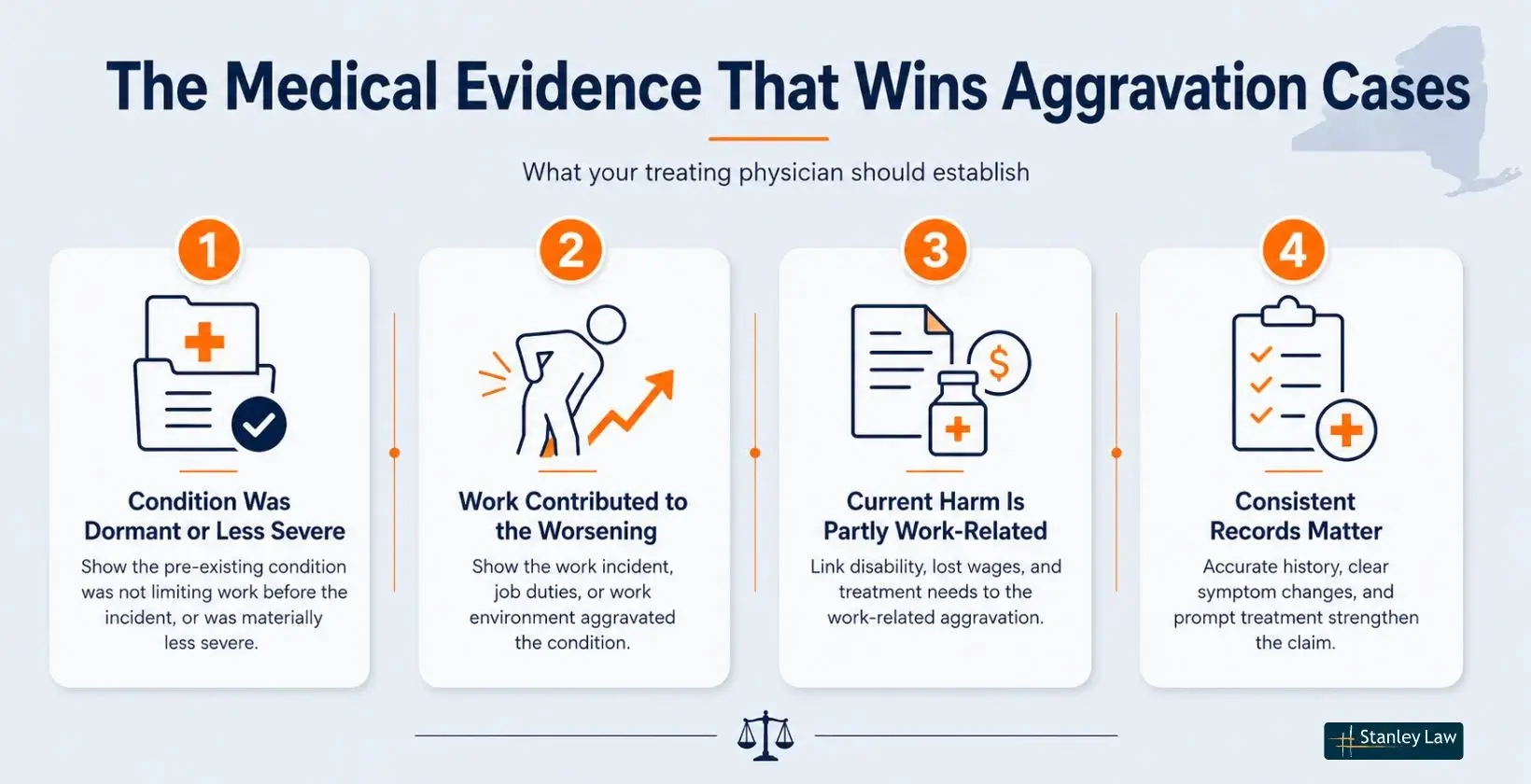
Winning a pre-existing condition denial at the Workers’ Compensation Board comes down to medical documentation. You need a treating physician who can establish three things:
- Your pre-existing condition was not causing functional impairment before the work incident (dormant), or was materially less severe before the incident (active but aggravated).
- The work incident, work environment, or job duties were a contributing cause to the current worsening of your condition.
- The current disability, lost wages, and treatment needs are at least partially attributable to the work-related aggravation.
Consistency in your medical records matters significantly. If you described your pre-existing condition accurately to your treating doctor, explained how the work incident changed your symptoms, and sought treatment promptly, those records become the foundation of the aggravation argument. Strong documentation also supports you at each stage of the New York workers’ compensation claims process.
What the Challenge Process Looks Like
Challenging a denial follows a defined path before the Workers’ Compensation Board, and knowing the sequence helps you avoid the mistakes carriers count on.
After the carrier files its Notice of Controversy, the Board schedules a pre-hearing conference where the disputed issues are identified. Before that conference, your treating physician’s causation opinion needs to be on record in the form the Board requires. At the hearing stage, the WCB Law Judge weighs your treating physician’s opinion against the carrier’s IME report and the rest of the evidence, and makes a credibility determination when the medical opinions genuinely conflict. A well-documented aggravation claim with a clear treating physician opinion routinely overcomes a carrier’s IME report.
What You Need to Do Right Now
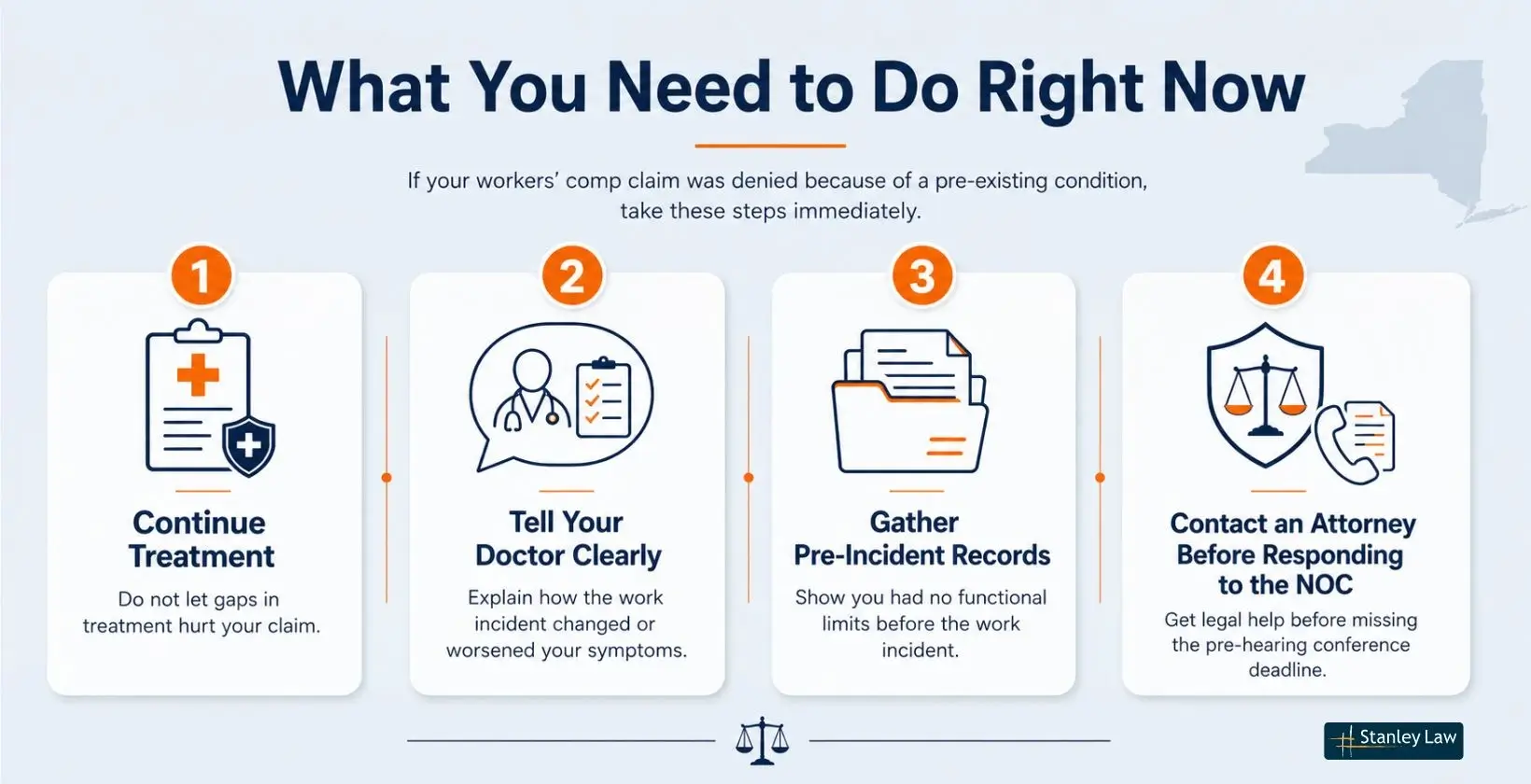
- Continue medical treatment with your authorized physician without interruption. A gap in treatment after a denial is the first thing a carrier’s attorney points to as evidence that your injuries were not serious.
- Tell your doctor clearly how the work incident changed your symptoms. Your medical records should describe the connection between the work event and the new or worsened condition in concrete terms.
- Gather your pre-incident medical records. Records showing no functional limitation before the work incident are powerful evidence that the incident caused a real change in your condition.
- Contact a workers’ compensation attorney before you respond to the NOC. Knowing when to hire a workers’ comp lawyer helps you avoid missing the pre-hearing conference deadline.
You Are Not Required to Disclose a Prior Condition to Your Employer
One worry stops injured workers from filing: they never told their employer about an old injury or surgery, and they assume that silence will sink the claim. It does not.
Workers are not required to disclose pre-existing medical conditions to an employer as a condition of workers’ compensation eligibility. Your employer’s knowledge of your prior medical history is generally not relevant to whether you qualify for benefits under the aggravation doctrine.
How the Aggravation Doctrine Applies Across Upstate New York
New York workers’ compensation law, including the aggravation doctrine, applies uniformly statewide. An injured worker in Binghamton, Watertown, or Rochester faces the same legal standard as one in Onondaga County.
What changes regionally is which WCB district office handles your pre-hearing conference. Our Upstate New York workers’ compensation lawyers are familiar with WCB proceedings across all Upstate New York districts.
How Sheila Fallon Handles Pre-Existing Condition Denials
Sheila Fallon has represented injured workers before the Workers’ Compensation Board in Onondaga County, Broome County, Jefferson County, and across Upstate New York since 1990. She is a member of theInjured Workers’ Bar Association” (IWBA) and has handled hundreds of pre-existing condition cases at the pre-hearing, hearing, and Board Review levels.
The Stanley Law workers’ compensation team, including appellate attorney Robert Geyer, brings more than 45+ years of combined experience. Founding partner Joseph Paul Stanley is ABOTA Board Certified in Civil Trial Practice, a credential requiring significant civil jury trial experience, and has represented injured workers at the trial and appellate level for more than four decades.
The two-year statute of limitations under WCL Section 28 for filing your C-3 Employee Claim with the WCB governs your right to pursue the claim. Call Sheila Fallon to evaluate your specific situation before any deadlines pass.
More results: Verdicts and Settlements
Prior results do not guarantee a similar outcome. Every case is unique, and the value of any claim depends on its specific facts.
Related Workers’ Compensation Denial Resources
- What to do if your workers’ comp claim is denied in Upstate New York?
- What to do immediately after a workplace injury in Upstate New York?
You Still Have Options After a Denial
A pre-existing condition denial is the carrier’s opening argument, not the final word. The aggravation doctrine is settled New York law, and the evidence that answers a denial is often already in your medical records.
Sheila Fallon and the Stanley Law workers’ compensation team review pre-existing condition cases at no cost, serving injured workers across Upstate New York from our Syracuse and Rochester offices to Binghamton, Watertown, and Oneonta. You can reach us at 1-800-608-3333 whenever you’re ready.