
Missing the 30-day deadline to report a workplace injury to your employer is a serious issue, but it does not automatically end your workers’ compensation claim. Injured workers across Upstate New York, from Central New York to the Southern Tier and the North Country, face this denial argument regularly. At Stanley Law Offices, L.L.P., attorney Megan Fallon has handled late-notice exception cases before the Workers’ Compensation Board (WCB) for more than 30 years. Call our Syracuse office at 1-800-608-3333 for a free case review, available 24 hours a day. There is no fee unless we recover your benefits.
Key Takeaways
- Section 18 requires notice within 30 days, but missing it does not automatically end your claim. The statute gives three grounds to excuse late notice.
- The “actual knowledge” exception is often the strongest: if a supervisor witnessed the injury or anyone at the company filed an incident report within 30 days, formal notice may already be satisfied.
- Occupational diseases are different. Under Section 45, the 30-day rule does not apply. You have two years from disablement, or from when you knew or should have known it was work-related, whichever is later.
- The two-year statute of limitations under Section 28 to file your C-3 Employee Claim is a separate deadline from the notice rule. Both apply for different reasons.
Why Workers’ Comp Gets Denied for Missing the 30-Day Reporting Deadline
When a carrier denies your claim for missing the 30-day reporting deadline, they are relying on New York Workers’ Compensation Law Section 18. This is a first-line carrier argument precisely because it is easy to document: the carrier simply compares the date of injury on the claim form to the date the employer received written notice. If the gap exceeds 30 days, they file a denial. What they do not tell you is that the same statute provides specific exceptions that regularly overcome this argument.
Most late-notice disputes are resolved at the pre-hearing conference stage, typically scheduled within a few weeks to a couple of months after the carrier files a Notice of Controversy (NOC). The evidence that wins at that stage depends on which exception applies to your situation. Megan Fallon identifies the applicable exception and begins building that evidence before the first conference.
The workers who lose on late-notice grounds are typically those who had no legal representation at the pre-hearing stage. The workers who win are those with attorneys who understand exactly what evidence to gather and how to frame the exception argument before the Workers’ Compensation Law Judge.
What New York’s 30-Day Reporting Rule Actually Requires Under WCL Section 18
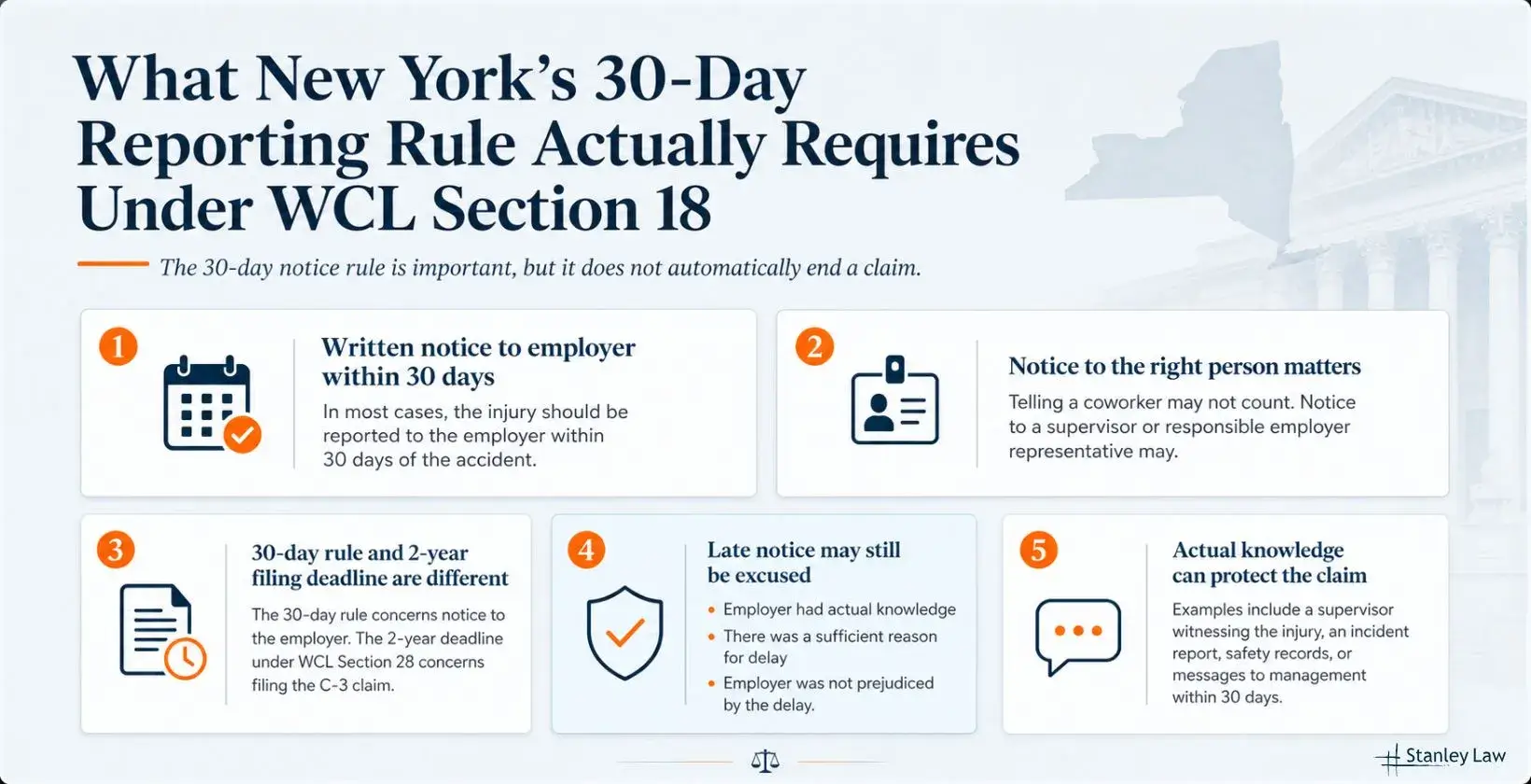
Under New York Workers’ Compensation Law Section 18, an injured worker must give written notice of an injury to the employer within 30 days of the date of the accident. Here is what that means in practice: if you were injured on October 1, you had until October 31 to provide written notice to your employer. Notice to a coworker typically does not satisfy this requirement. Notice to a supervisor may, depending on the circumstances.
The notice requirement is separate from the two-year deadline for filing your C-3 Employee Claim form with the WCB under WCL Section 28. Both apply, but they serve different purposes. The 30-day rule protects the employer’s investigation rights. The two-year deadline governs your right to pursue the claim at all.
The Legal Exceptions That Can Save Your Claim After a Late Report
New York Workers’ Compensation Law Section 18 itself provides three grounds on which the Board can excuse late notice. A WCB Law Judge can excuse it when the worker establishes one or more of the following:
- The employer, or an agent of the employer in charge of the business or supervising the injured worker, had knowledge of the accident within the notice period.
- Notice could not have been given for some sufficient reason. This is where physical or mental incapacitation, not immediately recognizing an injury as work-related (common with repetitive stress or gradual-onset conditions), or being misled by the employer about reporting, can each qualify.
- The employer was not prejudiced by the late notice.
Each exception requires documentation. Your attorney builds the case for excusing the late notice the same way the carrier builds the case for rejecting it: with evidence presented at the pre-hearing conference.
What “Actual Knowledge” Means and How It Protects You
Actual knowledge is often the strongest late-notice exception. If your supervisor witnessed your injury, if your employer dispatched a safety officer to the scene, if an incident report was completed by anyone at the company within the 30-day window, or if coworkers texted or emailed management about what happened, actual knowledge likely exists.
Actual knowledge does not require the employer to have received formal written notice from you. It requires only that the employer or a responsible agent of the employer knew about the injury within the notice period. Megan Fallon looks for actual knowledge evidence in every late-notice case before anything else.
Why Carriers Use the Reporting Deadline as a First-Line Denial
Insurance carriers file late-notice denials because they are easy to document and because they work on workers without legal representation. The carrier reviews the date of injury on the claim form, checks the date of the employer’s incident report, calculates whether more than 30 days passed, and files the denial. They count on you not knowing about the exceptions.
The denial is especially common in cases involving repetitive stress injuries and occupational diseases, where the date of injury is ambiguous, and the 30-day window is harder to calculate. Carriers use that ambiguity to argue the deadline was missed. In many cases, the exception is clear once someone with WCB experience looks at the full factual picture.
How to Build the Case for a Late-Notice Exception
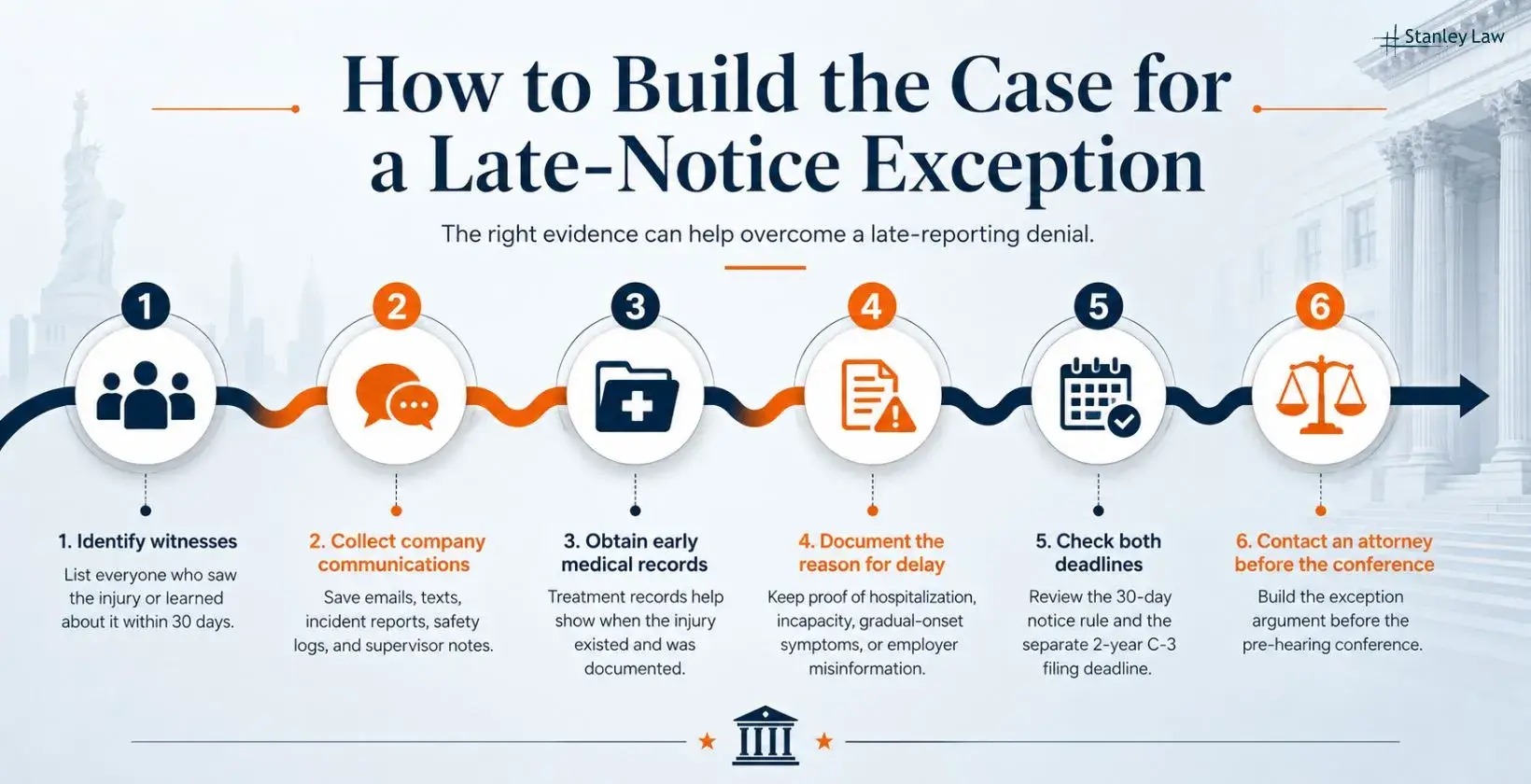
- Identify every person who witnessed the injury or learned about it within 30 days of the accident. These witnesses can establish actual knowledge.
- Collect all company communications from around the time of the injury: emails, texts, incident reports, safety logs, and supervisor notes.
- Obtain medical records from any treatment you received near the time of injury. Medical records showing treatment dates establish that the injury existed and was being addressed.
- Document any reason for the delay. If you were hospitalized, incapacitated, or received bad advice from a supervisor, that documentation supports an exception argument.
- Contact an attorney before responding to the NOC. Know when to hire a workers’ comp lawyer so you do not miss the pre-hearing conference deadline.
What You Need to Do Right Now
The 30-day notice issue does not become stronger with time. If you received a denial citing late notice, the pre-hearing conference will be scheduled within weeks. Contact a workers’ compensation attorney now to begin building the exception argument before that conference.
If you have not yet filed your C-3 Employee Claim with the Workers’ Compensation Board, check your injury date against the two-year deadline under WCL Section 28. You can also review what workers’ comp covers in New York and the workers’ compensation process to understand your options.
How Much Time Do You Have to Appeal a Late-Notice Denial?
After a pre-hearing conference decision on a late-notice issue, you have 30 days to file an Application for Board Review using Form RB-89 with the Workers’ Compensation Board. The outside limit for the entire claim is the two-year statute of limitations under WCL Section 28 for filing the C-3 claim. You can find the relevant WCB forms, including the RB-89, on the WCB’s website.
Why Megan Fallon and Stanley Law Offices WC Team Win Late-Notice Cases
Megan Fallon has represented injured workers across Upstate New York since 1994. She is a member of the NY State Injured Workers Bar Association and has appeared before the Workers’ Compensation Board’s Syracuse, Binghamton, and Watertown district offices on late-notice and procedural disputes.
Client reviews consistently describe Megan Fallon as direct, honest, and thorough. Founding partner Joseph Paul Stanley is ABOTA Board Certified in Civil Trial Practice, a credential awarded only to attorneys with extensive civil jury trial experience, and has advocated for injured workers across Upstate New York for more than four decades. Our Stanley Law Offices workers’ compensation team also includes appellate attorney Robert Geyer Jr., who handles Board Review and court appeals.
More results: Verdicts and Settlements
Prior results do not guarantee a similar outcome. Every case is unique, and the value of any claim depends on its specific facts.
Related Workers’ Compensation Denial Resources
- What to do if your workers’ comp claim is denied in Upstate New York
- What to do immediately after a workplace injury in Upstate New York
Frequently Asked Questions: Missed Reporting Deadline in New York Workers’ Comp
I Told My Supervisor About the Injury Verbally But Did Not File a Written Report. Does That Count?
It can. Telling a supervisor verbally, without a written report, may still count if that supervisor is a responsible agent. Verbal notice can establish actual knowledge, one of three statutory grounds for excusing late notice under Section 18.My Injury Developed Gradually. What Deadline Applies?
The deadline that applies to a gradual injury depends on its type. An occupational disease falls under Section 45: two years from disablement, or from when you knew it was work-related. An accident follows the 30-day rule.What If I Was Out of Work on Medical Leave and Could Not Report the Injury Within 30 Days?
Being unable to report the injury within 30 days because of medical incapacitation can qualify as a “sufficient reason” under Section 18, one of three grounds for excusing late notice. Your medical records from that period support the exception.Does the 30-Day Reporting Rule Apply the Same Way Across Upstate New York?
Yes. The 30-day reporting rule applies the same way across Upstate New York. Section 18 is a statewide statute, so workers in Binghamton, Watertown, or Syracuse face the same framework. Megan Fallon handles late-notice cases in every WCB district.
A Denial Is Not the End of Your Workers’ Comp Claim
A late-notice denial is the carrier’s opening move, not the last word. The exceptions are real, the evidence is often available, and the window for challenging the denial at the pre-hearing conference is short.
Megan Fallon and our workers’ compensation lawyers review these cases at no cost, serving injured workers across Upstate New York from our Syracuse and Rochester offices to Binghamton, Watertown, and Oneonta. Call 1-800-608-3333 for a free case review. No fee unless we recover your benefits.