
A “not in the course of employment” denial is the insurance carrier’s opening argument, not a final ruling, and it is one of the most frequently overturned denials at the Workers’ Compensation Board (WCB). New York law recognizes exceptions that can still cover your injury, including special errands, work-related travel, company vehicles, and incidents on employer premises. The carrier’s denial settles nothing on its own. A Workers’ Compensation Law Judge decides whether your injury qualifies.
Injured workers across Upstate New York, from Central New York to the Southern Tier and the North Country, face these denials every day. At Stanley Law Offices, L.L.P., attorney Robert Geyer has handled course-of-employment disputes before the WCB and its appellate panels across Upstate New York for more than 25 years. He handles cases that other attorneys call complicated because he understands the legal exceptions the carrier is hoping you do not. Call us at 1-800-608-3333 for a free case review. No fee unless we recover your benefits.
Key Takeaways
- A “not in the course of employment” denial is an opening argument, not a final ruling. These get overturned often.
- The coming-and-going rule blocks most commute injuries, but exceptions can still cover you: special errands, traveling employees, company vehicles, and dual-purpose trips.
- Injuries on employer premises and during authorized breaks can be covered, even off-task.
- You usually have 30 days to appeal a pre-hearing decision using Form RB-89.
- Rob Geyer has handled these disputes across Upstate New York for over 25 years.
What You Need to Do Right Now
- Write down every detail of what you were doing, where you were going, and why immediately. Memory fades, and employer records get altered. Your account is the most important starting point.
- Identify any witnesses who knew what you were doing at the time of the injury, including coworkers, supervisors, or customers.
- Do not assume your employer’s version of events on the incident report is accurate or complete. Request a copy immediately.
- Contact a workers’ compensation attorney before the 30-day window for challenging a pre-hearing decision closes, and know when to hire a workers’ comp lawyer so you do not miss the deadline. Rob Geyer evaluates course-of-employment cases specifically.
Why Workers’ Comp Gets Denied as ‘Not in the Course of Employment’
When an insurance carrier denies your claim by saying your injury was not in the course of employment, they are asserting that you were not acting within the scope of your job duties or your employment relationship at the time you were hurt. This argument appears regularly, and it is regularly defeated.
Most course-of-employment disputes are resolved at the pre-hearing conference stage, which is typically scheduled within 4 to 8 weeks of the carrier filing a C-7 form (Notice of Controversy).
New York workers’ compensation law covers injuries that arise out of and in the course of employment. That phrase sounds simple, but decades of decisions by the Workers’ Compensation Board and the Appellate Division, Third Department, have carved out specific rules, exceptions, and tests that define exactly when an injury qualifies. Our lawyers know those rules and apply them on your behalf.
A denial on course-of-employment grounds is a legal argument, not a final factual determination. The Workers’ Compensation Law Judge at your WCB hearing decides whether your circumstances fall within the covered category. That is a fight worth having.
What ‘Arising Out of and in the Course of Employment’ Actually Means Under New York Law
An injury arises ‘out of’ employment when it has a rational connection to the employee’s job duties or the conditions of employment. An injury occurs ‘in the course of’ employment when it happens during work hours, at the workplace, or during a work-related activity. Both elements must be present, but New York courts have interpreted each broadly.
The legal test does not require you to be performing your specific job duty at the exact moment of injury. It requires a meaningful connection between the circumstances of the injury and the employment relationship. Injuries during authorized work breaks, during work-related travel, and during activities that benefit the employer can all qualify, which is why it helps to understand what workers’ compensation actually covers before accepting a denial.
The Coming-and-Going Rule and Its Exceptions
The most common course-of-employment denial involves injuries during a commute. New York’s coming-and-going rule generally bars workers’ comp coverage for injuries sustained while traveling to or from work. The rationale is that the commute does not benefit the employer.
The exceptions to this rule are broad, and they apply to many real-world work situations. If any of the following describes your situation, your commuting injury may be covered despite the carrier’s denial:
- Special errand exception: Your employer asked you to handle a work task on your way in or out, like picking up supplies in Syracuse or dropping documents at a client site in Rochester before heading home.
- Traveling employee exception: Your job sends you between locations during the day, common for home health aides across the Southern Tier, outside sales reps, and construction crews moving between job sites in Central New York.
- Company vehicle exception: You were driving a vehicle owned or provided by your employer at the time of the injury.
- Employer-paid transportation: Your employer paid for or arranged your transportation to and from the worksite.
- Dual-purpose trip: Your travel served both a personal and a business purpose simultaneously.
- Business trip: Injuries during all business travel, including hotel-to-conference-center travel, are generally covered.
On-Premises Injuries, Authorized Breaks, and Company Events
Injuries that occur on employer premises are generally covered, even if you were not performing your specific job duty at the time. An injury during an authorized lunch break in the company cafeteria, an injury while using a company-provided restroom, or an injury while walking from the parking area the employer controls to the worksite entrance can all be compensable. If a structural hazard or neglected property conditions caused your fall on the premises, you may also have grounds for a third-party lawsuit involving workplace negligence managed by our Upstate New York premises liability lawyers.
Company-sponsored events present a more nuanced picture. Injuries at company picnics, team events, or organized work-related social activities may be covered if attendance was required, strongly encouraged, or if the event served a legitimate business purpose. Rob Geyer has handled WCB hearings involving exactly these circumstances.
How Insurance Carriers Misuse the Course-of-Employment Defense
Carriers use the course-of-employment denial as a first-line response to any claim involving a commute, a break period, or a non-standard work location. That pattern is common in Upstate New York work, where crews drive between rural job sites, aides cover wide home-care routes, and field staff travel between facilities. They bet that the worker does not know the exceptions, does not have an attorney, and will not pursue the appeal.
They also use this argument to exploit gaps in the incident report. If your employer’s first report of injury (FROI) describes the accident in a way that omits a key fact about your work purpose at the time, the carrier builds its course-of-employment defense around that incomplete description. What your employer wrote on the FROI is not necessarily what happened, and it is not the last word at a WCB hearing.
Rob Geyer looks at every aspect of your work situation on the day of the injury: where you were, why you were there, what task you were performing or expected to perform, and whether your employer knew or instructed you to be in that location. The answer often reveals an exception the carrier ignored.
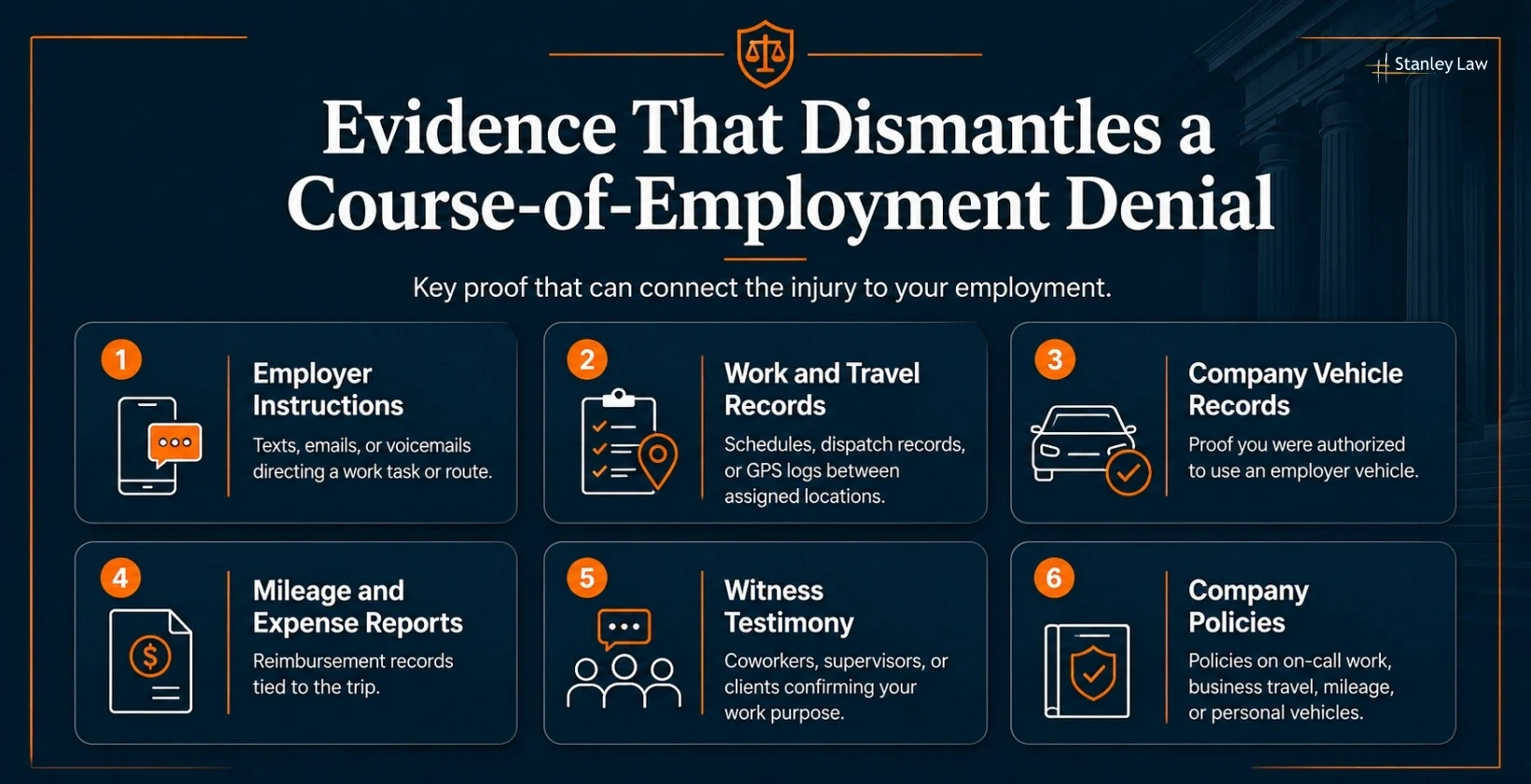
Evidence That Dismantles a Course-of-Employment Denial
The evidence that overcomes a course-of-employment denial depends on which exception applies to your situation. The following types of evidence are regularly used at WCB hearings:
- Text messages, emails, or voicemails from your employer directing you to perform a task outside your normal work location or on a non-standard route.
- Work schedules, dispatching records, or GPS logs showing you were traveling between assigned work locations.
- Vehicle use agreements or company fleet records establishing that you were authorized to use a company vehicle.
- Expense reports or mileage records reflecting reimbursement for the trip in question.
- Witness testimony from coworkers, supervisors, or clients confirming your work purpose at the time of injury.
- Company policy documents regarding on-call requirements, travel reimbursements, or authorized use of personal vehicles for work.
Workers’ Comp Benefits You May Qualify For
Benefit type is determined at WCB hearings and routinely contested by carriers. New York workers’ compensation provides four categories, and understanding what you are fighting for matters before you decide whether to appeal.
- Temporary total disability (TTD): You cannot work at all while recovering, and benefits replace a portion of your lost wages.
- Temporary partial disability (TPD): You return to work in a limited capacity, and benefits cover the difference between your pre-injury and current wage.
- Permanent partial disability, schedule loss of use (PPD/SLU): A permanent impairment to a scheduled body part (arm, leg, hand, eye) is assigned a fixed number of benefit weeks under state statute.
- Permanent total disability (PTD): your injuries permanently prevent any gainful employment.
The carrier’s classification position does not bind the WCB. A Law Judge determines benefit type based on medical evidence and your actual work capacity.
Before You Accept a Settlement: What a Section 32 Agreement Means
If the carrier offers a settlement, they may propose a Section 32 agreement. This lump-sum payment closes your workers’ compensation claim permanently, subject to WCB approval.
In exchange, you give up your right to future wage replacement benefits and, in most cases, future medical treatment through the claim. For workers with stable conditions who want certainty, a Section 32 can make sense. For workers who still need ongoing care or face continued work limitations, closing the claim prematurely can mean giving up benefits worth considerably more than the settlement figure.
Rob Geyer reviews every Section 32 offer before advising on whether to accept. A carrier’s opening number is rarely its final one.
How Rob Geyer Handles Course-of-Employment Denials
Robert Geyer has handled Workers’ Compensation Board proceedings and appellate matters across Upstate New York for more than 25 years. He has taken cases to the WCB’s Appellate Division and to the Court of Appeals on complex questions of workers’ compensation law. When a course-of-employment case requires legal arguments about the coming-and-going exceptions or the traveling employee doctrine, he has the precedent knowledge and appellate experience to make them effectively.
Founding partner Joseph Paul Stanley is ABOTA Board Certified in Civil Trial Practice, a credential awarded only to attorneys with extensive civil jury trial experience, and has represented injured workers at the trial and appellate level for more than four decades.
More results: Verdicts and Settlements

A Denial Is Not the End of Your Workers’ Comp Claim
A course-of-employment denial is the carrier’s opening move, not the last word. The exceptions are real, the evidence is often available, and the deadlines are shorter than most injured workers expect. The sooner you preserve texts, schedules, and witness accounts, the stronger your position at the pre-hearing conference.
Rob Geyer and our workers’ compensation lawyers review these cases at no cost to you, for injured workers across Upstate New York, from Syracuse and Rochester to Binghamton, Watertown, Oneonta, and the North Country. Call 1-800-608-3333 for a free case review. No fee unless we recover your benefits. Available 24/7.
“It’s Always Personal Because Your Story Matters.”
Frequently Asked Questions
What Is a Notice of Controversy in a New York Workers’ Comp Claim?
A Notice of Controversy is a formal document that an insurance carrier files to dispute a workers’ comp claim in New York. It does not end the case. It triggers the WCB hearing process, where a Law Judge decides whether coverage applies to your injury.
Does Workers’ Comp Cover Remote Work or Work-from-Home Injuries in New York?
It depends on the circumstances. Workers’ comp may cover a remote work injury in New York if the activity was work-directed and arose out of employment. A personal errand or off-duty activity at home does not qualify, even if it occurs during work hours.
How Long Do I Have to Appeal a Workers’ Comp Course-of-Employment Denial in New York?
You generally have 30 days to appeal a course-of-employment denial after a pre-hearing decision in New York. The deadline runs from the date of that decision. Missing it forfeits your right to a full Board Review.
Can a Workers’ Comp Denial Be Reversed on Appeal in New York?
Yes. A workers’ comp denial can be reversed on appeal before a WCB Law Judge or a full Board Review panel in New York. The outcome depends on which exception applies to your situation and the strength of your evidence.
What Happens at a New York Workers’ Comp Pre-Hearing Conference?
A New York workers’ comp pre-hearing conference is an initial proceeding before a WCB Law Judge where disputed issues, including course-of-employment questions, are argued. The judge may resolve the dispute at that stage or schedule a formal evidentiary hearing for additional evidence.
Is a “Not in the Course of Employment” Denial the Same as a “Not Work-Related” Denial?
No. A “not in the course of employment” denial challenges when and where the injury occurred. A “not work-related” denial challenges the causal connection between the injury and your job duties. Carriers can raise both arguments to deny a single claim.