
A workers’ comp denial in New York is not a final decision. When an insurance carrier denies your claim, it files a Notice of Controversy with the New York Workers’ Compensation Board, which opens a formal dispute process under state law. You have the right to request a hearing before a Workers’ Compensation Law Judge, and workers who appeal regularly win benefits their carriers initially refused to pay. The New York Workers’ Compensation Board processed 165,320 claims in 2024 (NY Workers’ Compensation Board, 2024 Annual Report), and denial is a routine carrier tactic, not a legal conclusion.
The attorneys at Stanley Law Offices have fought workers’ comp denials across Upstate New York for decades. Founding attorney Joe Stanley, ABOTA board-certified, leads the firm’s workers’ compensation appeal team. The firm’s dedicated workers’ compensation team, including attorneys with 45+ years of experience representing injured workers in Syracuse, Binghamton, Watertown, Rochester, and Oneonta, handles every appeal on a contingency basis, with no fee unless compensation is recovered.
Key Takeaways
- The New York Workers’ Compensation Board oversees a four-level review system. A denial is the start of that process, not the end.
- NY Workers’ Compensation Law 18 requires written notice to your employer within 30 days of injury. Missing this deadline gives the carrier a defense, but it does not automatically close your claim.
- Under Workers’ Compensation Law (WCL) 23, Full Board appeals must be filed within 30 days of the Law Judge’s written decision.
- If the Full Board rules against you, the next appeal to the Appellate Division, Third Department must be filed within 30 days of that decision; missing this window closes Level 3.
- Bursitis, carpal tunnel syndrome, and other repetitive stress conditions are compensable when work activity caused or aggravated the condition, even alongside pre-existing diagnoses.
- A denied workers’ comp claim does not eliminate a third-party personal injury lawsuit if someone other than your employer contributed to the accident.
Why Would Your Workers’ Comp Claim Be Denied?
In the video, our founding attorney Joe Stanley breaks down the three most common reasons insurance carriers reject workers’ comp claims in New York, and what you should do the moment you’re injured on the job. If you’re dealing with a denial right now, this is the best place to start before reading further.
Insurance carriers in New York deny workers’ comp claims for six reasons: late notice to the employer, disputed injury causation, pre-existing condition arguments, independent contractor misclassification, insufficient medical documentation, and disputes over whether the injury occurred during employment.
Your denial letter identifies the exact ground the carrier used. That ground determines your entire evidence strategy on appeal.
- Late notice: A Law Judge can excuse the missed window if the employer had actual knowledge of the injury or if the delay did not prejudice the investigation, but the carrier will use it as a defense immediately.
- Disputed causation: Most common in repetitive stress and occupational disease cases. Medical evidence directly linking your condition to job duties is the foundation of the appeal.
- Pre-existing condition: New York follows the eggshell worker doctrine: an employer takes a worker as they find them. A prior diagnosis does not bar a claim if work activity aggravated, accelerated, or combined with that condition to produce the disability. The carrier cannot point to an old MRI and close the file.
- Independent contractor misclassification: New York applies a multi-factor control test to determine employment status. Many workers labeled “contractors” by their employers are employees under that test. That group of workers’ compensation exemptions is far narrower than carriers claim.
- Insufficient medical documentation: No physician report connecting the injury to work means no award. An independent medical evaluation and a detailed occupational causation narrative resolve this.
- Injury not during employment: Carriers argue the incident occurred off the clock or outside the scope of work. Accident reports, timecards, and coworker statements address this directly.
- Carrier Independent Medical Examination (IME) reports: After a denial, the insurer may send you to a doctor of their choosing, whose report often contradicts your treating physician. A written rebuttal from your own doctor, submitted before the hearing, is your most effective counter.
What Must You Do Within the First 30 Days After a Denial?
Request a Workers’ Compensation Board hearing, preserve your medical treatment, and consult an attorney all within 30 days of the denial to protect your strongest appeal position.
- Read the denial letter carefully: The carrier must state the specific denial ground. Every word shapes what evidence you need to gather.
- Continue medical treatment: A denied claim does not automatically suspend medical coverage during dispute, but coverage can be interrupted pending the hearing. Document every visit.
- Use an authorized treating physician: In New York, your care should come from a provider authorized by the Workers’ Compensation Board, and you have the right to a treating physician of your choice from that authorized list. Treatment records from an authorized provider carry weight at the hearing that out-of-system records may not.
- Request a hearing: You or your attorney files a request with the Workers’ Compensation Board (WCB) district office covering your county. Upstate New York workers who file with the Syracuse, Binghamton, or Rochester district offices find the correct location through the NY Workers’ Compensation Board district office locator. For documentation obligations from the moment an injury occurs, steps injured workers must follow on the job cover what you may need to backfill before the hearing.
- Gather supporting evidence: Accident reports, coworker statements, payroll records, and a written physician narrative all strengthen your position before the judge.
- Light-duty assignments: If your employer offers one while your claim is denied, review it with your treating physician before accepting – performing duties your doctor has restricted can be used against you at the hearing.
- Recorded statements: Do not give the adjuster one without counsel. It is the single mistake that damages more appeals than any other.
- Employer retaliation: If your employer reduces your hours, changes your duties, or terminates you after you file or appeal, document everything. NY WCL §120 prohibits retaliation for exercising workers’ comp rights.
How Does the NY Workers’ Compensation Board Appeal Process Work?
New York’s appeal process has four levels: a hearing before a Workers’ Compensation Law Judge, an Application for Full Board Review, an appeal to the Appellate Division (Third Department), and a final appeal to the New York Court of Appeals.
- Level 1: Hearing before a Workers’ Compensation Law Judge. The judge reviews medical reports, takes testimony, and issues a written decision. If the ruling is in your favor and the carrier does not appeal, benefits begin. However, if the carrier appeals, they may withhold payment until the appeal is decided. Once they lose the appeal, they must begin paying even if they appeal further.
- Level 2: Application for Board Review (Form RB-89). Under WCL 23, any party has 30 days from the Law Judge’s decision to file with the Full Board. A three-member panel reviews the record and can affirm, modify, or reverse the judge. Full procedural requirements are published on the NY Workers’ Compensation Board appeals page. The complete appeals path, including Pennsylvania claims, workers’ compensation claims, and appeals in New York and PA, covers both systems.
- Level 3: Appellate Division, Third Department. If the Full Board rules against you, the next appeal goes to the New York Supreme Court Appellate Division in Albany within 30 days of that decision. This court reviews whether the Board applied the law correctly. Legal representation here is essential.
- Level 4: New York Court of Appeals. The state’s highest court handles cases presenting novel legal questions. Stanley Law Offices attorney Rob Geyer has argued before both the WCB Appellate Division and the Court of Appeals, experience that matters most at levels 3 and 4.
What Is a Section 32 Settlement, and Should You Consider One?
A Section 32 settlement is a voluntary agreement that resolves a workers’ comp claim for a negotiated lump sum, ending the carrier’s ongoing obligation to pay weekly benefits and, in most cases, future medical costs. No Section 32 agreement is binding until the Workers’ Compensation Board reviews it at a hearing and approves it as fair to the injured worker.
The trade-off is real: a lump sum delivers certainty and immediate funds, but it closes the door on future wage and medical benefits tied to that injury, even if your condition worsens later. For a contested or denied claim, a settlement can also resolve the dispute without years of appeals, though the right figure depends on your disability classification and projected medical needs.
Is Bursitis Covered Under Workers’ Compensation in New York?
Yes. Bursitis is compensable under New York workers’ comp when work activity caused, aggravated, or accelerated the condition. Repetitive lifting, kneeling, and overhead work are recognized occupational causes in WCB cases.
Bursitis, inflammation of the fluid-filled sacs cushioning joints, develops most commonly in the shoulder, elbow, hip, and knee. For Upstate New York workers in manufacturing, construction, healthcare, and warehouse distribution, repetitive joint loading is a daily occupational reality.
Carriers deny bursitis claims by arguing the condition results from natural aging. The legal standard does not require work to be the sole cause, only a contributing cause. A treating physician’s written opinion stating that job duties contributed to the inflammation is the core of a successful claim.
Many workers don’t realize how broad their entitlements actually are until they face a denial, and that knowledge often makes the difference between walking away and fighting back. For a full breakdown of benefits available to injured workers, read our guide on ‘what does workers’ comp cover.’
Can Carpal Tunnel Syndrome Be Covered Under Workers’ Compensation in New York?
Yes. Carpal tunnel syndrome is a compensable occupational disease under New York workers’ comp law when repetitive hand and wrist movements at work caused or contributed to median nerve compression. Data entry, assembly work, and prolonged tool use are the most commonly documented causes in WCB cases.
The New York WCB classifies carpal tunnel syndrome as a cumulative trauma disorder that develops from repeated occupational exposure over time, not from a single incident. Carriers most aggressively dispute carpal tunnel syndrome (CTS) claims when non-occupational risk factors exist: diabetes, thyroid disease, or obesity. The same legal standard applies as with bursitis; work must be a contributing cause, not the exclusive one.
Documentation requirements are specific; an electromyography (EMG)/nerve conduction study confirming median nerve compression, a treating physician’s occupational causation opinion, and a job description demonstrating the nature and frequency of wrist exposure. The types of workers’ comp benefits in New York include wage replacement, medical treatment, and permanent partial disability awards.
What Should You Never Say to a Workers’ Comp Adjuster?
Insurance adjusters are not neutral parties. When one calls after a denial, every question is designed to minimize what the carrier pays. We have seen a single casual phone statement resurface months later as the carrier’s central argument against a client’s disability classification.
- “I feel fine” or “It’s not that bad.” Adjusters document minimizing statements and submit them as evidence that the injury is not disabling.
- “I’m not sure it happened at work.” Any expression of uncertainty about causation becomes a carrier exhibit at the hearing.
- “I hurt this same area before.” Prior injury admissions feed pre-existing condition defenses. Let medical records speak, not casual conversation.
- “I was distracted” or “I should have been more careful.” New York is a no-fault workers’ comp state. Worker negligence is legally irrelevant to eligibility. But a contributory fault statement gives the carrier grounds to challenge the claim’s circumstances.
- “I don’t need a lawyer.” Adjusters routinely discourage legal representation because represented claimants recover more. An adjuster steering you away from counsel is protecting the carrier’s interest. Carriers also document inconsistencies they can use to build workers’ compensation fraud accusations, which is another reason every communication should be precise.
When Does a Denied Claim Open the Door to a Third-Party Lawsuit?
Workers’ comp is the exclusive remedy against your employer, not against every party involved in your injury. A denied claim does not eliminate your right to sue a negligent third party, and in New York, both claims can proceed simultaneously.
Third-party liability exists when a contractor, property owner, equipment manufacturer, or negligent driver caused or contributed to the accident. Construction workers in Upstate New York face this regularly. New York Labor Law 240 (the Scaffold Law) and 241(6) impose absolute liability on property owners and general contractors for elevation-related injuries entirely independent of the workers’ comp system. Upstate New York construction accident attorneys handle both the workers’ comp and Labor Law sides of construction injury cases together.
The difference between workers’ comp and a personal injury lawsuit clarifies which path applies to each category of loss. Workers’ comp covers wage replacement and medical costs. A civil lawsuit recovers pain and suffering, loss of consortium, and future earning capacity, none of which workers’ comp provides.
What Types of Benefits Are at Stake in Your Appeal?
A denied workers’ compensation claim can put several types of benefits at risk.
- Temporary total disability: Pays when you cannot work at all while recovering.
- Temporary partial disability: Pays when you return to reduced duties or hours and earn less.
- Permanent partial disability: Covers lasting impairment, including scheduled loss-of-use awards for the loss of a body part or its function.
- Permanent total disability: Applies when the injury prevents any return to gainful work.
Your appeal protects whichever benefit category your medical evidence supports.
What Do You Permanently Lose Without an Appeal?
An unappealed denial forfeits three categories of recovery with no path back after the deadline passes. A worker who lets the 30-day window close walks away from benefits that were legally theirs to fight for.
- Lost wage benefits: New York workers’ comp pays two-thirds of your average weekly wage tax-free up to the annual statutory maximum set by the WCB. These payments continue for the full duration of documented disability.
- Medical treatment costs: Every authorized treatment is covered by the carrier, including surgery, physical therapy, specialist visits, diagnostic imaging, and prescriptions.
- Permanent disability awards: Workers with lasting impairment receive scheduled loss of use awards calculated under WCB guidelines. In serious injury cases, these represent the most significant financial recovery in the entire claim. Forfeiting the appeal forfeits this entirely.
For workers weighing a settlement offer against continuing an appeal, whether settling your workers’ compensation case makes sense covers that decision directly. Stanley Law’s standard: no case is ever settled without the client’s informed consent.
How Stanley Law Offices Fights Denied Workers’ Comp Claims in Upstate New York
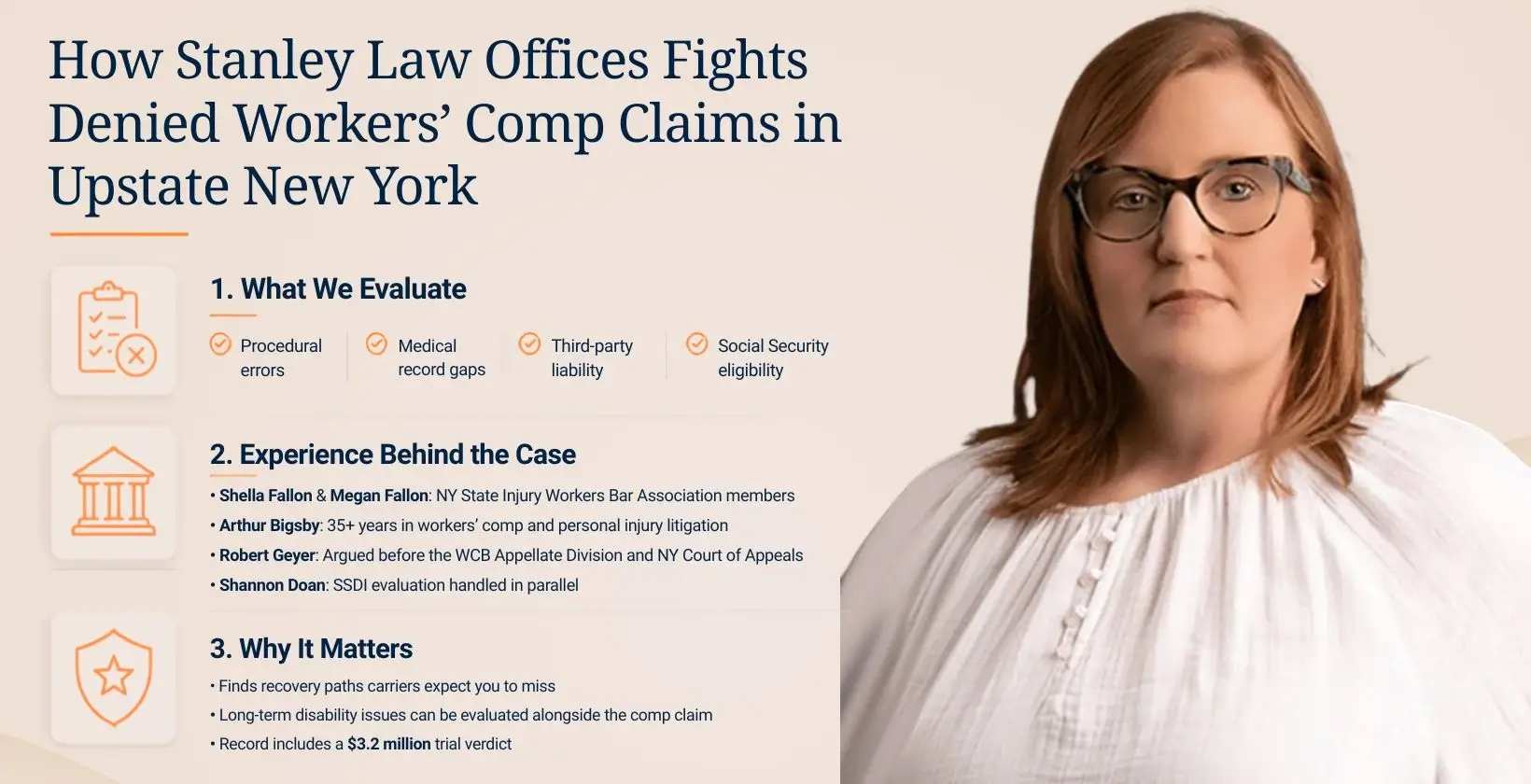
A denial letter identifies one ground. It doesn’t tell you whether a procedural error weakens the carrier’s position, whether medical record gaps are fixable before the hearing, whether a third party shares liability, or whether your disability qualifies for Social Security benefits simultaneously. Stanley Law Offices evaluates all four dimensions before filing anything. That evaluation finds recovery paths the carrier is counting on you to miss.
Joe Stanley, the firm’s founding attorney, sets the appeal strategy his team carries out across every Upstate New York office. Sheila Fallon and Megan Fallon are both members of the New York State Injured Workers Bar Association, which represents injured workers exclusively, not carriers. Arthur Bigsby brings over 35 years of workers’ comp and personal injury litigation experience. Robert Geyer has argued before the WCB Appellate Division and the New York Court of Appeals. For long-term disabilities, Shannon Doan’s SSDI team runs the Social Security evaluation in parallel at no additional step for the client.
The firm’s record of verdicts and settlements, including a $3.2 million trial verdict, reflects what fully contested cases deliver. When to hire a workers’ compensation lawyer in New York covers the specific situations where representation produces measurably better outcomes.
Talk to an Upstate New York Workers’ Comp Attorney
If your claim has been denied, two deadlines govern what options remain: 30 days to appeal a Law Judge decision to the Full Board under WCL 23, and 2 years from the date of injury to file under WCL 28. Acting before those windows close is the only thing that preserves your rights.
Meet workers’ compensation attorneys at Stanley Law Offices. The firm offers free consultations by phone, at any of its five offices across Upstate New York, or at your home or hospital if you cannot travel. Call 1-800-608-3333, available 24 hours. Request your free case review here.
Frequently Asked Questions About Denied Workers’ Comp Claims in New York
How Much Does a Workers’ Comp Lawyer Cost in New York?
A workers’ comp lawyer in New York costs nothing upfront. The Workers’ Compensation Board sets the fee and deducts it from your award only if you win, so a denied claim carries no out-of-pocket legal cost.Will I Get Back Pay If I Win My Workers’ Comp Appeal in New York?
Yes. When you win your workers’ comp appeal, benefits are typically paid retroactively to the date your disability began, so back pay covers the period the carrier wrongly withheld.How Long Does a Workers’ Comp Appeal Take in New York?
It varies. A workers’ comp appeal in New York can run from a few months to over a year, depending on the district office’s hearing backlog and how heavily the carrier disputes your medical evidence.Can I Collect Unemployment If My Workers’ Comp Claim Is Denied in New York?
It depends. To collect unemployment, you must be ready and able to work. If your workers’ comp claim is denied and you can perform some work, you may qualify; a total disability usually disqualifies you.What Happens If My Employer Has No Workers’ Comp Insurance in New York?
If your employer has no workers’ comp insurance, New York’s Uninsured Employers’ Fund may pay your benefits, and you may also sue your employer directly in court, an option the law normally bars when coverage exists.